


You may also like
-

Egytian 7 Poster
Owen Jones · 1899 · Striking Egyptian pattern poster with layered geometric motifs in bold red and blue
Poster from £9 · Framed from £16
-

Persian 2 Poster
Owen Jones · 1899 · Persian-inspired geometric pattern poster with interlaced motifs in warm red, green, and beige
Poster from £9 · Framed from £16
-

Byzantine 3 Poster
Owen Jones · 1899 · Byzantine geometric pattern poster with crisp symmetry and bold historic color accents
Poster from £9 · Framed from £16
-

Moresque 5 Poster
Owen Jones · 1899 · Vivid Moorish-inspired geometric poster with interlaced stars and bold color contrasts
Poster from £9 · Framed from £16


-

"Very nice Posters. The quality is amazing and we received it very quickly !"
-

"A shop to visit absolutely. Huge selection of posters. We spent more than an hour there !"
-

"Perfect to find gift. Price are very good. An they can frame and pack it on site"


About the Artist
Owen Jones was a pioneering British architect and design theorist whose research into historical ornament profoundly shaped Victorian and modern decorative arts. His landmark publication, The Grammar of Ornament, compiled motifs from diverse world cultures, providing artists and manufacturers with a comprehensive visual reference. Jones’s influence extended through the late nineteenth century, as his systematic approach to pattern and color became foundational in design education and interior decoration.
To discover more from this era, browse our classic art prints and thoughtfully curated our selection.
The Artwork
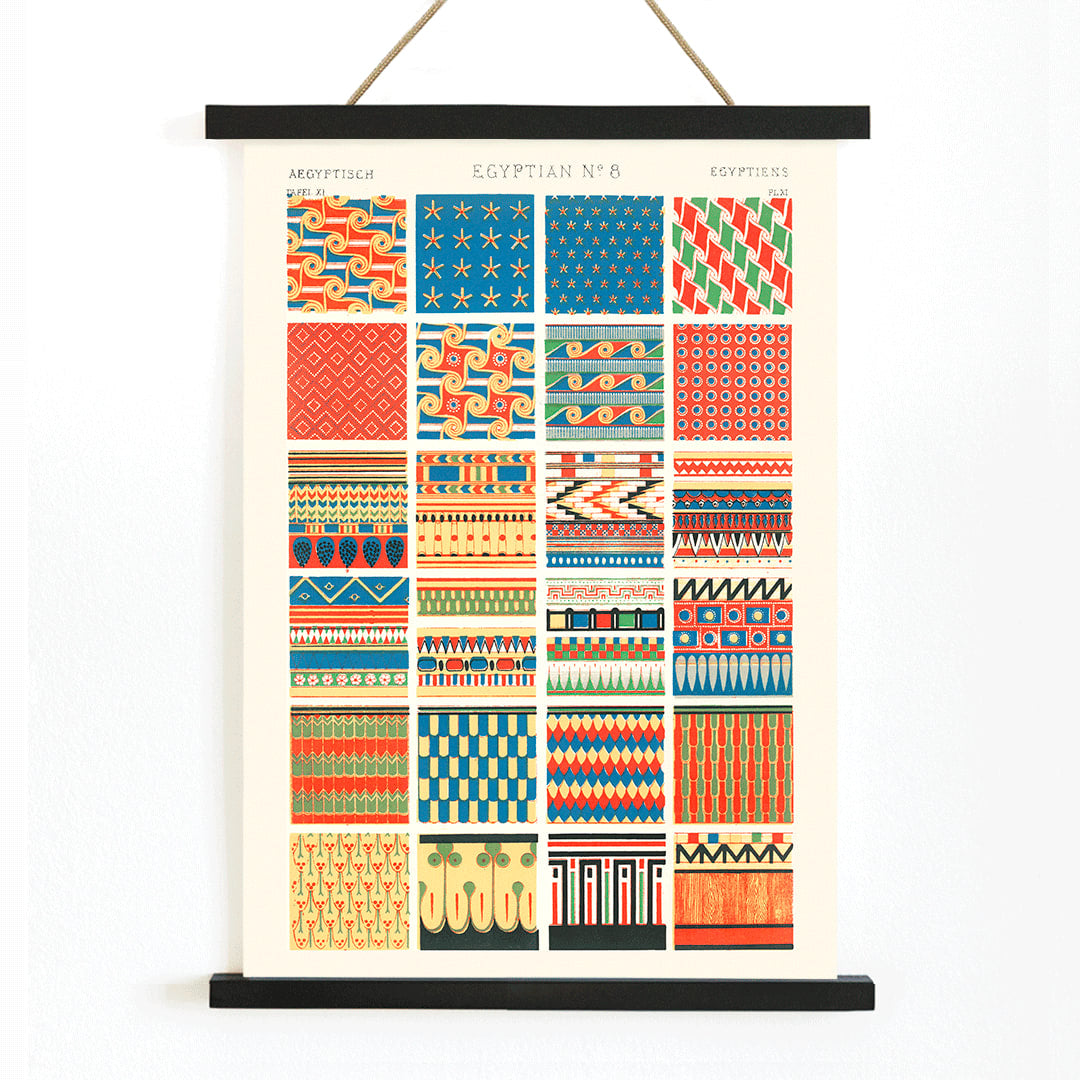
Egyptian 8 reflects the Victorian fascination with ancient civilizations, a period when archaeological discoveries and museum collections inspired new directions in art and design. Created as part of Jones’s effort to document and teach ornamental systems, this plate draws from Egyptian sources to illustrate principles of symmetry, proportion, and decorative logic. Rather than depicting a scene, it serves as a didactic tool, bridging scholarship and practical application for designers, architects, and craftspeople of the era.
This work embodies the nineteenth-century belief that the study of historical ornament could elevate contemporary taste and enrich the visual language of modern life.
Style & Characteristics
The print presents a disciplined ornamental composition, featuring repeating geometric bands and stylized natural motifs. Bold, flat areas of saturated red, blue, green, and yellow are sharply defined by black outlines, creating a striking sense of order and clarity. The arrangement is meticulously structured, with each element contributing to a harmonious overall rhythm reminiscent of ancient Egyptian decorative arts.
The mood is vibrant yet balanced, making this geometric pattern a versatile choice for interiors. For those drawn to ornamental design, explore our oriental wall art and abstract posters for more inspiration.
In Interior Design
This decorative art print brings energy and structure to entryways, dining rooms, or offices. Its architectural symmetry complements mid-century modern, eclectic, and maximalist interiors, while the crisp geometry can provide a bold focal point in minimalist spaces.
Pair with warm neutrals, matte black frames, or natural wood accents to highlight the pattern. For a cohesive look, echo one of the print’s dominant hues in textiles or ceramics within the room.