


You may also like
-

Persian 1 Poster
Owen Jones · 1899 · Ornamental Persian pattern poster with interlaced florals, medallions, and lively jewel tones
Poster from £9 · Framed from £16
-

Byzantine 3 Poster
Owen Jones · 1899 · Byzantine geometric pattern poster with crisp symmetry and bold historic color accents
Poster from £9 · Framed from £16
-

Moresque 5 Poster
Owen Jones · 1899 · Vivid Moorish-inspired geometric poster with interlaced stars and bold color contrasts
Poster from £9 · Framed from £16
-

Egytian 7 Poster
Owen Jones · 1899 · Striking Egyptian pattern poster with layered geometric motifs in bold red and blue
Poster from £9 · Framed from £16


-

"Very nice Posters. The quality is amazing and we received it very quickly !"
-

"A shop to visit absolutely. Huge selection of posters. We spent more than an hour there !"
-

"Perfect to find gift. Price are very good. An they can frame and pack it on site"


About the Artist
Owen Jones was a British architect, designer, and influential design theorist whose research into historical ornament profoundly shaped nineteenth-century decorative arts. His seminal work, The Grammar of Ornament, introduced a systematic approach to studying patterns from around the world, inspiring generations of designers to integrate global motifs with modern sensibilities. Jones’s dedication to understanding and cataloging ornament made his designs essential resources for architects and craftsmen of his era.
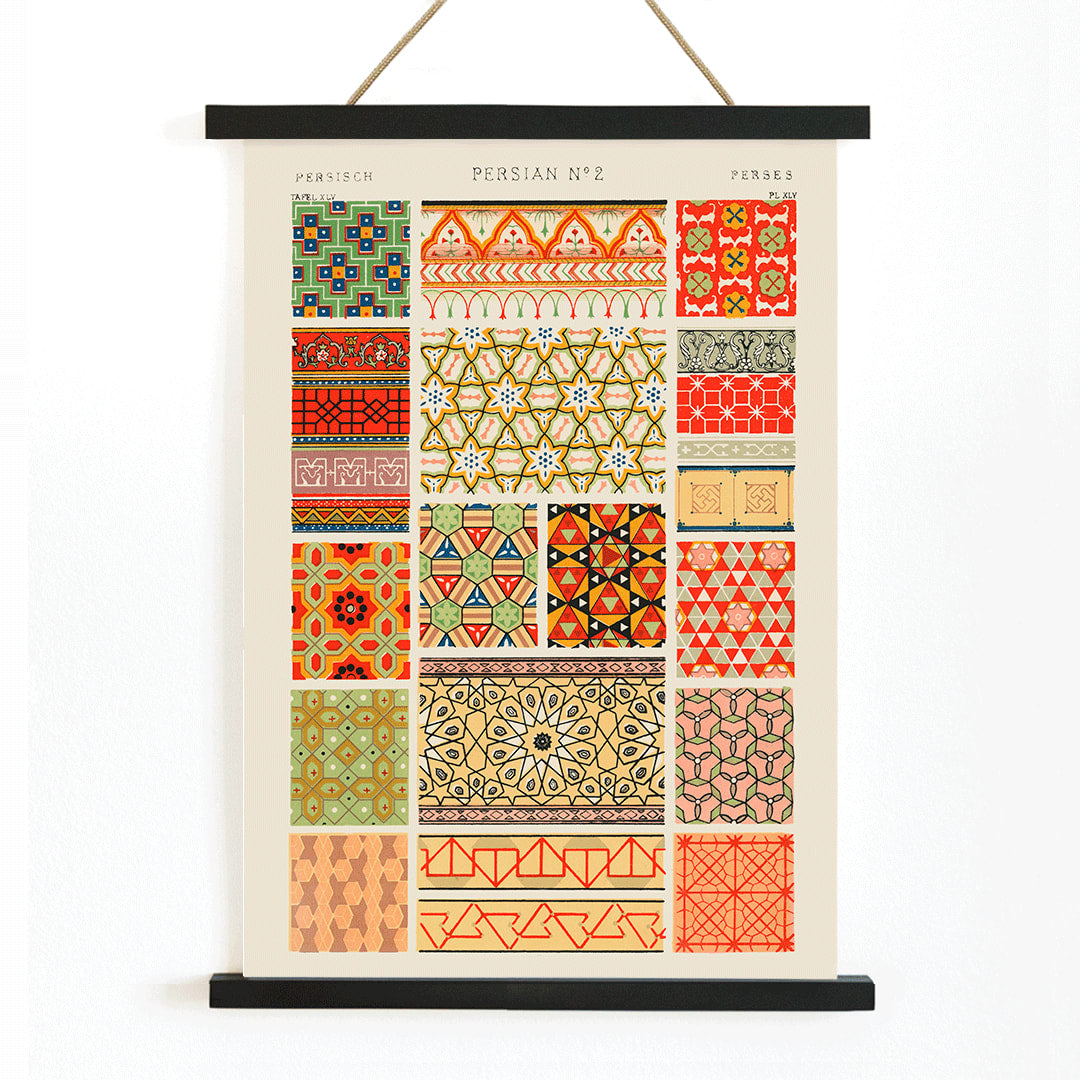
Persian 2 exemplifies Jones’s scholarly approach, merging historical study with practical application. Created as part of a broader movement to revive and reinterpret Islamic and Persian decorative traditions, this plate served as a model for those seeking to enrich contemporary interiors with time-honored patterns.
The Artwork
Emerging during the late nineteenth century’s fascination with Orientalism, Persian 2 reflects a period when Western designers actively sought inspiration from Persian and Islamic art. These pattern plates were not intended as mere decoration, but as working references for artisans producing wallpapers, textiles, ceramics, and book covers. The focus is on the universal language of ornament—an exploration of symmetry, repetition, and abstraction that transcends narrative and foregrounds craftsmanship.
For admirers of Oriental design, this work captures the intellectual curiosity and cross-cultural exchange that defined Victorian-era decorative arts. It stands as a testament to the era’s efforts to document and adapt global visual traditions for new contexts, a legacy still visible in today’s classic art and design collections.
Style & Characteristics
The composition features a tightly interwoven geometric grid, adorned with repeating floral and star motifs. Framed by distinct borders, the design achieves clarity and order, making it visually striking even from a distance. The palette balances warm reds and oranges with deep greens, softened by beige and yellow accents that lend the surface a textile-like richness.
Flat, opaque color fields and precise outlines create a sense of rhythm and ceremony, while the overall effect remains harmonious and architectural. The poster’s intricate geometry and vibrant hues make it a compelling example of Persian-inspired pattern work, ideal for those drawn to ornamental wall art with historical depth.
In Interior Design
This vintage poster brings a sense of structure and warmth to living rooms, dining areas, or studies, especially when paired with brass, walnut, or woven materials. Its bold geometry can anchor a gallery wall or serve as a focal point above a console, complementing both eclectic and modern interiors.
To harmonize with its colors, consider terracotta accents, olive textiles, or warm neutral walls, allowing the pattern to stand out. Collectors interested in red wall art or globally inspired decor will appreciate how this piece bridges tradition and contemporary style in curated spaces.