


You may also like
-

Egyptian 8 Poster
Owen Jones · 1899 · Vibrant Egyptian pattern poster with stylized motifs and crisp geometric banding
Poster from £9 · Framed from £16
-

Persian 2 Poster
Owen Jones · 1899 · Persian-inspired geometric pattern poster with interlaced motifs in warm red, green, and beige
Poster from £9 · Framed from £16
-

Byzantine 3 Poster
Owen Jones · 1899 · Byzantine geometric pattern poster with crisp symmetry and bold historic color accents
Poster from £9 · Framed from £16
-

Moresque 5 Poster
Owen Jones · 1899 · Vivid Moorish-inspired geometric poster with interlaced stars and bold color contrasts
Poster from £9 · Framed from £16


-

"Very nice Posters. The quality is amazing and we received it very quickly !"
-

"A shop to visit absolutely. Huge selection of posters. We spent more than an hour there !"
-

"Perfect to find gift. Price are very good. An they can frame and pack it on site"


About the Artist
Owen Jones was a British architect, designer, and influential theorist of color and ornament whose ideas shaped Victorian design. Renowned for his publication The Grammar of Ornament, Jones advocated for the study and adaptation of historical decorative systems to inspire modern manufacturing and interiors. His Egyptian-inspired pattern plates became essential references for 19th-century designers and remain influential in decorative arts today.
Collectors value Jones’s work for its blend of scholarly rigor and practical application, making his designs important both as art prints and as historical documents of design reform.
The Artwork
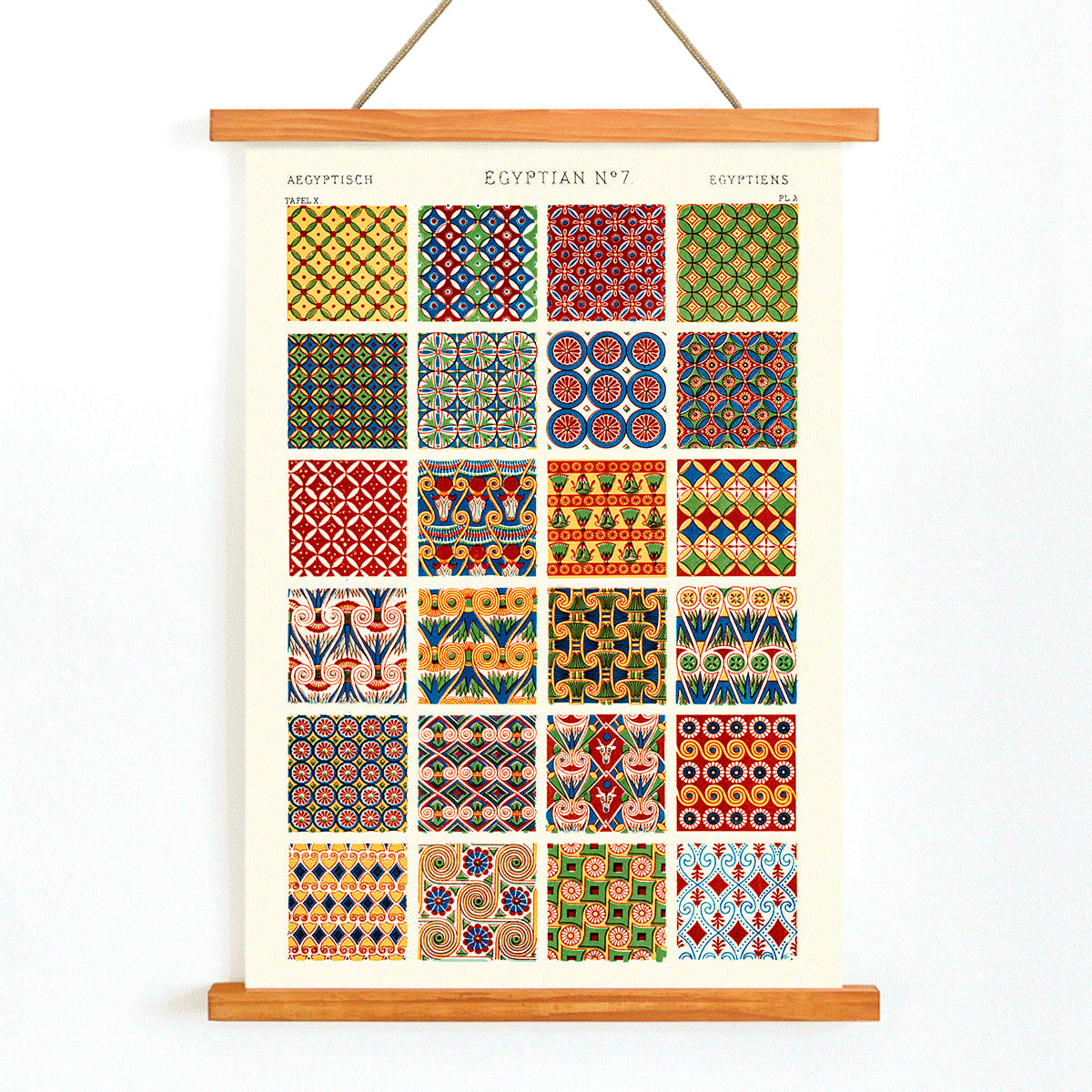
This plate, Egyptian 7, was created as part of a series intended to educate designers and craftsmen about the principles of ancient ornament. In Victorian Britain, Egyptian motifs were admired for their association with antiquity and intellectual curiosity, often incorporated into architecture, textiles, and household objects to convey a sense of worldliness and sophistication.
Jones’s pattern plates served as visual teaching tools, distilling archaeological discoveries into accessible templates for contemporary use. This artwork exemplifies how 19th-century designers looked to the past to inform a new visual language for modern interiors and products.
Style & Characteristics
The image displays a precise arrangement of repeating geometric motifs, organized in horizontal bands with a strong sense of order and rhythm. Flat, saturated colors—primarily bold reds and deep blues—are accented by bright yellows, greens, and touches of orange, creating a lively yet harmonious palette.
The design’s crisp outlines and measured repetition reflect the clarity and discipline of Victorian pattern plates. The overall effect is both architectural and ceremonial, characteristic of the Egyptian Revival style that was popular in 19th-century decorative arts.
In Interior Design
This vintage poster adds a striking focal point to entryways, offices, or dining rooms, especially in interiors that balance modern furnishings with historical references. It pairs seamlessly with ornament and Eastern inspired prints or curated abstract pattern wall art for a layered, cultured look.
For a cohesive scheme, echo one of the print’s vivid hues in textiles or ceramics while keeping surrounding elements neutral or natural. Framing this art print with a simple mat and a classic frame enhances its scholarly and decorative appeal.