


You may also like
-

Diagram no.4 Poster
Hiram Erastus Butler · 1887 · Precise black-and-white solar system scientific print built from concentric rings and fine labels
Poster from £9 · Framed from £16
-

Diagram no.3 Poster
Hiram Erastus Butler · 1887 · Esoteric zodiac anatomy poster rendered as a crisp black and white chart
Poster from £9 · Framed from £16
-

Diagram no.5 Poster
Hiram Erastus Butler · 1887 · Celestial diagram poster mapping planetary cycles with crisp black linework
Poster from £9 · Framed from £16
-

Signs of the Zodiac Poster
Asa Smith · 1850 · Detailed zodiac chart print pairing constellation emblems with crisp Victorian linework
Poster from £9 · Framed from £16


-

"Very nice Posters. The quality is amazing and we received it very quickly !"
-

"A shop to visit absolutely. Huge selection of posters. We spent more than an hour there !"
-

"Perfect to find gift. Price are very good. An they can frame and pack it on site"


About the Artist
Hiram Erastus Butler was an American astrologer and writer active in the late nineteenth century, best known for developing Solar Biology, a system that blended celestial observation with character analysis. Working in an era fascinated by spiritualism, self improvement, and popular science, he presented astrology in the language of diagrams, cycles, and measurable influence.
For collectors interested in vintage astrology, Butler's work stands out for its effort to make complex metaphysical ideas accessible through visual aids and structured charts.
The Artwork
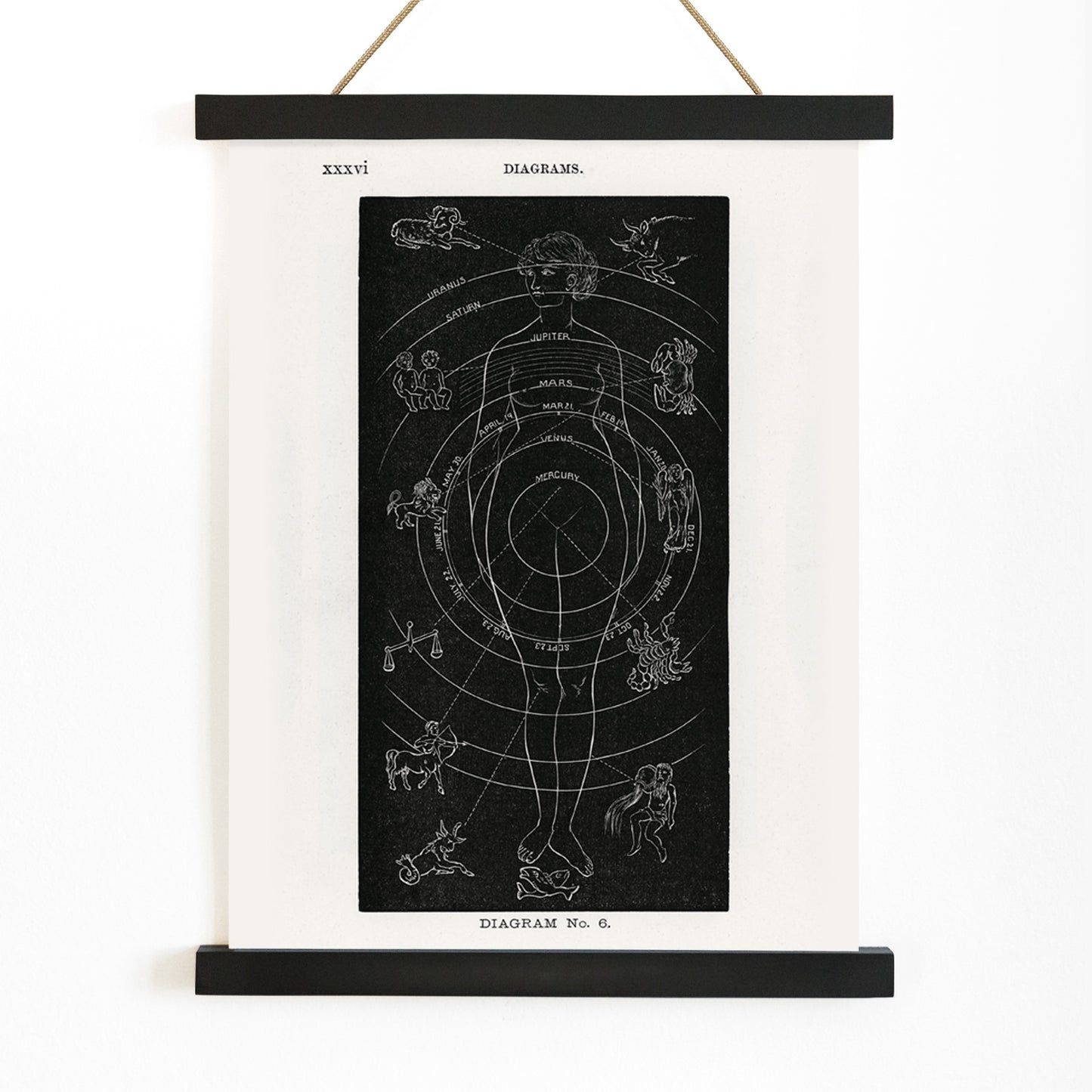
This diagram, published in 1887 as part of Butler's Solar Biology, was designed as a practical tool for students and enthusiasts of astrology. It served as a reference plate to help interpret planetary cycles and their supposed influence on human character and fate. In the context of the 1880s, such diagrams bridged the gap between scientific curiosity and esoteric traditions, offering a systematic approach to understanding celestial phenomena.
Butler's charts were intended not just for display, but for active use in study, discussion, and personal reflection, reflecting the era's fascination with both rational inquiry and mystical exploration.
Style & Characteristics
This black and white composition resembles a technical celestial map, featuring concentric rings, intersecting arcs, and detailed labels. The precise linework and symmetrical arrangement evoke the clarity and order of scientific diagrams, while the dense labeling hints at the complexity of astrological systems.
The mood is both analytical and mysterious, blending the authority of a scientific chart with the allure of occult symbolism. The monochrome palette enhances its archival quality, making it strikingly modern when framed simply or paired with minimalist decor.
In Interior Design
This poster is well suited to home offices, libraries, or creative studios where intellectual curiosity is valued. Its monochrome scheme complements minimalist, industrial, or eclectic interiors, and it can serve as a focal point among both antique and contemporary furnishings.
For a cohesive look, pair it with other esoteric wall art, science themed prints, or space posters that share its celestial and diagrammatic qualities.