


You may also like
-

Diagram no.5 Poster
Hiram Erastus Butler · 1887 · Celestial diagram poster mapping planetary cycles with crisp black linework
Poster from £9 · Framed from £16
-

Diagram no.6 Poster
Hiram Erastus Butler · 1887 · Celestial diagram poster mapping planetary cycles with crisp rings and dense labeling
Poster from £9 · Framed from £16
-

Diagram no.3 Poster
Hiram Erastus Butler · 1887 · Esoteric zodiac anatomy poster rendered as a crisp black and white chart
Poster from £9 · Framed from £16
-

Transparent Solar System Poster
James Reynolds · 1851 · Detailed solar system scientific print with labeled orbits and hand-tinted planetary accents
Poster from £9 · Framed from £16


-

"Very nice Posters. The quality is amazing and we received it very quickly !"
-

"A shop to visit absolutely. Huge selection of posters. We spent more than an hour there !"
-

"Perfect to find gift. Price are very good. An they can frame and pack it on site"


About the Artist
Hiram Erastus Butler was a late nineteenth-century American author and lecturer who explored the intersection of astronomy and metaphysical thought. In an age fascinated by the mysteries of the cosmos, Butler sought to make abstract celestial concepts accessible to a wider audience through his writings and visual diagrams. His work reflects the Victorian enthusiasm for scientific discovery, as well as a desire to find deeper meaning in the patterns of the universe.
Butler’s diagrams are part of the era’s broader movement to popularize science, when educational charts and plates were essential tools for both teaching and contemplation. His legacy endures among those who appreciate the blend of scientific inquiry and philosophical speculation, as seen in collections of scientific wall art and esoteric prints.
The Artwork
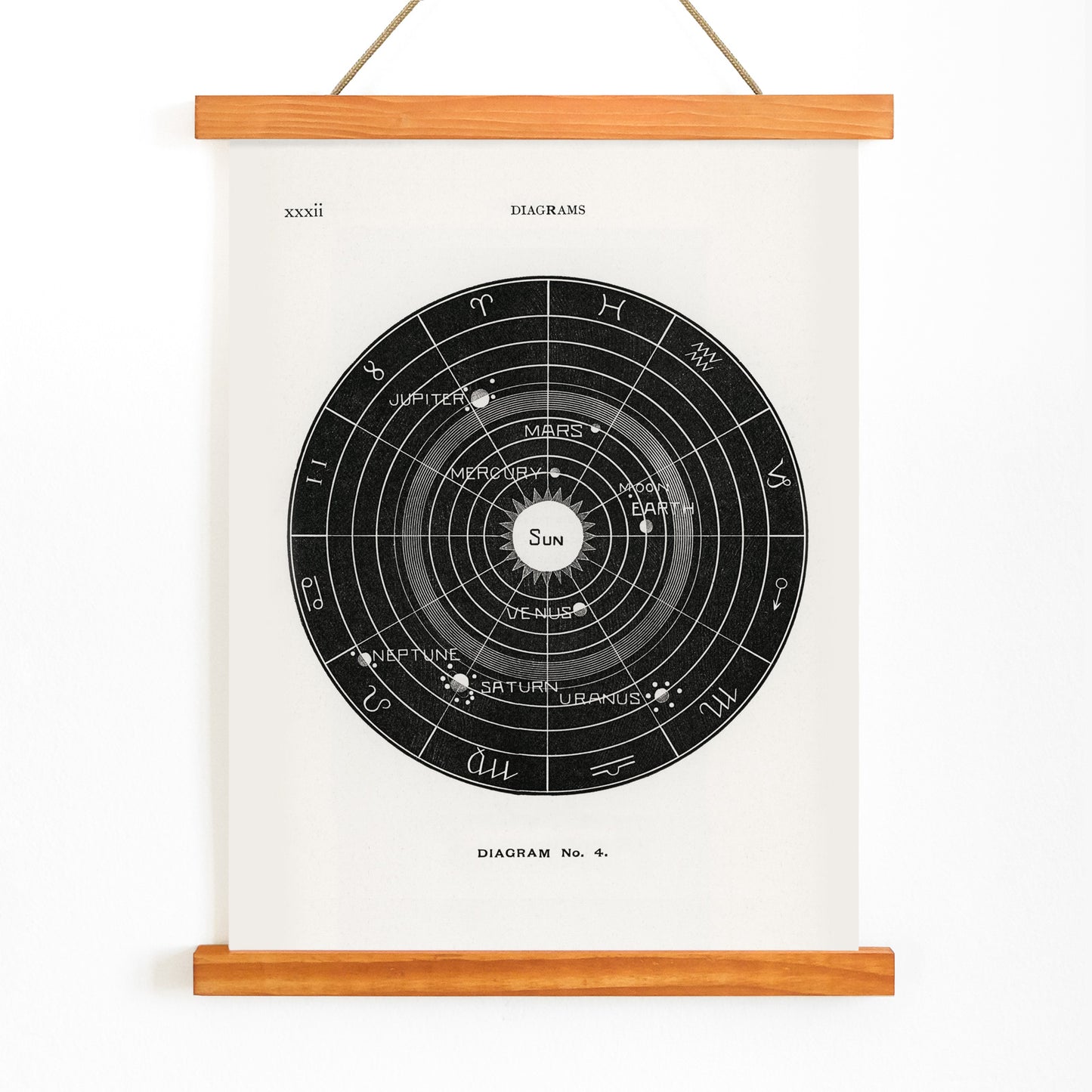
This diagram, created in 1887, was conceived as part of Butler’s Solar Biology, a system that sought to explain human character and destiny through the cycles and relationships of celestial bodies. Serving as a visual aid, the chart distills complex astronomical and metaphysical ideas into a form that could be easily referenced and studied by readers and students.
In the context of its time, such diagrams were not only educational but also carried an aura of authority, bridging the gap between scientific fact and speculative cosmology. This piece embodies the Victorian ambition to map the heavens in a way that invites both rational analysis and imaginative reflection, resonating with those drawn to space themed wall decor.
Style & Characteristics
The artwork is composed of meticulously rendered concentric circles, arcs, and precise radial lines, all arranged with mathematical order. Small, clear labels and carefully measured spacing give it the unmistakable appearance of a reference chart, prioritizing clarity and legibility.
The palette is strictly black and white, emphasizing stark contrast and a sense of archival precision. The mood is contemplative and disciplined, with the diagram’s clean geometry lending it a timeless, almost modern quality. It fits naturally within the tradition of black and white wall art.
In Interior Design
This vintage scientific print is well-suited to studies, home offices, libraries, or hallways where viewers can pause to engage with its logic and structure. Its graphic clarity complements modern, minimalist, and industrial interiors, as well as eclectic spaces inspired by cabinets of curiosity.
The monochrome scheme allows it to integrate seamlessly with white walls, dark frames, and natural wood, making it a versatile choice for gallery walls centered on science, astronomy, or esoteric history. Its calm geometry appeals to those who value thoughtful design over decorative excess.