


You may also like
-

Diagram no.4 Poster
Hiram Erastus Butler · 1887 · Precise black-and-white solar system scientific print built from concentric rings and fine labels
Poster from £9 · Framed from £16
-

Diagram no.6 Poster
Hiram Erastus Butler · 1887 · Celestial diagram poster mapping planetary cycles with crisp rings and dense labeling
Poster from £9 · Framed from £16
-

Diagram no.3 Poster
Hiram Erastus Butler · 1887 · Esoteric zodiac anatomy poster rendered as a crisp black and white chart
Poster from £9 · Framed from £16
-

Transparent Solar System Poster
James Reynolds · 1851 · Detailed solar system scientific print with labeled orbits and hand-tinted planetary accents
Poster from £9 · Framed from £16


-

"Very nice Posters. The quality is amazing and we received it very quickly !"
-

"A shop to visit absolutely. Huge selection of posters. We spent more than an hour there !"
-

"Perfect to find gift. Price are very good. An they can frame and pack it on site"


About the Artist
Hiram Erastus Butler was an American writer and lecturer active in the late 19th and early 20th centuries. He is best known for developing Solar Biology, a system that combined astronomy, astrology, and metaphysical ideas to explore the relationship between cosmic cycles and human life. Butler’s work emerged during a period of renewed interest in both scientific discovery and esoteric traditions, reflecting the era’s fascination with finding hidden patterns in the universe.
His publications often featured detailed diagrams and charts, aiming to make complex celestial concepts accessible to a broader audience. Butler’s legacy endures among collectors of historical scientific prints and those interested in the intersection of science and mysticism.
The Artwork
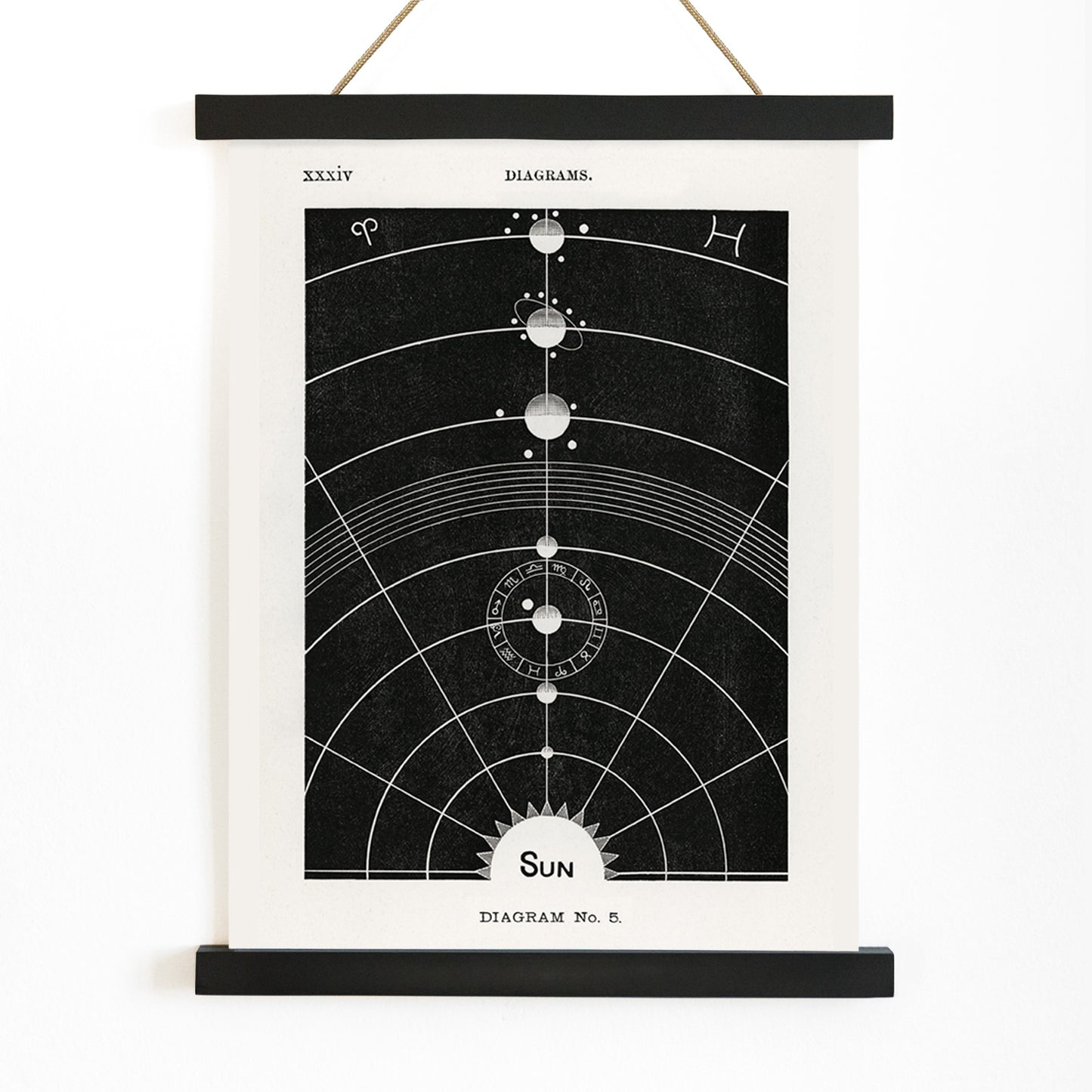
This diagram, published around 1887 as part of Butler’s Solar Biology teachings, was created to illustrate the connections between planetary movements and the passage of time. Such charts were used as educational tools in lectures and books, inviting viewers to contemplate the structure of the cosmos beyond conventional astronomy.
The artwork reflects a moment when scientific illustration and metaphysical speculation were intertwined, offering a visual gateway into the era’s search for cosmic order. For more on related themes, explore our space posters and esoteric wall art collections.
Style & Characteristics
The print is rendered in crisp black and white, with a precise arrangement of concentric circles, geometric forms, and annotated labels. The technical, almost architectural linework emphasizes clarity and order, guiding the viewer’s eye through planetary cycles and symbolic correspondences.
The overall effect is analytical and contemplative, making this vintage print appealing to those who appreciate celestial charts, astrological diagrams, or historical scientific design. For more monochrome artwork, see our black and white prints.
In Interior Design
This vintage diagram poster lends a thoughtful, intellectual touch to offices, libraries, or reading nooks, where its intricate details invite closer inspection. Its structured design complements minimalist, modern, or industrial interiors, anchoring a gallery wall or standing alone as a conversation piece.
Pair with black or natural wood frames and neutral walls for a refined, museum-like atmosphere. The print also harmonizes with brass accents and dark textiles, making it a sophisticated choice for astronomy enthusiasts and admirers of vintage scientific art.