


You may also like
-

Pine tree botanical illustration Poster
Johann Kautsky · 1889 · Botanical print of a towering pine with separate studies of needles and cones
Poster from £9 · Framed from £16
-

Martime pine Poster
Charles Dessalines d Orbigny · 1855 · Detailed botanical print of maritime pine with clustered needles and cone studies
Poster from £9 · Framed from £16
-

Black locust tree Poster
August Gerasch · 1889 · A botanical print showing a spreading black locust above blossoms and specimen studies
Poster from £9 · Framed from £16
-

Summer linden Poster
August Gerasch · 1889 · Botanical print of a summer linden with a flowering branch and detailed leaf studies
Poster from £9 · Framed from £16


-

"Very nice Posters. The quality is amazing and we received it very quickly !"
-

"A shop to visit absolutely. Huge selection of posters. We spent more than an hour there !"
-

"Perfect to find gift. Price are very good. An they can frame and pack it on site"


About the Artist
Anton Hartinger made botanical images for readers who wanted to recognise plants beyond the garden gate. Working in Vienna as a flower painter and lithographer, he illustrated Paradisus Vindobonensis, a publication devoted to plants cultivated in the city. Stone Pine dates to 1889, near the end of a career that joined careful observation to the demands of printmaking. His name is closely associated with botanical illustration, yet this subject reaches beyond flowers to a tree valued for its edible seeds. An Anton Hartinger botanical print shows how nineteenth-century art helped make plant knowledge portable.
The Artwork
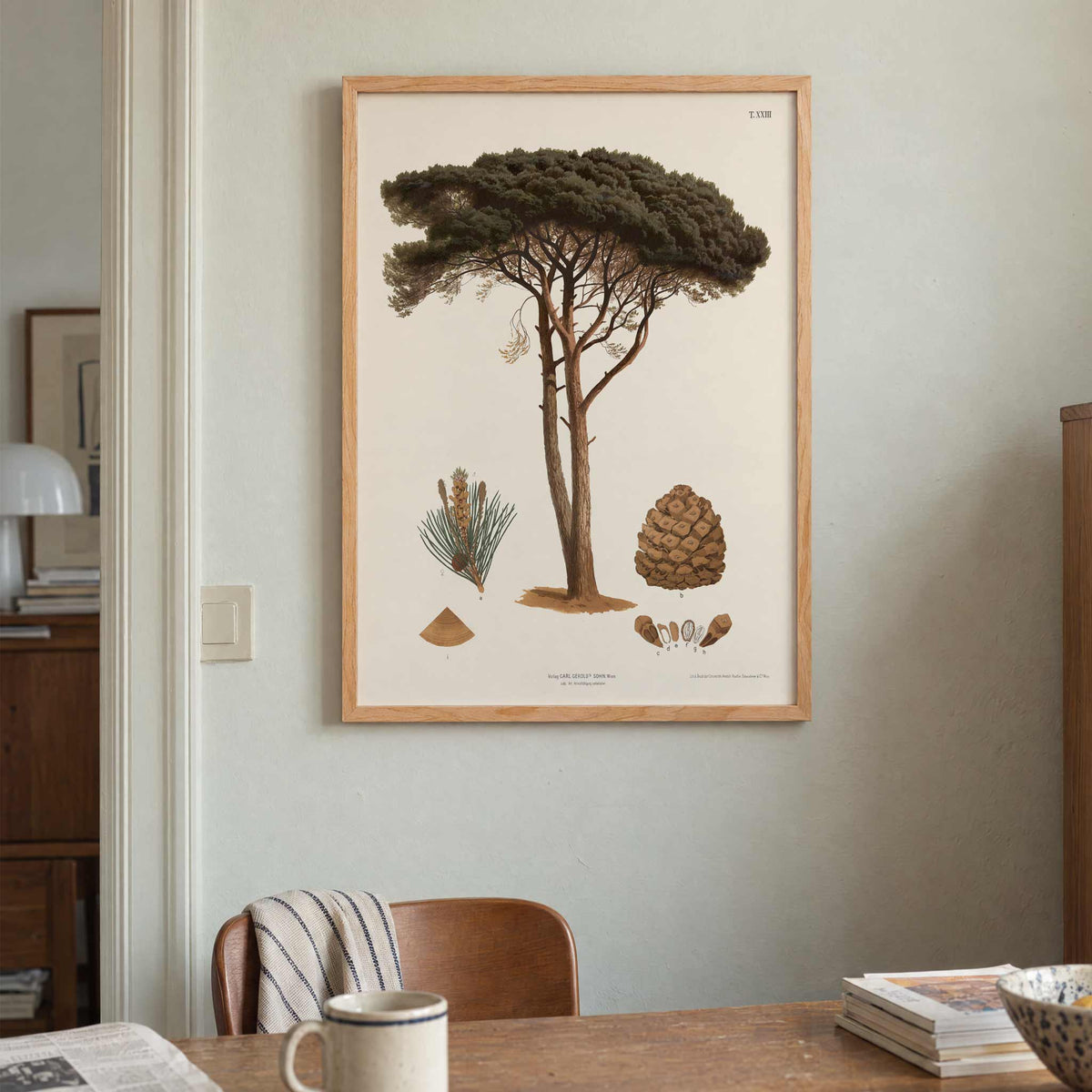
Stone pine, or Pinus pinea, has long been cultivated around the Mediterranean for its edible pine nuts. That connection gives this 1889 plate a purpose beyond recording a tree for its appearance: it helps a reader identify the species behind a familiar food. Botanical plates brought such information into books, where plants could be compared and studied far from the places they grew. Reproduced as a vintage poster, the illustration keeps that educational purpose in view. Its subject also recalls the everyday connection between botanical knowledge and the ingredients that reach a kitchen table.
Style & Characteristics
Dark green foliage stretches outward in a broad crown above the narrow, branching trunk. Follow the brown limbs upward and they disappear beneath the dense canopy; look down, and a separate needle sprig and large cone bring the tree within reach. Small seed studies appear along the bottom of the cream ground. The cone scales are individually outlined, while the needles resolve into fine strokes. As a stone pine art print, the image moves between the height of the mature tree and the details of a specimen, giving the vertical poster a striking shift in scale.
In Interior Design
In a reading room, hang this stone pine botanical print above an oak desk, where daylight brings warmth to the cream ground. A slim dark frame echoes the trunk without crowding the smaller studies near the foot of the image. From a chair beside the desk, the cone invites close inspection; from the doorway, the crown suggests a patch of shade. Leave the surrounding wall bare so the vertical poster has space to breathe. Here, botanical wall art rewards the pause before opening a book, making close observation part of the room.