


You may also like
-

Summer linden Poster
August Gerasch · 1889 · Botanical print of a summer linden with a flowering branch and detailed leaf studies
Poster from £9 · Framed from £16
-

Stone pine Poster
Anton Hartinger · 1889 · Detailed stone pine botanical print featuring a spreading canopy above separate cone and seed studies
Poster from £9 · Framed from £16
-

Pine tree botanical illustration Poster
Johann Kautsky · 1889 · Botanical print of a towering pine with separate studies of needles and cones
Poster from £9 · Framed from £16
-

Pawpaw Poster
Mark Catesby · 1754 · Graceful pawpaw botanical print with broad green leaves and ripening fruit on ivory ground
Poster from £9 · Framed from £16


-

"Very nice Posters. The quality is amazing and we received it very quickly !"
-

"A shop to visit absolutely. Huge selection of posters. We spent more than an hour there !"
-

"Perfect to find gift. Price are very good. An they can frame and pack it on site"


About the Artist
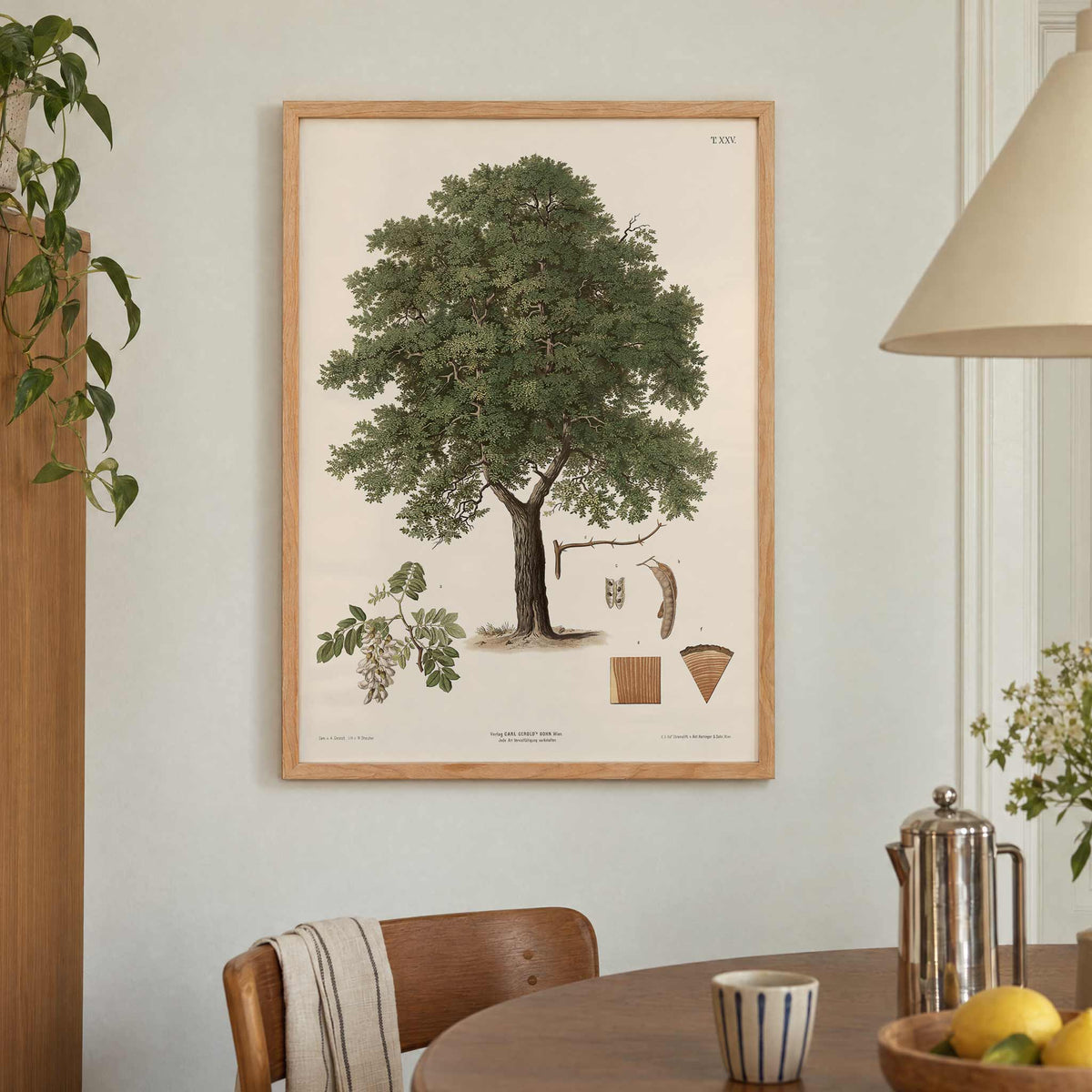
August Gerasch makes the black locust identifiable without reducing it to a single leaf. His 1889 study presents the tree as a complete living subject while giving its smaller parts the attention needed for botanical identification. Gerasch, an Austrian painter and lithographer, worked in a period when illustrated natural history helped readers compare species on the page. In this botanical print, the tree is more than a picturesque subject: the accompanying specimens invite closer examination. The August Gerasch art print joins the appeal of a tree portrait to the patient habits of nineteenth-century botany.
The Artwork
Black locust had travelled far before this 1889 botanical plate appeared. Native to eastern North America, Robinia pseudoacacia became established in Europe through cultivation, valued for durable timber as well as ornamental planting. Its common name can mislead: it is not a true acacia, but a member of the pea family. That distinction gives this scientific print a purpose beyond celebrating a tree. Its named subject asks viewers to recognise a particular species. As a vintage print today, it also recalls how nineteenth-century botany helped readers identify trees they might encounter beyond the page.
Style & Characteristics
The crown spreads almost from edge to edge, its dense green foliage broken by glimpses of twisting branches. Below, a deeply ridged trunk draws the eye down to a small patch of earth. Cream paper opens around the lower specimens, giving each detail room to register. A flowering sprig leans in from the left, carrying oval leaflets and hanging white blossoms. On the right, a curved brown pod hangs above two neatly bounded samples. As a vertical poster, the image lets the tree fill most of the page, while fine lettering near the base returns attention to the smaller studies.
In Interior Design
Place this black locust fine art print above a narrow oak desk in a quiet study, where the detailed specimens are close enough to examine from a chair. A slender dark frame echoes the trunk, while the cream paper stands gently against a pale plaster wall. Leave the surrounding wall bare so the flowering branch has space to register beneath the broad canopy. For home decor built around reading, this botanical wall art offers more than a distant view of a tree: it gives a seated viewer details to return to between pages of a book.