


You may also like
-
Persimmons Poster
Amanda Almira Newton · 1923 · Delicate botanical print of ripe persimmons on a leafy branch against clean white space
Poster from £9 · Framed from £16
Regular price From £6.00Regular price -
Avocado Persea Poster
Amanda Almira Newton · 1916 · Refined avocado botanical print with luminous green skins and a softly painted cut fruit
Poster from £9 · Framed from £16
Regular price From £6.00Regular price -
Citrus Sinensis Poster
Amanda Almira Newton · 1916 · Luminous orange botanical print showing fruit, leaves, blossoms, and a clean cutaway
Poster from £9 · Framed from £16
Regular price From £6.00Regular price -
Malus Domestica Poster
Amanda Almira Newton · 1908 · Refined apple botanical print with luminous red fruit and crisp leaves on white
Poster from £9 · Framed from £16
Regular price From £6.00Regular price


-

"Very nice Posters. The quality is amazing and we received it very quickly !"
-

"A shop to visit absolutely. Huge selection of posters. We spent more than an hour there !"
-

"Perfect to find gift. Price are very good. An they can frame and pack it on site"


About the Artist
Amanda Almira Newton was an American botanical illustrator renowned for her precise fruit studies in the early twentieth century. Working during a period when scientific illustration was essential for horticultural documentation, Newton contributed significantly to the visual record of American pomology, shaping how fruit varieties were catalogued and understood before the advent of color photography.
This vintage botanical print pairs seamlessly with other works in our Amanda Almira Newton prints collection, where artistry and scientific observation come together in refined detail.
The Artwork
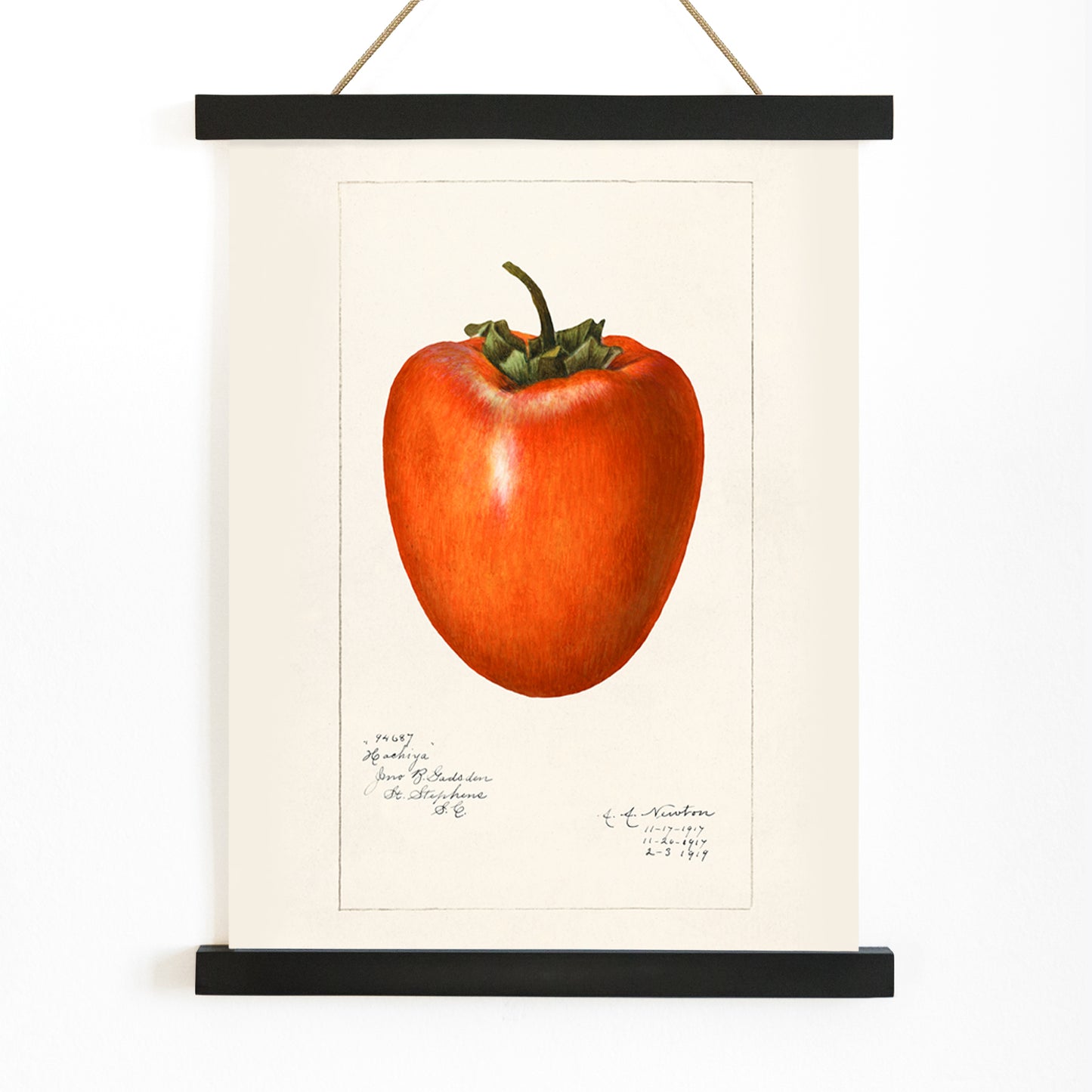
Created in 1916, this persimmon illustration reflects a time when accurate depictions of fruit were vital for growers, researchers, and agricultural exchange. Botanical prints like this served as trusted references for identifying cultivars, supporting the exchange of knowledge in a rapidly developing agricultural landscape.
The persimmon, valued for its seasonal abundance and cultural significance, was a fitting subject for Newton’s meticulous approach. This work embodies the intersection of scientific heritage and the quiet beauty of everyday nature. For those interested in the history of scientific illustration, discover more in our science wall art collection.
Style & Characteristics
The artwork features a single persimmon fruit with its leafy calyx, rendered in watercolor and set against a clean white background. Newton’s technique emphasizes clarity and accuracy, with gentle shading and crisp outlines that highlight the fruit’s form and surface texture.
The palette is dominated by warm orange-reds of the persimmon and fresh green leaves, creating a luminous and serene effect. The minimalist composition draws the eye to botanical detail, making it a timeless example of vintage scientific illustration and decorative art.
In Interior Design
This persimmon print brings a welcoming, natural touch to kitchens, dining areas, or breakfast nooks, where food imagery feels especially at home. Its white background and balanced arrangement complement Scandinavian, modern, and classic interiors without overwhelming the space.
Pair it with pale woods, linen, and ceramics in neutral tones, or combine it with other botanical prints for a cohesive, nature-inspired decor scheme.