


You may also like
-
Sleeping beauty Poster
Unknown artist · 1872 · Romantic reclining figure poster framed by flowers and drapery in warm pink tones
Poster from £9 · Framed from £16
Regular price From £6.00Regular price -
Brown Odalisque Poster
Francois Boucher · 1745 · Rococo reclining nude art print with cool blue drapery and soft intimate glow
Poster from £9 · Framed from £16
Regular price From £6.00Regular price -
Reclining Nude Poster
Isidore Pils · 1841 · Academic nude art print with soft graphite shading and quiet, intimate repose
Poster from £9 · Framed from £16
Regular price From £6.00Regular price -
Egyptian dancer Poster
Willem de Famars Testas · 1870 · Intimate Orientalist art print of an Egyptian dancer with musicians and spectators
Poster from £9 · Framed from £16
Regular price From £6.00Regular price


-

"Very nice Posters. The quality is amazing and we received it very quickly !"
-

"A shop to visit absolutely. Huge selection of posters. We spent more than an hour there !"
-

"Perfect to find gift. Price are very good. An they can frame and pack it on site"


About the Artist
Jean Auguste Dominique Ingres was a prominent French painter of the nineteenth century, renowned for his mastery of line and his refined, idealized approach to the human figure. Associated with Neoclassicism, Ingres drew inspiration from classical antiquity while developing a distinctive style that balanced clarity, sensuality, and compositional harmony. His influence extended across generations, shaping both academic and modern artists.
His legacy endures in collections of classic art posters and among famous artists prints, offering a glimpse into the atelier traditions and artistic ideals of his era.
The Artwork
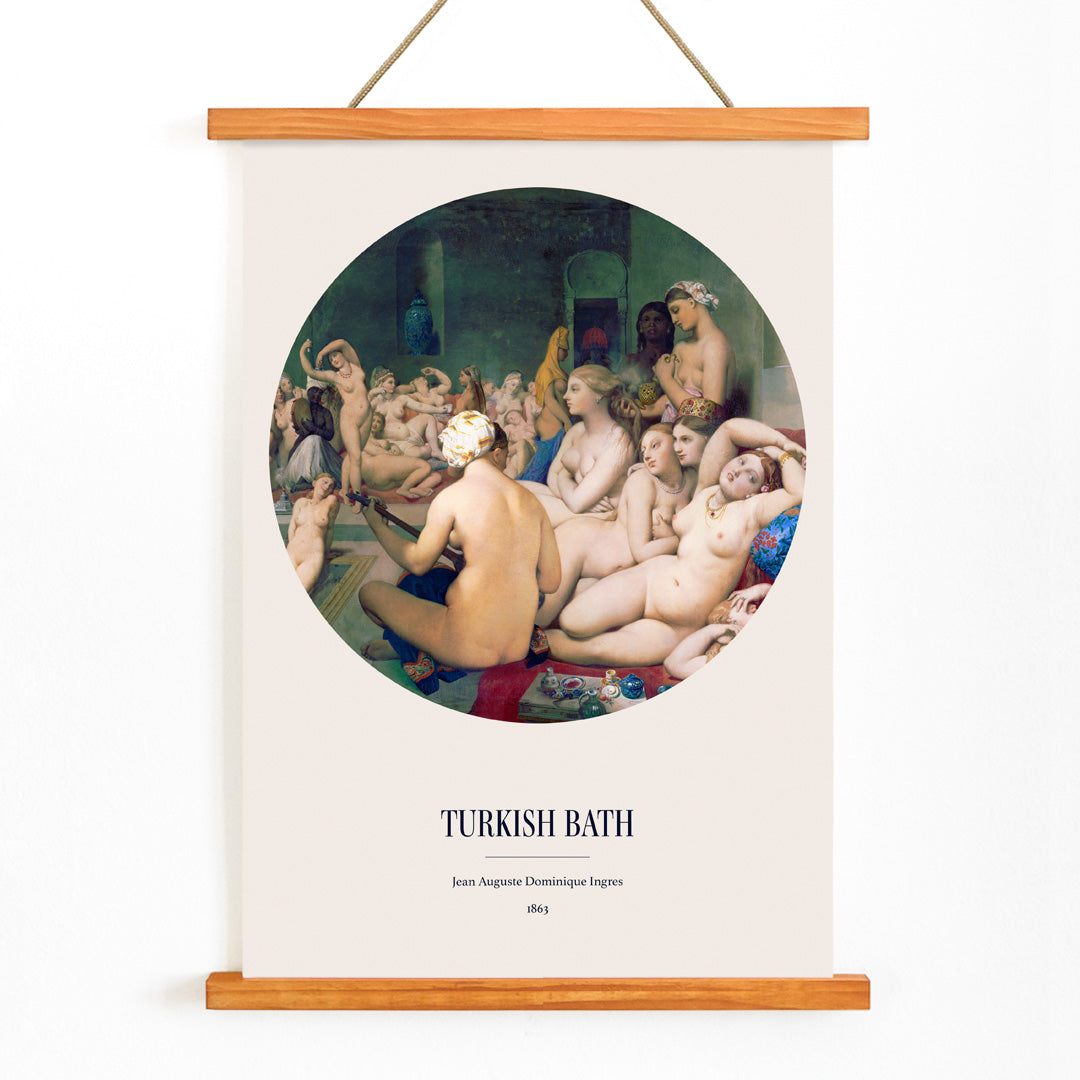
Completed in 1863, The Turkish Bath emerged during a period of heightened European interest in the cultures and aesthetics of the Ottoman Empire. Rather than depicting a literal scene, Ingres crafted an imaginative vision of the hammam, drawing on travel accounts, earlier sketches, and the Romantic fascination with distant lands. The painting reflects the broader Orientalist movement, where artists explored themes of luxury, sensuality, and escapism through imagined settings.
This work also invites reflection on how nineteenth-century artists negotiated ideas of beauty, desire, and cultural otherness, making it a significant example within the context of Orientalist wall decor.
Style & Characteristics
The artwork is composed as a circular tondo densely filled with intertwined, reclining female figures. Ingres employs precise contours and a polished, enamel-like surface, emphasizing the elegance of line over visible brushwork. The figures are rendered in warm, luminous skin tones, set against a subdued interior palette of beige and stone, with subtle accents of green, red, and blue in the textiles and accessories.
The overall mood is tranquil and intimate, with the rhythmic arrangement of bodies creating a sense of continuous movement. The refined sensuality and classical composition make this art print both timeless and evocative.
In Interior Design
This piece is well-suited for spaces that embrace softness and sophistication, such as bedrooms, dressing rooms, or personal libraries. Its gentle palette pairs beautifully with antique brass, dark wood, marble, and plush textiles like velvet or linen, fitting seamlessly into classic, eclectic, or boutique-inspired interiors.
To echo the artwork's tones, consider creamy beige walls, deep green foliage, muted red rugs, or blue ceramic accents. As a vintage wall decor selection, it also harmonizes with other erotic art prints and the understated elegance of beige posters.