




-

"Very nice Posters. The quality is amazing and we received it very quickly !"
-

"A shop to visit absolutely. Huge selection of posters. We spent more than an hour there !"
-

"Perfect to find gift. Price are very good. An they can frame and pack it on site"


About the Artist
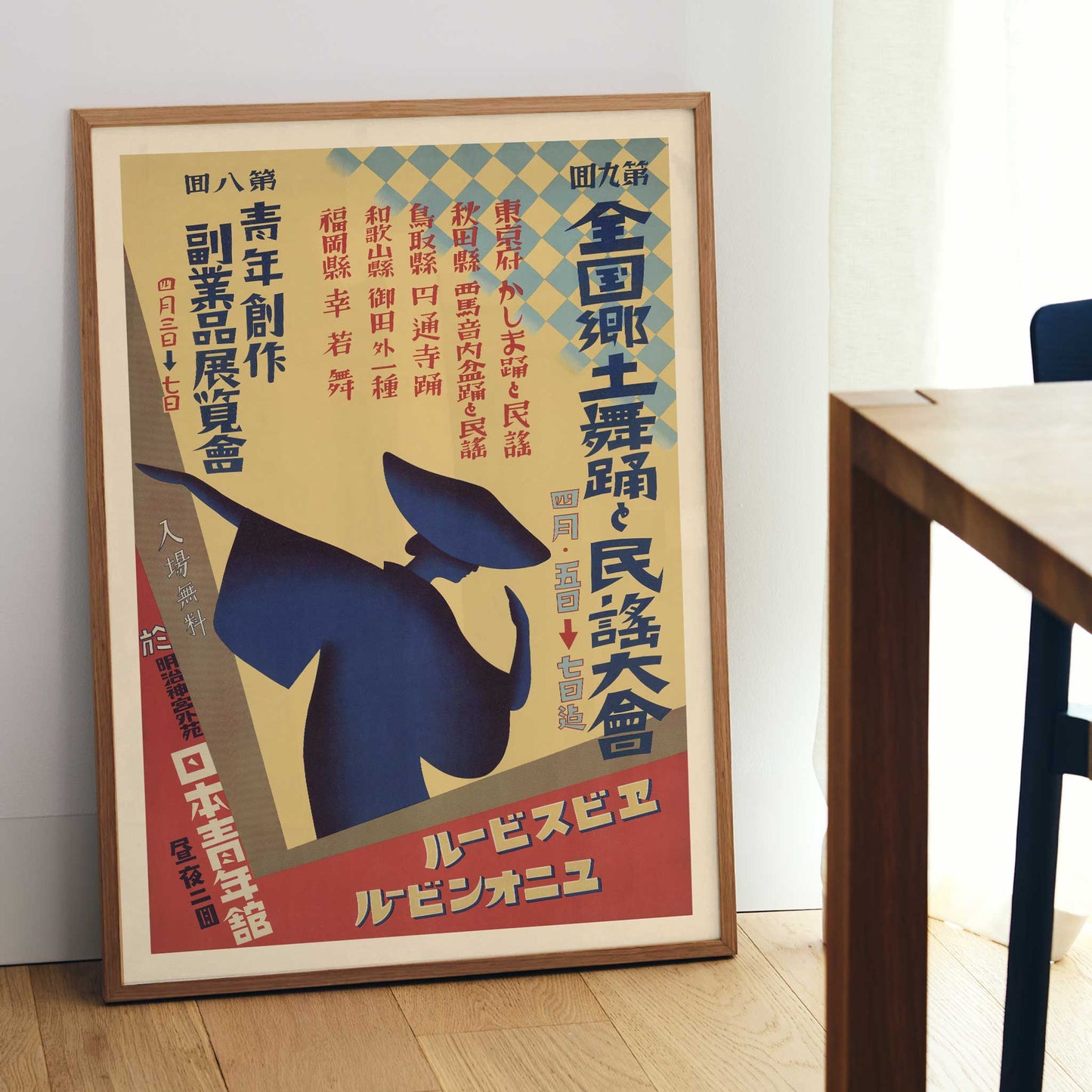
By an unknown artist, this 1934 Japanese festival poster records the Ninth National Japanese Folk Dance and Folk Song Festival. The maker remains unidentified, so the event itself provides the strongest route into the print’s history. Its title presents a nationwide gathering devoted to regional performance, bringing folk dance and song into a formally announced public program. Additional Japanese wording points to the festival’s organized schedule and related activities, showing how much information a single sheet was expected to carry. Rather than attach an invented biography to the artist, the poster can be read as a period document of early Showa cultural life. For collectors of vintage poster design, it offers a direct connection to a named Japanese event, while a fine art print of the sheet preserves that historical purpose for contemporary study.
The Artwork
The Ninth National Japanese Folk Dance and Folk Song Festival was not simply an entertainment listing; it was a public invitation to encounter regional traditions through a national presentation. In 1934, a printed announcement could gather distant practices under one title and give them a shared civic setting. The festival’s pairing of folk dance and folk song is central to its meaning, linking movement with oral musical heritage. This advertising poster therefore served both practical and cultural purposes: it announced an occasion and framed traditional performance as part of modern public life. Read today as Japanese wall art, the vintage print carries the memory of an event whose performance has passed, while its historical narrative remains legible through the festival name and date.
Style & Characteristics
The eye first lands on the large blue dancer, whose bent figure and lifted arm create a strong diagonal across the beige ground. A broad blue headpiece extends the silhouette toward the upper centre, while deep blue Japanese lettering anchors the right side. Red text runs through the open space and continues into the broad red panel at the bottom, giving the vintage poster a visual beat without softening its bold graphic force. Along the top, repeating blue and beige diamonds suggest a textile border, connecting the modern poster language with the subject of folk performance. Small yellow details warm the restrained palette. As a vertical poster, it turns a simple silhouette into memorable Japanese art print wall art.
In Interior Design
In a dining room with a pale plaster wall, this vertical poster would bring a theatrical focal point above a low wooden sideboard. A slim black frame could echo the dark contour of the dancer while keeping the beige field open around the image. The blue silhouette would read clearly in daylight, and the red lower panel would add warmth beside natural wood without making the room feel crowded. A single ceramic bowl on the sideboard would leave the Japanese typography and diamond border unobstructed. Used as home decor, the fine art print gives the dining space a measured dose of early twentieth-century graphic energy, while its subject keeps the interior decoration connected to music and movement.