


You may also like
-

Diagram of Meteorology Poster
James Reynolds · 1846 · Detailed meteorology poster mapping winds and cloud forms in hand-colored diagrams
Poster from £9 · Framed from £16
-

Volcanoes and Earthquakes Poster
James Reynolds · 1849 · Detailed world map vintage print charting volcanic belts and earthquake zones
Poster from £9 · Framed from £16
-

Mountains Poster
James Reynolds · 1851 · Educational mountain-height vintage print combining labeled silhouettes into a dramatic panorama
Poster from £9 · Framed from £16
-

Geological map of the world Poster
James Reynolds · 1850 · Detailed world geology vintage print with color-coded strata and neat Victorian labels
Poster from £9 · Framed from £16


-

"Very nice Posters. The quality is amazing and we received it very quickly !"
-

"A shop to visit absolutely. Huge selection of posters. We spent more than an hour there !"
-

"Perfect to find gift. Price are very good. An they can frame and pack it on site"


About the Artist
James Reynolds was a nineteenth-century scientific illustrator who contributed to the popularization of geology and meteorology during the Victorian era. Working at a time when visual aids were essential for scientific education, Reynolds specialized in transforming complex natural phenomena into accessible and engaging images for a broad audience.
His illustrations bridged the gap between scientific rigor and public curiosity, making the wonders of the natural world understandable to both scholars and laypeople. Reynolds’s legacy endures in the way his prints capture the spirit of early science communication and Victorian fascination with discovery.
The Artwork
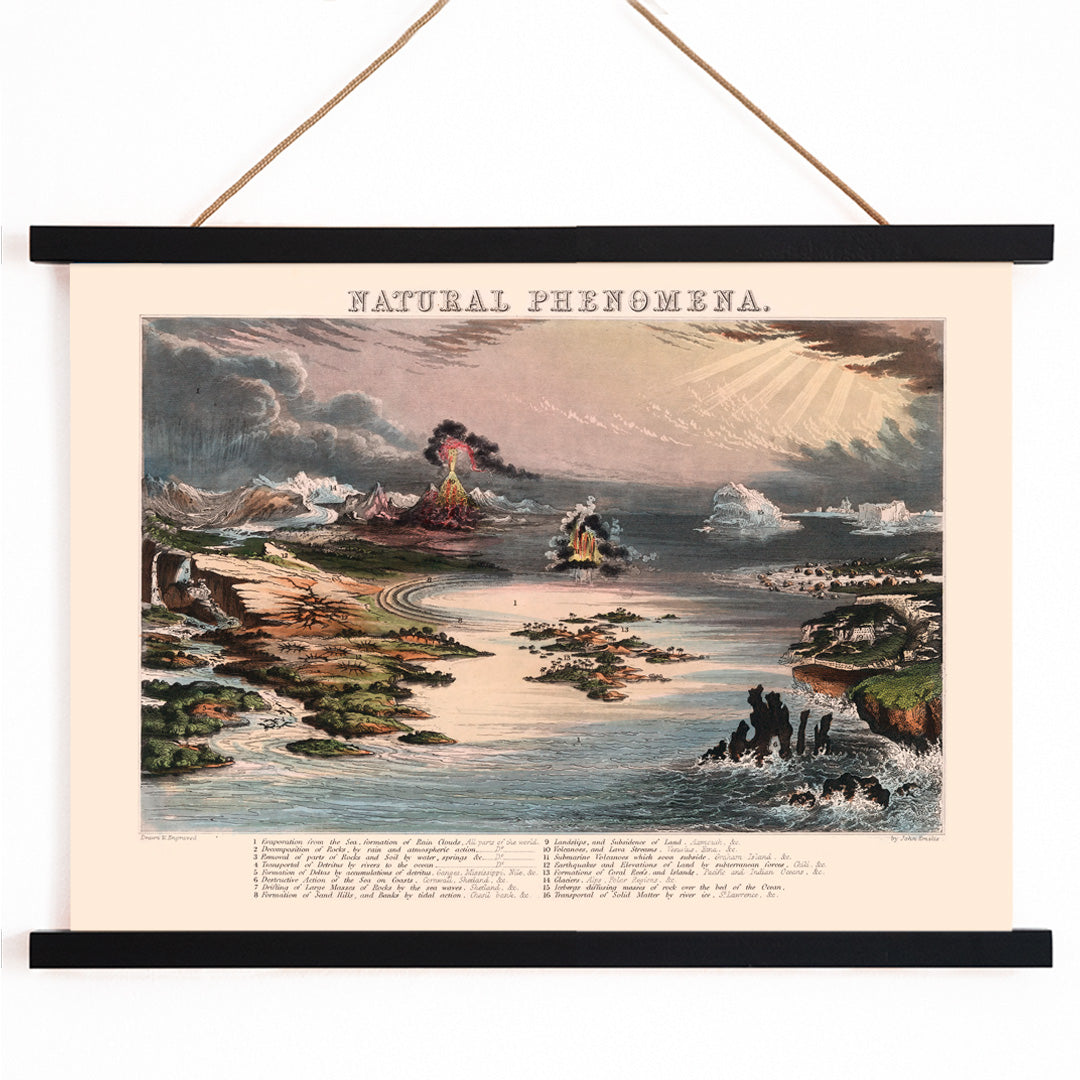
Natural Phenomena from 1852 was created during a period of intense interest in the forces shaping the Earth and atmosphere. This print was intended as an educational tool, synthesizing contemporary knowledge about volcanoes, storms, ocean currents, and other dramatic events into a single, instructive image.
Such works were often used in classrooms and public lectures, reflecting the Victorian commitment to spreading scientific understanding. The print embodies the era’s drive to classify and explain the world, offering a visual summary of nature’s most powerful processes for both study and contemplation.
Style & Characteristics
The composition is arranged as a didactic tableau, featuring labeled illustrations of volcanoes, lightning, clouds, and ocean currents. Fine linework and precise shading define each element, while careful hand coloring adds depth with blues for sky and sea, greens for land, browns for earth, and touches of red for volcanic activity.
The overall effect is both dynamic and orderly, balancing visual drama with scientific clarity. The print’s structured layout and restrained palette make it a sophisticated example of nineteenth-century scientific illustration, suitable for both educational and decorative contexts.
In Interior Design
This vintage scientific print is an excellent choice for studies, libraries, or home offices where intellectual curiosity is celebrated. Its historical character pairs well with wood, leather, and brass, but it can also serve as a striking focal point in modern interiors seeking a touch of vintage sophistication.
For a cohesive display, combine it with other science posters or echo its blue tone wall art in soft furnishings. It also complements landscape prints, creating a gallery wall that bridges natural imagery and educational design.