


You may also like
-
Sant Jordi, Patro de Catalunya Poster
Unknown artist · 1500 · Medieval Sant Jordi poster featuring the saint confronting a dragon in warm beige and brown
Poster from £9 · Framed from £16
Regular price From £6.00Regular price -
Praying woman Poster
Dirk Jurriaan Sluyter · 1843 · Quiet devotional print of a headscarved woman gazing upward in soft greys
Poster from £9 · Framed from £16
Regular price From £6.00Regular price -
Libra Poster
Henri van der Stok · 1900 · Elegant Libra poster featuring a poised female figure with balanced scales in black and cream
Poster from £9 · Framed from £16
Regular price From £6.00Regular price -
Rose de Provins Poster
Jean Benjamin Godefroy · 1819 · Refined rose botanical print with precise engraving lines and airy natural history spacing
Poster from £9 · Framed from £16
Regular price From £6.00Regular price


-

"Very nice Posters. The quality is amazing and we received it very quickly !"
-

"A shop to visit absolutely. Huge selection of posters. We spent more than an hour there !"
-

"Perfect to find gift. Price are very good. An they can frame and pack it on site"


About the Artist
Created by an anonymous artist, this 1571 devotional image reflects the late Renaissance tradition of Catholic sacred art, a period when prints played a vital role in spreading religious doctrine and offering comfort in daily life. Such works were typically produced in workshops, prioritizing clarity and adherence to established iconography over individual artistic expression.
The emphasis is on continuity and tradition: familiar religious figures, clear visual hierarchies, and a sense of enduring spiritual authority. Collectors interested in classic art wall art appreciate these historical prints for their contemplative presence and cultural resonance.
The Artwork
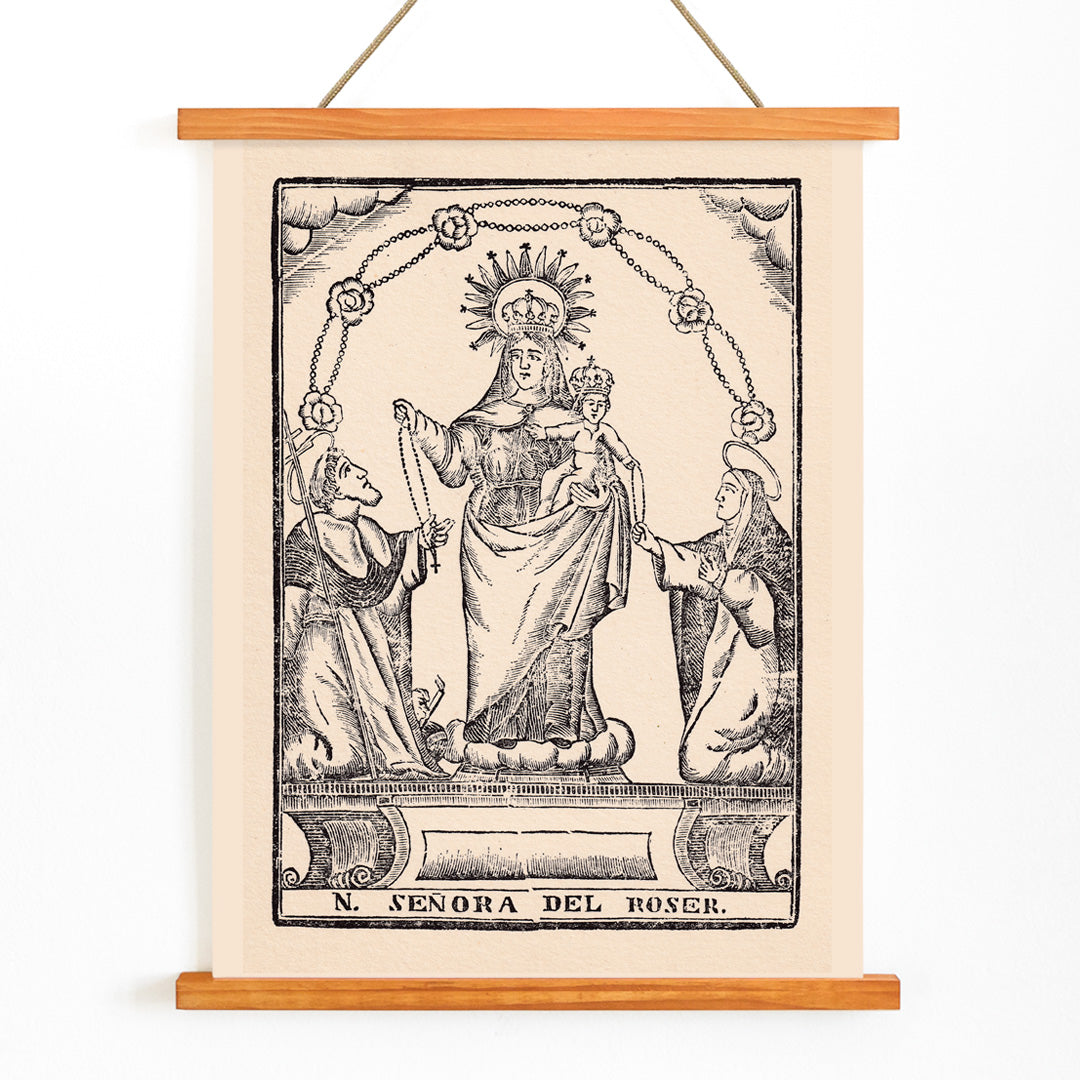
Nuestra Senora del Roser commemorates the widespread devotion to Our Lady of the Rosary, which gained renewed significance in the 16th century as rosary confraternities flourished throughout Catholic Europe. The year 1571, marked by the Battle of Lepanto, saw Marian intercession and rosary prayer promoted as vital sources of spiritual strength and communal identity.
This image served as a devotional aid, intended for private prayer or communal reflection. By depicting the Madonna and Child enthroned and surrounded by saints, it offered viewers a visual focus for meditation and a reminder of the protective power of faith during turbulent times.
Style & Characteristics
The composition is formal and symmetrical, with the crowned Madonna and Child centrally placed and flanked by attendant saints. The figures are arranged in a balanced manner, guiding the viewer's gaze toward the sacred focal point.
Rendered in black ink on warm, aged paper, the print features delicate linework that defines the contours, garments, and symbolic elements. The restrained palette and fine detail evoke a sense of reverence and introspection, making it a fitting choice among black and white prints for a serene, gallery-like interior.
In Interior Design
This sacred artwork complements interiors designed for tranquility, such as entryways, bedrooms, reading nooks, or home offices where a calm atmosphere is desired. It pairs well with minimalist spaces seeking a touch of historical depth, as well as traditional rooms featuring dark wood, linen, or stone textures.
Coordinate with cream, parchment, and charcoal accents, or use it to soften a monochrome scheme with its antique paper tone. For harmonious styling, explore beige tone posters and consider a simple mat and slender frame for an understated, archival presentation.