


You may also like
-

Voyage autour du monde 17 Poster
Louis-Isidore Duperrey · 1825 · Detailed scientific print of Pacific fish studies with crisp linework and soft hand-coloring
Poster from £9 · Framed from £16
-

Voyage autour du monde 112 Poster
Louis-Isidore Duperrey · 1825 · Delicate dolphin scientific print arranged as a natural history plate in blue-grey tones
Poster from £9 · Framed from £16
-

Voyage autour du monde 16 Poster
Louis-Isidore Duperrey · 1825 · Hand-colored fish scientific print with crisp linework and lively aquatic tones
Poster from £9 · Framed from £16
-

Voyage autour du monde 5 Poster
Louis-Isidore Duperrey · 1825 · Scientific print of a snake with crisp linework on warm beige background
Poster from £9 · Framed from £16


-

"Very nice Posters. The quality is amazing and we received it very quickly !"
-

"A shop to visit absolutely. Huge selection of posters. We spent more than an hour there !"
-

"Perfect to find gift. Price are very good. An they can frame and pack it on site"


About the Artist
Louis-Isidore Duperrey was a French naval officer, explorer, and naturalist whose early 19th century voyages greatly expanded European understanding of the Pacific and its marine life. As commander of the La Coquille expedition from 1822 to 1825, Duperrey led a team of scientists and artists who documented new species and collected specimens, resulting in influential illustrated atlases for the scientific community.
His contributions bridged the worlds of exploration and natural history, providing a visual record that supported taxonomy and museum collections. Today, his works are valued for their blend of scientific precision and the spirit of adventure that defined the era of global exploration.
The Artwork
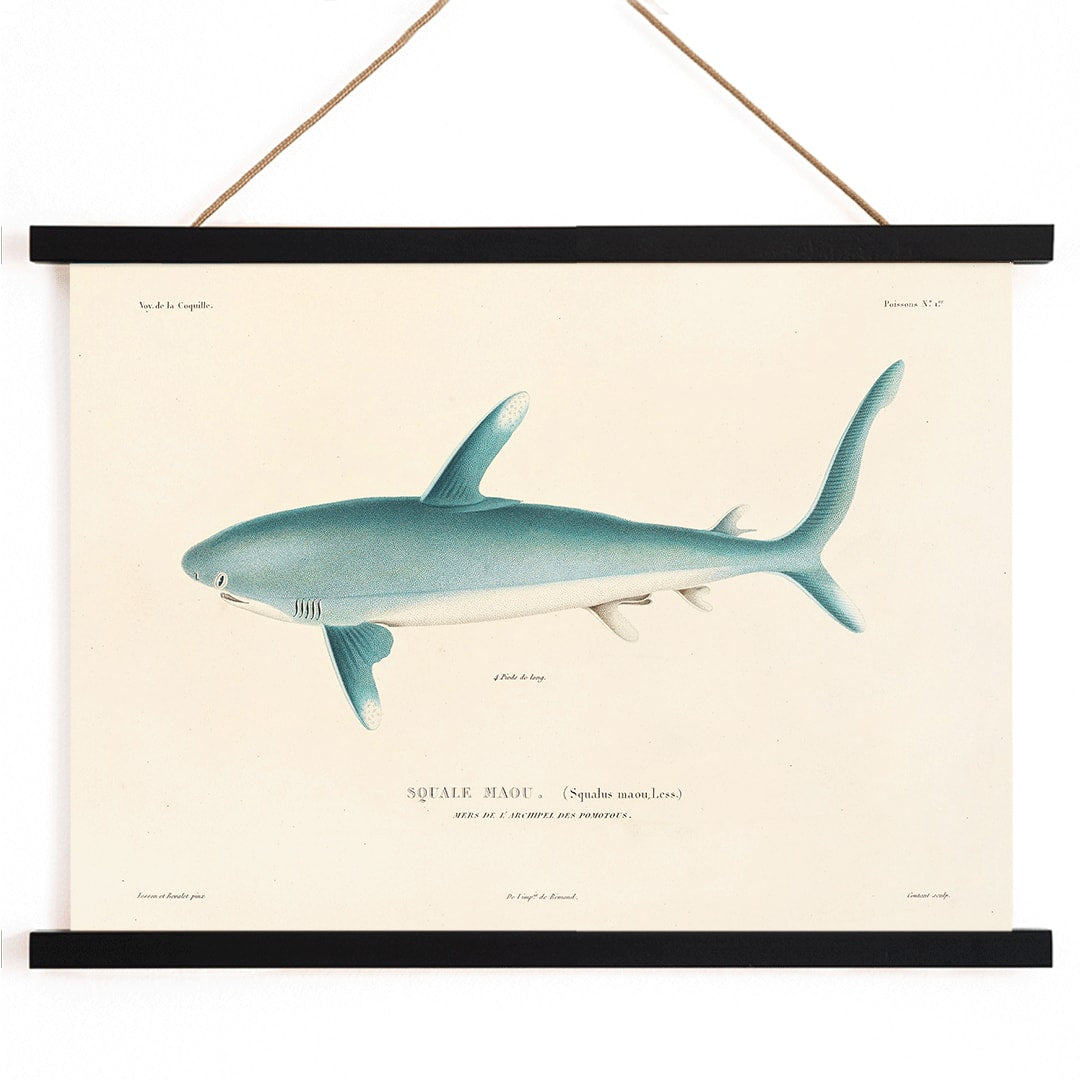
This plate from Duperrey's Voyage autour du monde was created during a time when naval expeditions served as floating laboratories, capturing rare encounters with ocean life. The illustration of the shark was intended as a scientific document, enabling scholars and institutions to study and compare marine species long after the voyage had ended.
Produced in the context of early 19th-century taxonomy, this shark study functioned as a vital reference for identifying and classifying marine fauna. It aligns with other exploration-era works found in vintage map prints and complements curated selections in sea and ocean posters.
Style & Characteristics
The artwork features a clear, side-profile depiction of the shark, emphasizing anatomical accuracy and proportion. Fine, controlled linework and subtle shading give the image a calm, analytical quality, while scientific notations and labels reinforce its documentary purpose.
The color palette is understated, with the paper showing warm beige tones and the shark rendered in shades of grey to near black. The overall effect is archival and restrained, characteristic of vintage scientific illustration prints.
In Interior Design
This shark scientific print adds a subtle maritime touch to spaces such as home offices, libraries, hallways, or gallery walls. It fits seamlessly into coastal, modern, Scandinavian, or classic interiors, especially where a single, graphic subject is desired as a focal point.
For a harmonious look, pair it with black or light oak frames and neutral textiles. It can be displayed alongside other scientific illustration prints or mixed with nautical photography for a layered, curated wall arrangement.