


You may also like
-

Jantzen Poster
Joseph Binder · 1952 · Energetic skiing poster with a stylized couple cutting through bold alpine shapes
Poster from £9 · Framed from £16
-

Jantzen 2 Poster
Joseph Binder · 1952 · Dynamic skiing poster with stylized couple and bold blue, white, and red blocks
Poster from £9 · Framed from £16
-

46th French Ski Championships Poster
H. Mathieu · 1959 · Vintage poster for the French Ski Championships in Barèges with a sweeping skier motif
Poster from £9 · Framed from £16
-

Crans Poster
Unknown artist · 1955 · Dynamic alpine ski poster with bold color blocks, crisp slopes, and blue sky
Poster from £9 · Framed from £16


-

"Very nice Posters. The quality is amazing and we received it very quickly !"
-

"A shop to visit absolutely. Huge selection of posters. We spent more than an hour there !"
-

"Perfect to find gift. Price are very good. An they can frame and pack it on site"


About the Artist
Created by an anonymous artist, this 1934 Swiss poster reflects the interwar era’s embrace of modern graphic design, when public spaces and leisure were promoted as symbols of civic progress. During this period, Swiss municipalities often commissioned striking posters to encourage healthy lifestyles and celebrate new public amenities, emphasizing clarity and visual impact over individual artistic fame.
This work is a testament to the optimism of 1930s Switzerland, when swimming pools were seen as beacons of modernity and social wellbeing. The poster stands as a historical artifact from a time when design played a key role in shaping public perceptions of health and urban life.
The Artwork
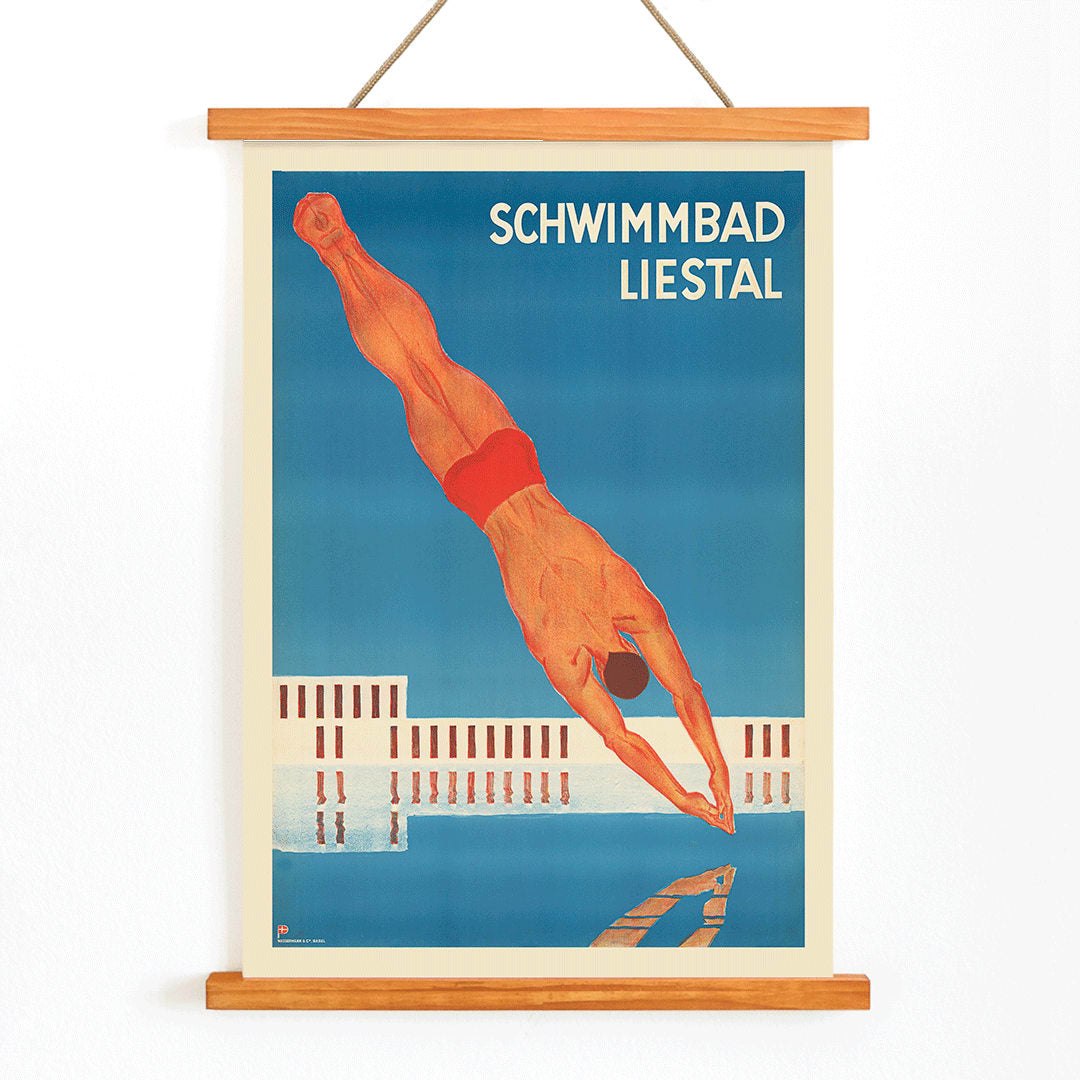
Schwimmbad Liestal was created to advertise the municipal swimming pool in Liestal, capturing the spirit of communal recreation and the growing popularity of physical culture. In the 1930s, such facilities represented not only places for sport and relaxation but also the ideals of hygiene, vitality, and civic pride. This poster transforms a local pool into a symbol of progress, aligning with the broader tradition of Swiss advertising posters that celebrated modern infrastructure and public life.
Style & Characteristics
The design features a diver in mid-air, rendered with bold geometry and simplified forms that convey energy and motion. The composition uses expansive fields of deep blue to evoke the pool, contrasted by the striking red of the diver’s figure and lighter architectural elements. The clean, sans-serif typography and limited color palette give the poster a crisp, modernist look reminiscent of Bauhaus influences.
The overall mood is dynamic and uplifting, with a sense of clarity and order that typifies Swiss graphic design of the era. The poster’s visual restraint and strong color contrasts make it a compelling example of early twentieth-century European poster art.
In Interior Design
This vintage swimming poster makes a bold statement in interiors that appreciate graphic art—ideal for entryways, bathrooms, or contemporary living spaces. Its clean lines and vivid colors pair well with mid-century modern or minimalist decor, while the aquatic blues and red accents can be echoed in textiles or ceramics for a harmonious palette.
For those curating a modern gallery wall, this piece offers a touch of Swiss heritage and design history, and it complements collections of blue wall art or other vintage advertising posters.