


You may also like
-
Tropical Flowers II Poster
Unknown artist · 1912 · Decorative tropical flower print with stylized foliage and warm early modern pattern rhythm
Poster from £9 · Framed from £16
Regular price From £6.00Regular price -
Floral motifs 15 Poster
Édouard Bénédictus · 1928 · Lively Art Deco floral poster with stylized petals and rhythmic color blocks
Poster from £9 · Framed from £16
Regular price From £6.00Regular price -
Flower pattern Poster
Owen Jones · 1912 · Refined floral pattern poster with crisp symmetry in red and blue on white
Poster from £9 · Framed from £16
Regular price From £6.00Regular price -
Leaves and fruits Poster
Paul Poiret · 1912 · Stylized leaves and fruit botanical print with bold green and purple forms on beige
Poster from £9 · Framed from £16
Regular price From £6.00Regular price


-

"Very nice Posters. The quality is amazing and we received it very quickly !"
-

"A shop to visit absolutely. Huge selection of posters. We spent more than an hour there !"
-

"Perfect to find gift. Price are very good. An they can frame and pack it on site"


About the Artist
Christian Rohlfs (1849–1938) was a German painter who played a significant role in the development of Expressionism. After an early period shaped by academic traditions, Rohlfs embraced a more liberated approach to color and brushwork, reflecting the evolving spirit of modern art in early twentieth-century Europe.
Rohlfs is celebrated for his still lifes, landscapes, and floral compositions, which often transform everyday subjects into explorations of mood and perception. His work bridges the gap between traditional motifs and the expressive energy that defined German modernism.
The Artwork
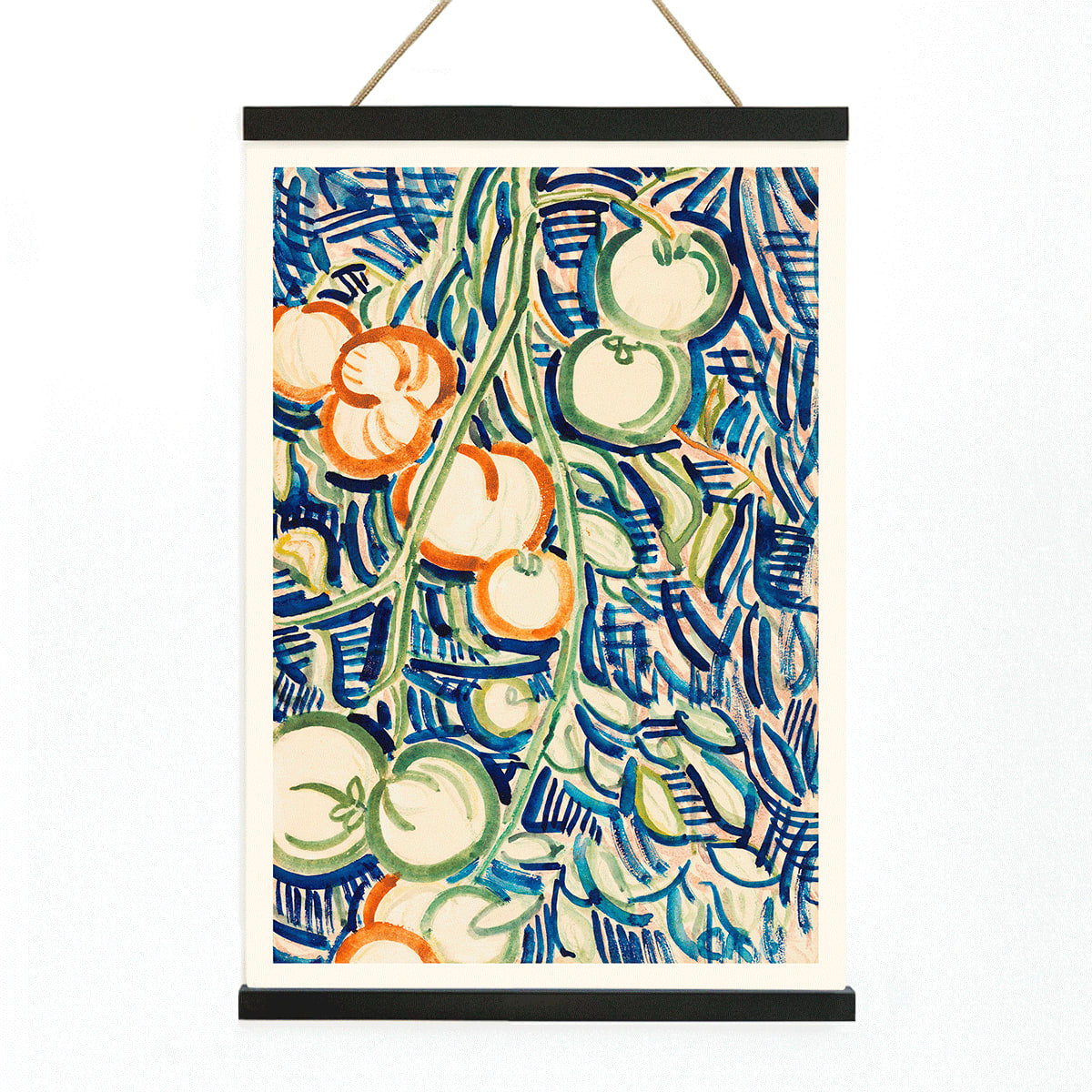
Painted in 1906, this still life of red and green tomatoes reflects a period when artists sought new ways to see the ordinary. At the turn of the century, still life painting became a space for experimentation, allowing painters like Rohlfs to focus on the sensory qualities of familiar objects rather than narrative or symbolism.
This artwork captures the quiet abundance of kitchen produce, inviting viewers to notice the subtle interplay of color and form. It stands as a testament to the artist’s interest in presence and immediacy, and it resonates with those who appreciate the intersection of domestic life and modern art. The piece is a natural fit for kitchen wall art and pairs well with other botanical art prints.
Style & Characteristics
The composition centers on a cluster of tomatoes rendered in bold, expressive brushstrokes. Vivid reds and greens dominate the palette, with the contrasting hues creating a lively visual tension. The forms are simplified and energetic, emphasizing volume and immediacy over precise detail.
Rohlfs’s technique imparts a sense of movement and vitality, while the overall mood remains calm and grounded. The modernist approach to color and form gives the piece a timeless appeal, making it suitable for a range of interiors, from contemporary kitchens to eclectic dining spaces.
In Interior Design
This tomato still life brings warmth and character to kitchens, dining rooms, or breakfast nooks, where food imagery feels both relevant and refined. Its expressive color contrasts can complement neutral walls or echo green and terracotta accents for a harmonious effect.
For a cohesive display, consider grouping it with other famous artists or classic art prints in simple frames, allowing the artwork’s vibrant palette to stand out and enliven the space.