


You may also like
-

The Artist’s Left Hand Poster
Henri-Charles Guérard · 1890 · Minimal black handprint poster set against calm beige space with tactile presence
Poster from £9 · Framed from £16
-

Discus Thrower Poster
Jan Veth · 1912 · Sculptural nude athlete art print capturing the coiled motion of a classical discus throw
Poster from £9 · Framed from £16
-

Nude Study Poster
Kenyon Cox · 1896 · Academic nude art print of a seated reader in delicate graphite shading
Poster from £9 · Framed from £16
-

Nude Woman Poster
Carl Newman · 1930 · Expressive black and white nude figure art print with bold charcoal contours
Poster from £9 · Framed from £16


-

"Very nice Posters. The quality is amazing and we received it very quickly !"
-

"A shop to visit absolutely. Huge selection of posters. We spent more than an hour there !"
-

"Perfect to find gift. Price are very good. An they can frame and pack it on site"


About the Artist
Dankvart Dreyer was a Danish artist associated with the Danish Golden Age, trained at the Royal Danish Academy in Copenhagen. Renowned for his landscape paintings, Dreyer’s academic foundation is evident in his precise drawings, which reveal his dedication to careful observation and classical ideals.
This 1829 study comes from a period when drawing from plaster casts was a key part of an artist’s education, reflecting the academic emphasis on mastering form before moving to live models. Such works are valued by collectors of classic art posters and those interested in the history of artistic training.
The Artwork
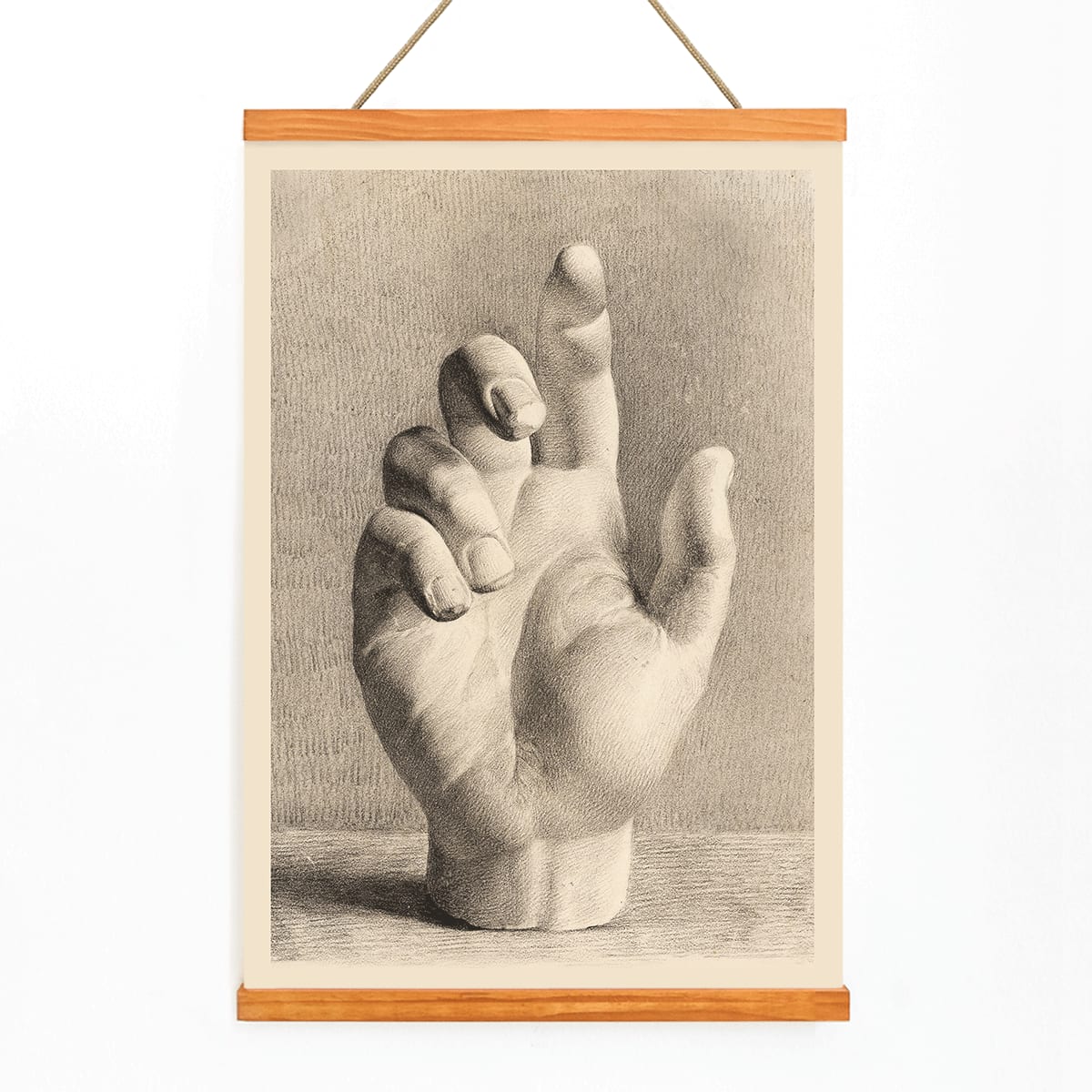
Plaster Hand is rooted in the academy tradition of studying casts to connect students with the aesthetics of antique sculpture and the principles of Neoclassicism. By focusing on a single hand, Dreyer transforms an ordinary gesture into a disciplined exploration of anatomy and movement, serving as both a technical exercise and a testament to the artist’s skill.
In early 19th-century studios, these studies were essential milestones, marking an artist’s readiness for more advanced work. Today, this drawing stands as a quiet homage to the rigors of classical training and the enduring value of foundational study, making it a meaningful addition to collections of academic art.
Style & Characteristics
The artwork features a detailed hand study rendered on a plain background, allowing the nuanced tonal modeling to take center stage. Subtle gradations of light and shadow give the form a lifelike presence, with particular attention to the contours and soft transitions at the edges.
The restrained palette—warm beige paper and deep black drawing lines—creates a serene, archival atmosphere. The overall effect is elegant and contemplative, harmonizing with beige wall art and black and white prints for those who appreciate understated, museum-quality décor.
In Interior Design
This art print is ideal for spaces that favor calm and focus, such as offices, libraries, hallways, or bedrooms where a subtle, reflective accent is desired. It complements Scandinavian and minimalist interiors, as well as traditional rooms with natural materials like wood and linen.
Pair it with soft neutrals or frame it in black for a crisp, gallery-inspired look. It appeals to artists, designers, and anyone who values the beauty of classical study in refined wall decor.