


You may also like
-
Chemistry of Combustion and Illumination Poster
Edward Livingston Youmans · 1856 · Classic flame diagram scientific print with labeled zones on aged paper
Poster from £9 · Framed from £16
Regular price From £6.00Regular price -
Diagram of Meteorology Poster
James Reynolds · 1846 · Detailed meteorology poster mapping winds and cloud forms in hand-colored diagrams
Poster from £9 · Framed from £16
Regular price From £6.00Regular price -
Descending Regions Poster
Levi Walter Yaggy · 1893 · Detailed scientific print mapping ocean depth zones with marine life in cool blues
Poster from £9 · Framed from £16
Regular price From £6.00Regular price -
Economical use of plants Poster
Marcius Willson · 1865 · Detailed botanical chart poster mapping practical plant uses in crisp labeled vignettes
Poster from £9 · Framed from £16
Regular price From £6.00Regular price


-

"Very nice Posters. The quality is amazing and we received it very quickly !"
-

"A shop to visit absolutely. Huge selection of posters. We spent more than an hour there !"
-

"Perfect to find gift. Price are very good. An they can frame and pack it on site"


About the Artist
Edward Livingston Youmans was an influential American science educator and writer, renowned for his ability to make scientific concepts accessible to a broad audience. In the mid-nineteenth century, he developed clear diagrams and teaching materials that bridged classroom instruction and the era’s expanding culture of public science lectures. As a science editor later in his career, Youmans played a pivotal role in shaping how generations engaged with modern biology and chemistry.
This educational approach is reflected in his vintage scientific prints, which aimed to make complex processes visible and understandable for learners of all ages.
The Artwork
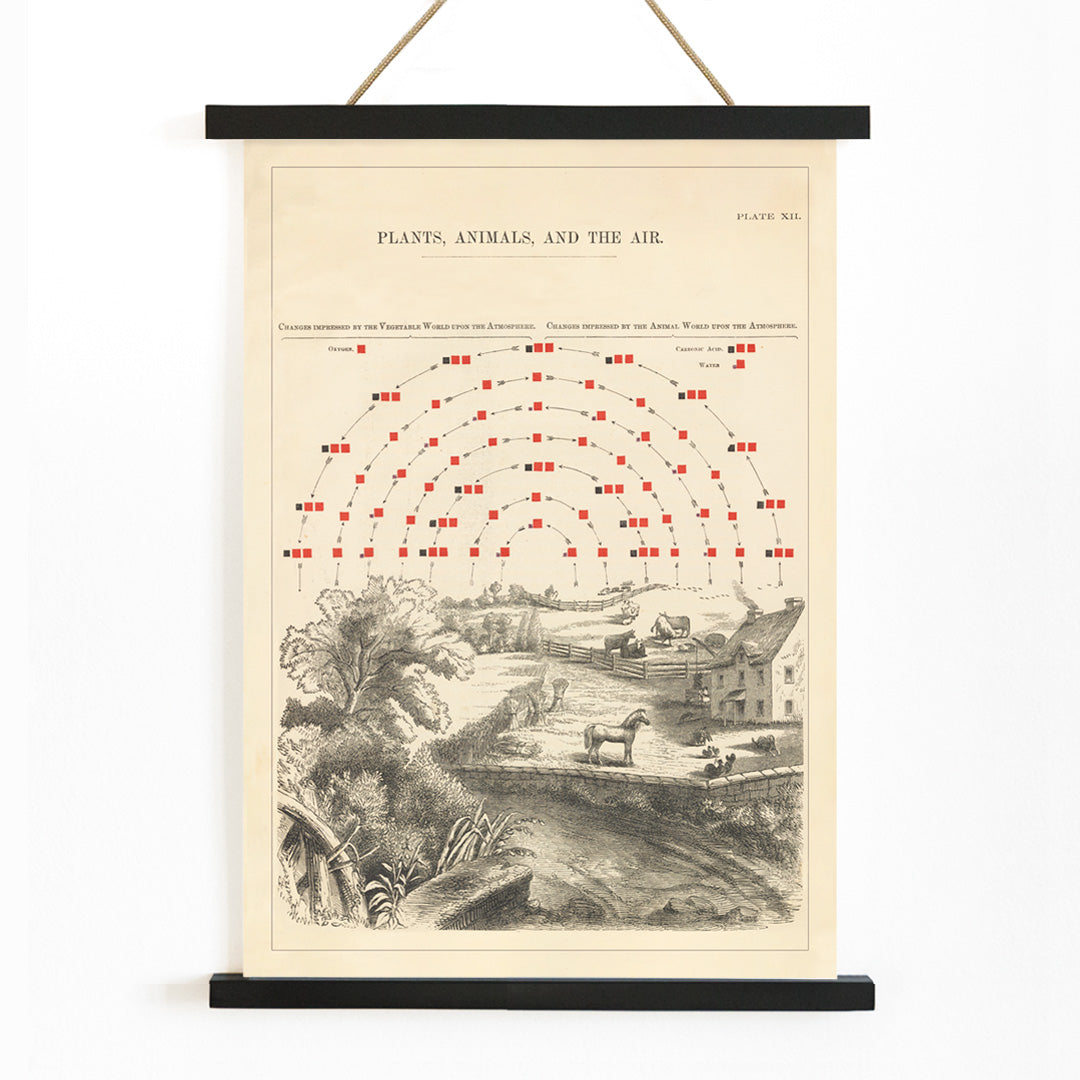
Plants, Animals, and the Air addresses a central nineteenth-century question: how do living organisms depend on the atmosphere, and how do they contribute to its renewal? Created during a period when physiology, botany, and chemistry were rapidly intersecting, this diagram was designed to help non-specialists grasp the essentials of respiration and plant growth. It exemplifies the era’s drive to visualize the cycles of nature and make scientific knowledge part of everyday understanding. For more historical science imagery, explore our science wall art collection.
Style & Characteristics
The print is structured like a classic teaching chart: meticulously organized, with labeled sections and directional lines that clarify the relationships between plants, animals, and the atmosphere. The fine black linework and precise typography create a logical flow, while subtle gray shading and restrained red highlights draw attention to key processes. The overall palette is black on warm off-white, giving the piece a timeless, analytical character. Discover more black and white posters and beige toned prints in our collection.
In Interior Design
This scientific print is well suited for home offices, libraries, hallways, or dining spaces where thoughtful conversation is welcome. Its orderly composition complements minimalist, Scandinavian, and modern classic interiors, adding a touch of intellectual curiosity to clean-lined spaces.
Pair it with natural wood accents, matte black frames, or light linen textiles to enhance its warmth. It also integrates beautifully into a nature-inspired gallery wall alongside botanical prints or animal art, making it a refined choice for science-minded homes.