


You may also like
-

Prunus Persica Poster
Amanda Almira Newton · 1911 · Delicate peach botanical print with ripening fruit and soft leaves on white ground
Poster from £9 · Framed from £16
-

Malus Domestica Poster
Amanda Almira Newton · 1908 · Refined apple botanical print with luminous red fruit and crisp leaves on white
Poster from £9 · Framed from £16
-

Malus Domestica Poster
Amanda Almira Newton · 1913 · Delicate apple botanical print with whole fruit, leafy stem, and a sliced cross section
Poster from £9 · Framed from £16
-

Persimmons Poster
Amanda Almira Newton · 1923 · Delicate botanical print of ripe persimmons on a leafy branch against clean white space
Poster from £9 · Framed from £16


-

"Very nice Posters. The quality is amazing and we received it very quickly !"
-

"A shop to visit absolutely. Huge selection of posters. We spent more than an hour there !"
-

"Perfect to find gift. Price are very good. An they can frame and pack it on site"


About the Artist
Amanda Almira Newton was a leading botanical illustrator of the early twentieth century, celebrated for watercolor studies that balance scientific accuracy with quiet beauty. Working in an era when pomology and agricultural research were rapidly expanding, she helped set a high standard for fruit illustration through careful observation and disciplined draftsmanship.
Collectors often seek her work for its blend of natural history and refined decorative art. For more from the same hand, explore the Amanda Almira Newton collection of vintage botanical wall art.
The Artwork
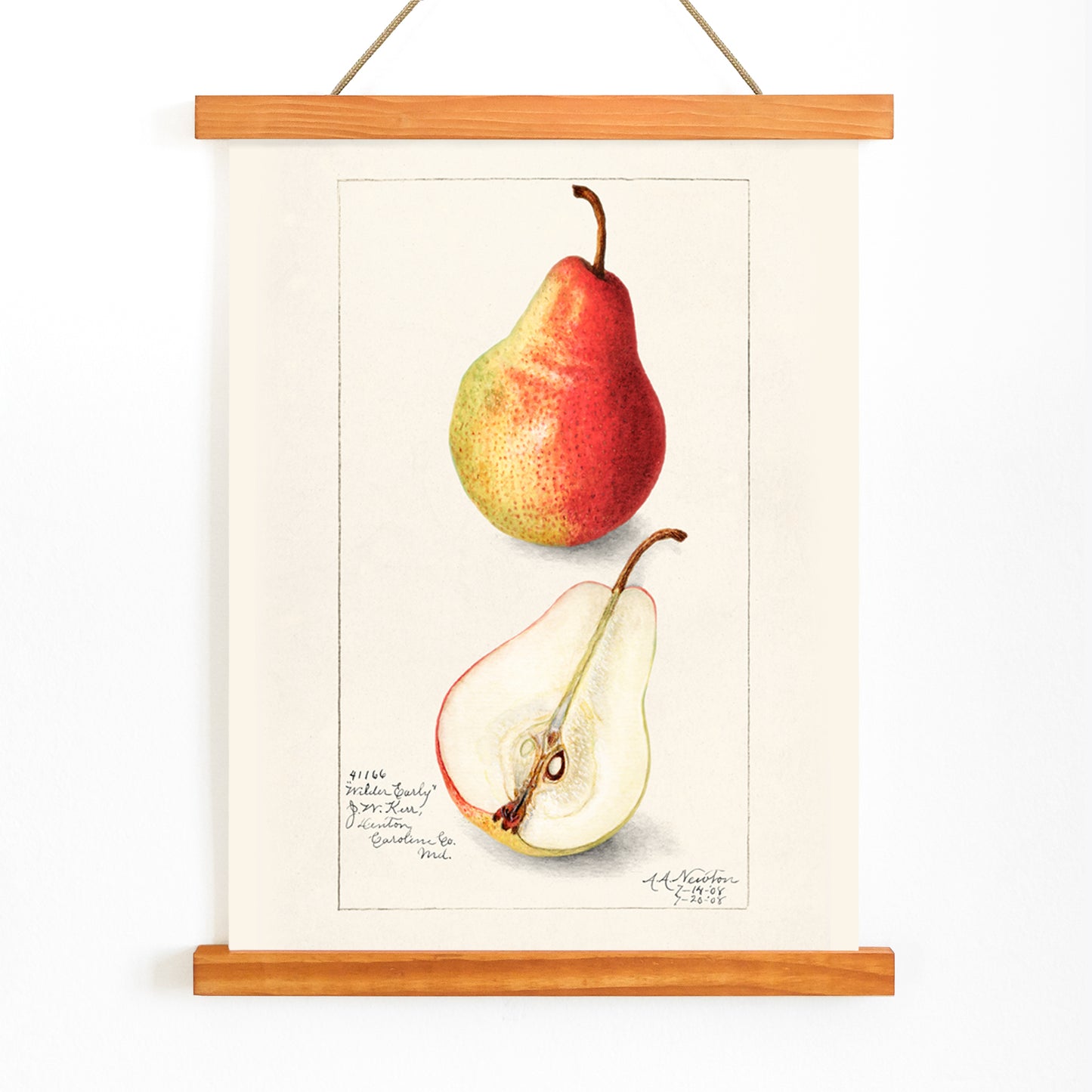
Pyrus Communis 2 belongs to the tradition of pomological plates, images created to record fruit varieties with clarity for growers, educators, and agricultural institutions. At the turn of the century, such illustrations functioned as visual evidence, supporting identification, comparison, and the preservation of cultivar knowledge before color photography became widespread.
Beyond documentation, the pear carries long associations with abundance, domestic comfort, and the pleasures of the table. As a vintage print, it bridges science and everyday life, turning a familiar orchard fruit into enduring wall decor with historical character.
Style & Characteristics
The composition focuses on a single pear study set against open, clean background space, giving the subject an almost specimen-like presence. Newton renders form through controlled watercolor gradations, with soft shadowing that models roundness and a crisp edge that keeps the image readable at a distance.
The palette sits in warm yellow tones with a gentle red blush and fresh green leaves, creating a calm, sunlit mood. This naturalistic style suits a classic botanical art print, poised between fine art print elegance and the precision of scientific illustration.
In Interior Design
This vintage pear poster feels at home in kitchens, dining rooms, and breakfast nooks, where food culture and still life imagery naturally belong. It also works in a hallway gallery wall when paired with other fruit or floral studies from the botanical prints collection.
For styling, it pairs beautifully with white walls, light oak, warm neutrals, and small accents of green or ochre. In contemporary interiors, it adds softness to minimalist cabinetry; in traditional homes, it complements antique frames and pantry-inspired kitchen wall art with understated charm.