


You may also like
-

Resilient Golf Club Head Patent Poster
L.A. Young · 1931 · Crisp vintage print of a resilient golf club head patent with annotated diagrams
Poster from £9 · Framed from £16
-

Golf Club Patent Poster
A.C. Fowler · 1909 · Detailed golf club patent vintage print with labeled diagrams and clean engineering lines
Poster from £9 · Framed from £16
-

Golf Ball Patent Poster
R.B. Cavanagh · 1902 · Precise golf ball patent poster with sectional diagrams and crisp black linework
Poster from £9 · Framed from £16
-

Shuttle Cock patent Poster
Robert Charles Booth · 1874 · Detailed shuttlecock patent poster with crisp diagrams on warm beige paper
Poster from £9 · Framed from £16


-

"Very nice Posters. The quality is amazing and we received it very quickly !"
-

"A shop to visit absolutely. Huge selection of posters. We spent more than an hour there !"
-

"Perfect to find gift. Price are very good. An they can frame and pack it on site"


About the Artist
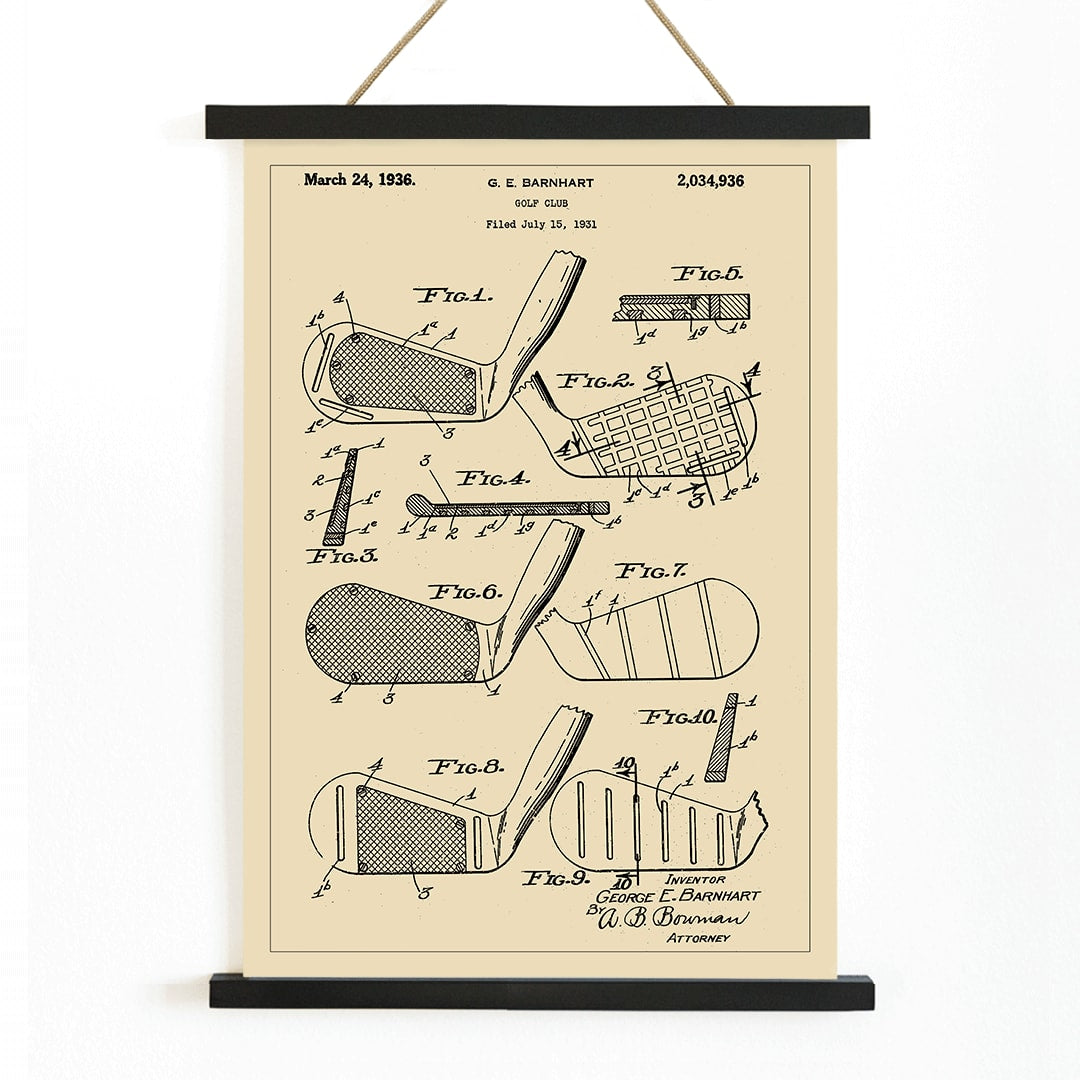
G.E. Barnhart is known for his inventive contributions to early twentieth-century American design, as documented by this 1931 patented golf club. Patent illustrators like Barnhart played a crucial role in visually communicating the mechanics of new inventions, ensuring clarity for examiners and manufacturers alike. His work reflects the era’s spirit of innovation, where advances in sport and industry were closely intertwined.
This type of technical drawing is especially appreciated by collectors interested in the intersection of engineering and visual art, and it aligns naturally with our science prints collection, where ingenuity and precision are celebrated.
The Artwork
This 1931 patent illustration captures a pivotal moment in golf history, when inventors sought to refine equipment for improved performance and comfort. The drawing serves as both a legal record and a testament to the ongoing evolution of sporting technology. Each figure on the sheet presents a different perspective of the golf club, emphasizing the importance of transparency and detail in the patent process. This artwork stands as a historical artifact, reflecting the optimism and technical curiosity of its time.
It offers a tangible link to the development of modern sports equipment, making it a meaningful addition for those interested in golf history or the broader narrative of American invention.
Style & Characteristics
The print features precise black linework and clearly labeled diagrams arranged on a warm beige background, characteristic of classic patent drawings. The composition is orderly, with measured spacing and minimal decorative elements, focusing attention on the technical details. Subtle typographic notations and figure labels enhance the archival authenticity and lend a sense of structure.
The overall aesthetic is minimalist and analytical, appealing to admirers of black-and-white wall art. This piece fits seamlessly with our black-white and beige selections, making it ideal for a cohesive, understated gallery wall.
In Interior Design
This vintage print is particularly suited for offices, studies, or libraries, where its technical detail can be appreciated up close. In living spaces, it introduces a refined graphic element that complements both modern and traditional decor. Paired with matte black or metal frames, it achieves a clean, sophisticated look.
Consider grouping it with other minimalist posters for a harmonious arrangement. It is a thoughtful choice for golf enthusiasts, engineers, or anyone drawn to the history of invention and design.