


You may also like
-

Seated nude with crossed legs I Poster
Henri Matisse · 1941 · Minimalist art print of a seated nude with crossed legs
Poster from £9 · Framed from £16
-

La Vasque Poster
George Barbier · 1914 · Elegant Art Deco bathing scene poster with cool blues and warm orange accents
Poster from £9 · Framed from £16
-

Caresse moi donc Poster
Auguste Rodin · 1882 · Intimate nude figure art print capturing a quiet caress in flowing lines
Poster from £9 · Framed from £16
-

Three Acrobats Poster
Arthur Bowen Davies · 1920 · Lithe circus figures in a black and white art print with rhythmic modernist line
Poster from £9 · Framed from £16


-

"Very nice Posters. The quality is amazing and we received it very quickly !"
-

"A shop to visit absolutely. Huge selection of posters. We spent more than an hour there !"
-

"Perfect to find gift. Price are very good. An they can frame and pack it on site"


About the Artist
Eric Gill was a British sculptor, draughtsman, and printmaker whose career bridged Arts and Crafts ideals with the emerging sensibilities of modernist design. Renowned for his mastery of carved letters, book illustration, and figure studies, Gill approached the human form with the same disciplined clarity that defined his work in typography and relief carving. By the early 1950s, his art reflected a synthesis of classical traditions and contemporary aesthetics, appealing to collectors interested in famous artists and classic art from the twentieth century.
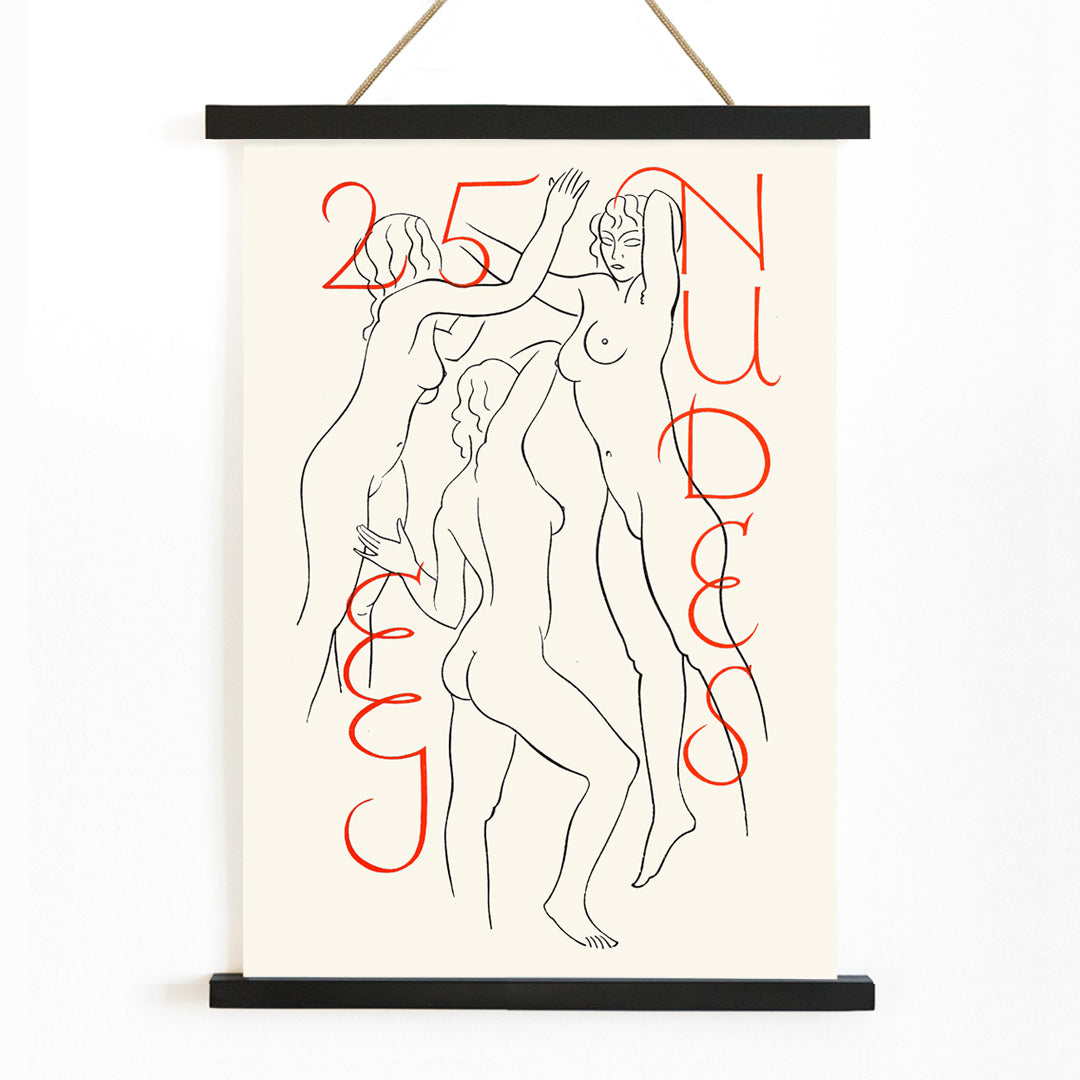
This 1951 composition demonstrates Gill’s ongoing exploration of the nude as a subject for both artistic inquiry and formal innovation. At a time when postwar artists were re-examining the fundamentals of proportion and presence, Gill’s work offered a contemplative study of the human figure, emphasizing both its universality and individuality.
The Artwork
Twenty-five nudes was conceived as a visual compendium of the human body, inviting viewers to observe subtle differences in pose, gesture, and balance across a series of studies. Rather than telling a single story, the sheet functions as a public page from the artist’s sketchbook, transforming private practice into a finished artwork. In the context of postwar Europe, such studies reflected a renewed interest in the enduring themes of dignity, vulnerability, and the expressive potential of the human form.
Rooted in the tradition of life drawing and figure compendiums, this work also resonates with the modernist impulse to distill complex subjects into essential forms. Its candid presentation aligns with the spirit of the erotic collection, yet it remains understated and analytical rather than theatrical.
Style & Characteristics
The composition is arranged as a precise grid featuring twenty-five small nude figures, each outlined in crisp black lines with minimal interior shading. The repetition of scale and format encourages close observation, drawing attention to nuanced shifts in posture and silhouette. The restrained palette, limited to black ink on pale paper, highlights the importance of line, negative space, and proportion.
The overall effect is contemplative and orderly, with a studio-like neutrality that appeals to admirers of black and white prints. Gill’s stylization leans toward modernist abstraction, simplifying anatomy into elegant arcs and defined shapes rather than detailed naturalism.
In Interior Design
This vintage nude figure poster lends a sense of calm structure to bedrooms, dressing areas, studios, or hallways, where its grid format acts as a subtle architectural element. In contemporary interiors, it pairs well with pale walls, matte black frames, and accents in earthy tones, echoing the print’s graphic restraint.
On a curated gallery wall, it complements minimalist line drawings, Bauhaus-inspired typography, and monochrome photography, contributing a sense of quiet sophistication. Ideal for those who appreciate figure drawing and modernist clarity, it brings a timeless, museum-study quality to any space.