


You may also like
-
Reclining Nude Poster
Isidore Pils · 1841 · Academic nude art print with soft graphite shading and quiet, intimate repose
Poster from £9 · Framed from £16
Regular price From £6.00Regular price -
Female Nude Poster
Carl Newman · 1917 · Expressive female nude art print with bold contour lines and warm color accents
Poster from £9 · Framed from £16
Regular price From £6.00Regular price -
Caresse moi donc Poster
Auguste Rodin · 1882 · Intimate nude figure art print capturing a quiet caress in flowing lines
Poster from £9 · Framed from £16
Regular price From £6.00Regular price -
Seated nude back view Poster
Egon Schiele · 1917 · A vintage poster art print of a seated nude in expressive contour lines
Poster from £9 · Framed from £16
Regular price From £6.00Regular price


-

"Very nice Posters. The quality is amazing and we received it very quickly !"
-

"A shop to visit absolutely. Huge selection of posters. We spent more than an hour there !"
-

"Perfect to find gift. Price are very good. An they can frame and pack it on site"


About the Artist
Laurits Tuxen was a Danish painter renowned for his association with the Skagen circle and his contributions to portraiture and grand historical scenes. Trained at the Royal Danish Academy and later in Paris under Léon Bonnat, Tuxen absorbed both the disciplined academic tradition and the observational rigor of French Naturalism.
His career bridged the worlds of Scandinavian light and French atelier methods, making his works appealing to admirers of famous artists. This figure study offers insight into the foundational exercises that shaped his approach to larger, more complex compositions.
The Artwork
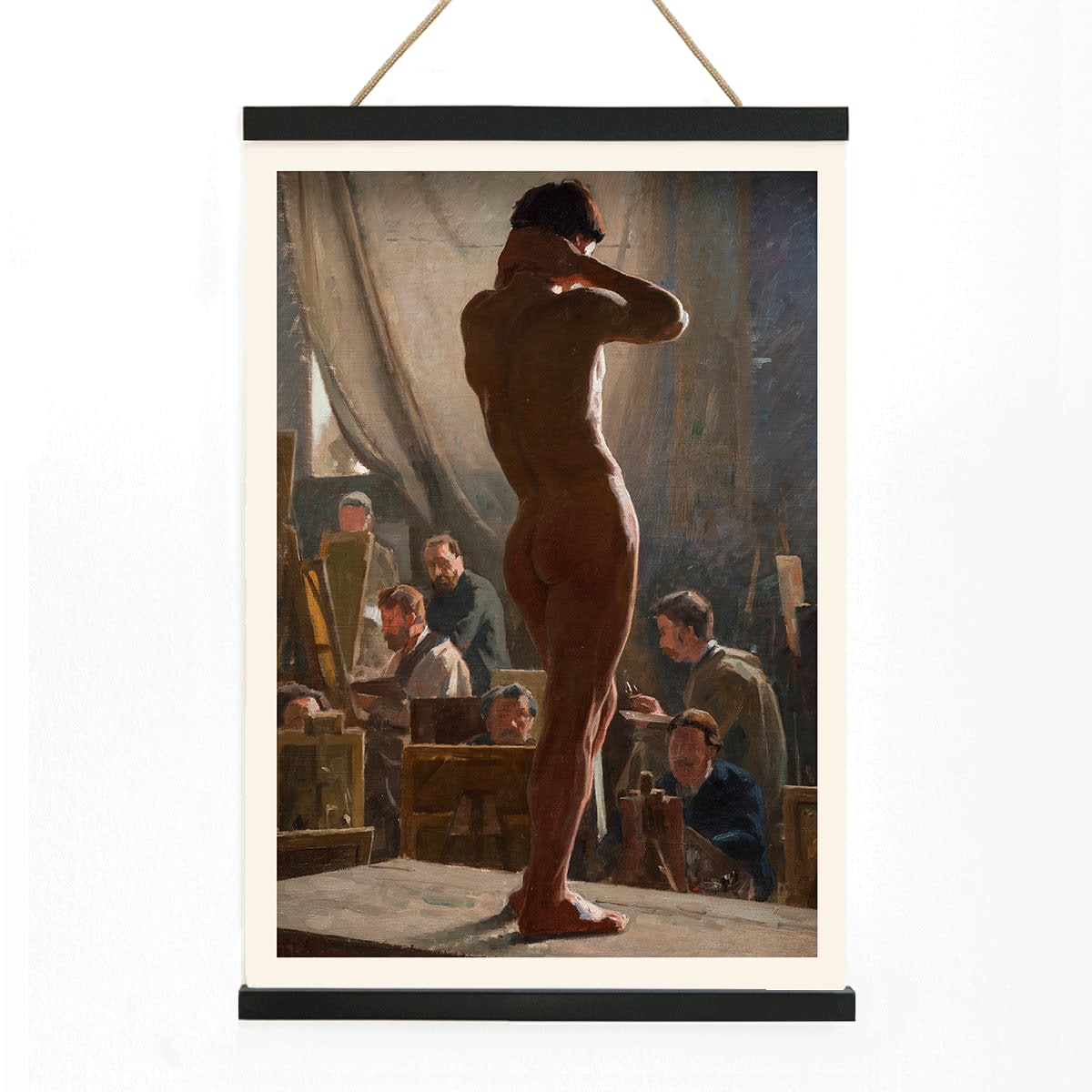
This 1899 study exemplifies the academic practice of working directly from the model, a cornerstone of late nineteenth-century art education. Such sessions were designed to hone the artist’s understanding of anatomy, proportion, and the effects of light on the human form. Within the Parisian studio environment, these exercises were vital for developing technical mastery and artistic sensitivity.
The work reflects a transitional period when academic traditions met the emerging realism of the modern era, capturing the quiet intensity of the artist’s engagement with the sitter. It stands as a document of the disciplined yet exploratory spirit that defined the era’s studio practice.
Style & Characteristics
The composition is intentionally simple, focusing on a single nude figure seated in profile against a neutral background. The palette is dominated by soft beiges and warm browns, with subtle blue-grey shadows lending depth and balance. The brushwork is economical and direct, emphasizing form and light rather than narrative detail.
This restrained approach creates a contemplative, almost meditative mood. The print’s understated elegance makes it a timeless example of classic art that brings a sense of calm and focus to any setting.
In Interior Design
This art print is well suited to spaces where tranquility and reflection are valued, such as studies, bedrooms, or reading nooks. Its muted tones pair harmoniously with natural materials like linen, wood, and ceramics, fitting seamlessly into modern, Japandi, or traditional interiors.
To enhance cohesion, consider echoing the artwork’s earthy hues in textiles or accessories, and select a frame from frames in natural wood or matte black for a refined finish.