


You may also like
-
Persimmons Poster
Amanda Almira Newton · 1923 · Delicate botanical print of ripe persimmons on a leafy branch against clean white space
Poster from £9 · Framed from £16
Regular price From £6.00Regular price -
Citrus nobilis Poster
Amanda Almira Newton · 1908 · Detailed mandarin botanical print with clean negative space and warm orange tones
Poster from £9 · Framed from £16
Regular price From £6.00Regular price -
Citrus paradisi Poster
Amanda Almira Newton · 1919 · Luminous grapefruit botanical print balancing scientific clarity with soft watercolor shading
Poster from £9 · Framed from £16
Regular price From £6.00Regular price -
Indian Tamarind Poster
Amanda Almira Newton · 1908 · Delicate tamarind botanical print featuring airy leaves and warm brown pods on cream
Poster from £9 · Framed from £16
Regular price From £6.00Regular price


-

"Very nice Posters. The quality is amazing and we received it very quickly !"
-

"A shop to visit absolutely. Huge selection of posters. We spent more than an hour there !"
-

"Perfect to find gift. Price are very good. An they can frame and pack it on site"


About the Artist
Amanda Almira Newton was a leading American botanical illustrator whose watercolors for the United States Department of Agriculture helped define scientific accuracy in early 20th century plant documentation. Her work sits at the intersection of art and agronomy, created to preserve cultivar knowledge with clarity that photography often could not match at the time.
Collectors value her images for their balance of precision and warmth, making this a vintage botanical print by Amanda Almira Newton as informative as it is decorative. Explore related works in the Amanda Almira Newton collection.
The Artwork
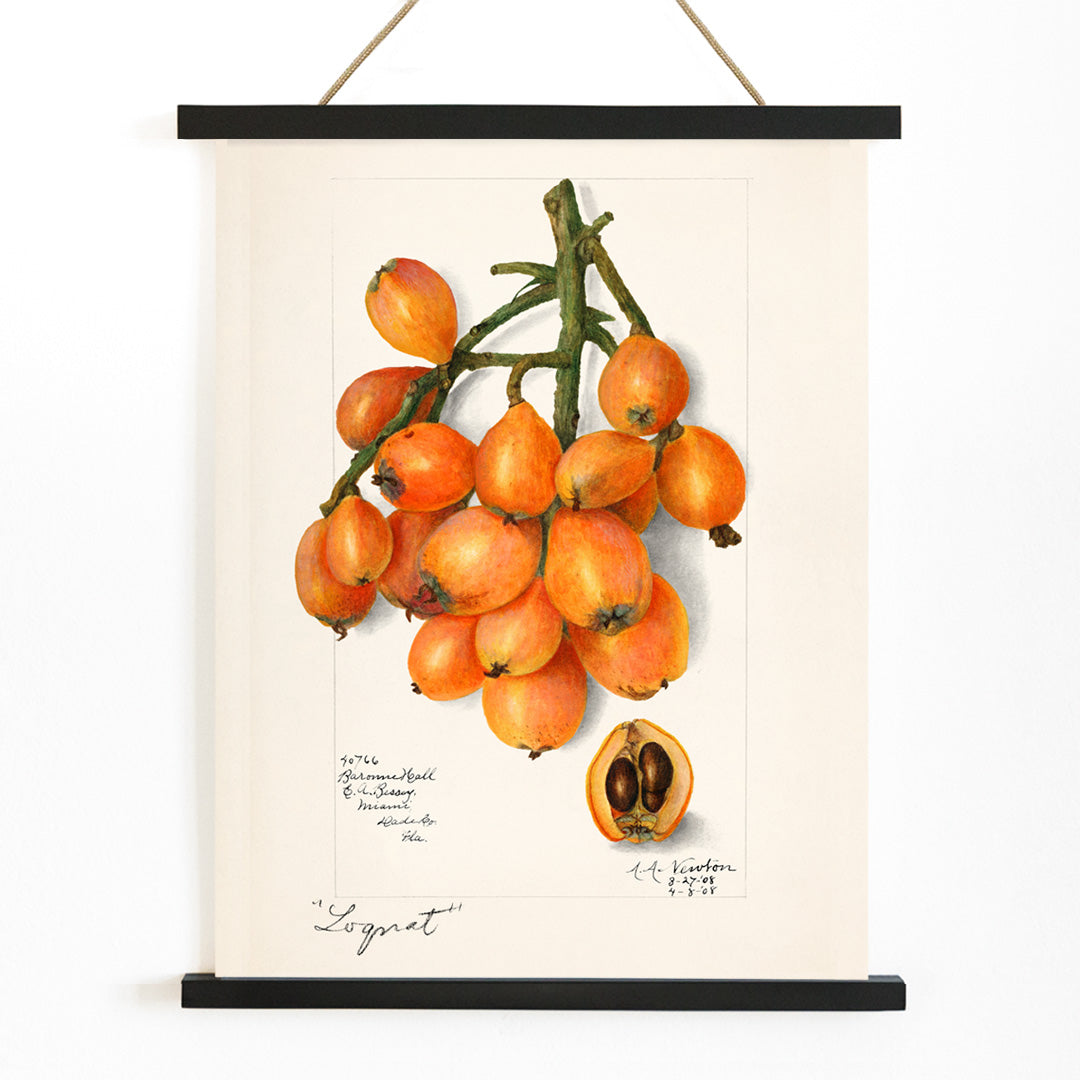
This depiction of loquats (Eriobotrya japonica) reflects a period when botanical illustration was essential for agricultural reference and scientific study. Created in 1908, Newton’s illustration served as a visual record for growers and researchers, supporting the identification and classification of fruit varieties as American orchards diversified and imported plants became more common.
The loquat, valued for its sweet, apricot-like fruit and evergreen foliage, is documented here to ensure accurate knowledge transfer and cultivar preservation. This artwork exemplifies the practical and educational role of botanical prints in early 20th-century horticulture. For more nature studies, see botanical prints and posters.
Style & Characteristics
This botanical print features a loquat branch with clusters of oval, golden-orange fruit and broad, textured leaves, all set against a clean white background. The composition is balanced and spacious, allowing each detail of the specimen to stand out clearly.
Newton’s use of watercolor creates soft transitions from pale yellow to rich orange on the fruit, while the leaves display subtle gradients of green with gentle shading. The overall effect is calm and sunlit, offering a refined example of natural history illustration. Discover more in kitchen wall art.
In Interior Design
With its warm fruit tones and crisp negative space, this loquat print is ideal for kitchens, dining rooms, breakfast nooks, or bright hallways. It complements modern farmhouse, Scandinavian, and classic interiors, where a single botanical image can anchor a small gallery wall.
Pair with white or cream walls, light oak, and accents in terracotta, sage, or brass for a seasonal lift. A simple mat and natural wood frame enhance its archival feel, making it an elegant vintage botanical print for kitchen styling.