


You may also like
-
An aquarian exposition in White Lake Poster
Unknown artist · 1969 · Iconic dove-on-guitar Woodstock poster in bold red with retro festival typography
Poster from £9 · Framed from £16
Regular price From £6.00Regular price -
Randy Brecker Quintet Poster
U.S. Information Agency · 1987 · Graphic jazz poster featuring silhouetted musicians on a bold purple background with green accents
Poster from £9 · Framed from £16
Regular price From £6.00Regular price -
The Kinks at Honolulu Poster
Unknown artist · 1965 · Bold red and yellow concert poster for The Kinks live in Honolulu
Poster from £9 · Framed from £16
Regular price From £6.00Regular price -
Max Bill Poster
Max Bill · 1974 · Geometric abstract poster with interlocking forms in vivid red, orange, green, and purple
Poster from £9 · Framed from £16
Regular price From £6.00Regular price


-

"Very nice Posters. The quality is amazing and we received it very quickly !"
-

"A shop to visit absolutely. Huge selection of posters. We spent more than an hour there !"
-

"Perfect to find gift. Price are very good. An they can frame and pack it on site"


About the Artist
Wes Wilson was a pioneering designer in the San Francisco psychedelic poster movement, transforming concert advertising into a form of collectible graphic art. During the vibrant 1960s rock era, Wilson became known for his innovative use of lettering, which he treated as a dynamic element, infusing words with rhythm and visual energy.
His work bridges the ornate curves of Art Nouveau and the immediacy of mid-century screenprinting, helping to define the visual language of the era’s rock posters. Wilson’s legacy continues to influence poster design and is celebrated among famous artist posters collectors.
The Artwork
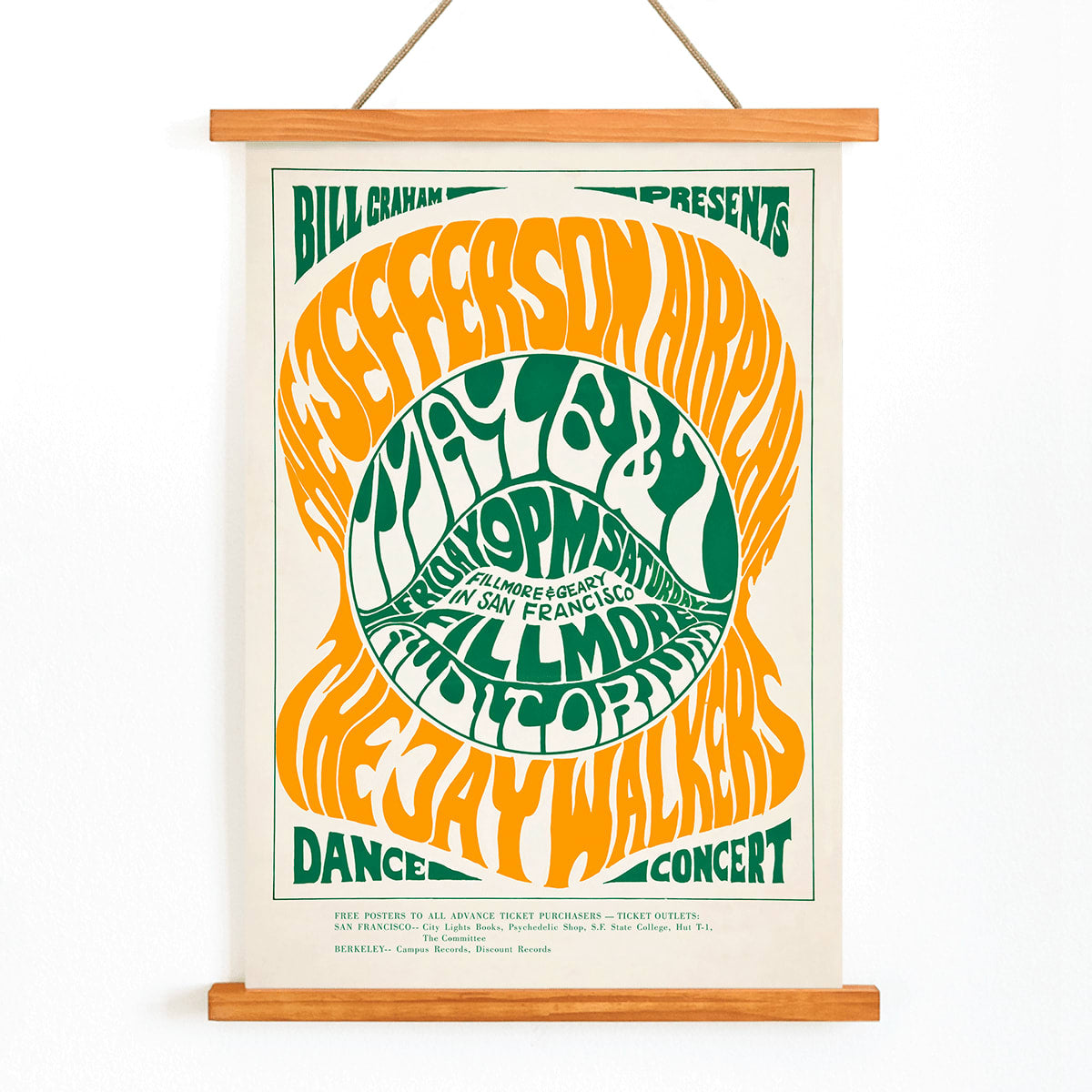
Created in 1966, this Jefferson Airplane poster emerged at a time when concert posters were more than advertisements—they were emblems of a growing counterculture. These posters served as invitations to events where music, art, and social change converged, and were often displayed as badges of identity within the community.
By featuring Jefferson Airplane, one of the most influential bands of the period, Wilson’s design captures the spirit of San Francisco’s rock scene. The poster stands as a cultural artifact, preserving the energy of live music and the ethos of the 1960s for future generations.
Style & Characteristics
This vintage poster is defined by its swirling, interlocking typography that fills the composition, creating a hypnotic visual rhythm. The color palette is bold and high-contrast, with vivid green and orange tones set against lighter spaces, producing a vibrant, almost pulsating effect.
The flat areas of color and strong outlines evoke the look of screenprinting, while the dense lettering makes deciphering the text part of the visual experience. The overall mood is electric and immersive, making it a quintessential example of psychedelic graphic design. Explore more in music posters.
In Interior Design
This Jefferson Airplane poster brings dynamic energy to listening rooms, studios, hallways, or living spaces where bold graphic art can make a statement. Its vivid hues pair well with neutral walls, warm wood, and black accents, allowing the colors to stand out without overwhelming the space.
As part of a gallery wall, it complements other mid-century and counterculture artworks, serving as a striking typographic centerpiece. It is especially suited for collectors interested in vintage concert posters and pairs well with selections from vertical posters and orange tone artworks.