


You may also like
-

Harp Patent Poster
G.B. Durkee · 1890 · Crisp harp vintage print featuring precise patent diagrams and elegant archival typography
Poster from £9 · Framed from £16
-

Musical Instrument Patent Poster
H. Ernst · 1916 · Intricate guitar patent print with precise diagrams and numbered callouts on warm beige
Poster from £9 · Framed from £16
-

Golf Club Patent Poster
A.C. Fowler · 1909 · Detailed golf club patent vintage print with labeled diagrams and clean engineering lines
Poster from £9 · Framed from £16
-

Corkscrew Patent Poster
T.M. Strait · 1883 · Detailed corkscrew patent vintage print with multiple technical views and annotations
Poster from £9 · Framed from £16


-

"Very nice Posters. The quality is amazing and we received it very quickly !"
-

"A shop to visit absolutely. Huge selection of posters. We spent more than an hour there !"
-

"Perfect to find gift. Price are very good. An they can frame and pack it on site"


About the Artist
D. Julliot is credited as the draughtsman behind this late 19th-century patent plate, reflecting the era’s dedication to technical innovation and industrial progress. During this period, inventors and engineers relied on detailed visual documentation to secure patents, ensuring their mechanical designs were clearly understood and protected. Julliot’s work exemplifies the intersection of artistry and engineering, where precision drawing became a vital part of the creative process.
Rather than focusing on personal expression, Julliot’s approach highlights the importance of clarity and functionality, capturing the spirit of invention that defined the age. The resulting images serve as both legal records and enduring tributes to the ingenuity of their creators.
The Artwork
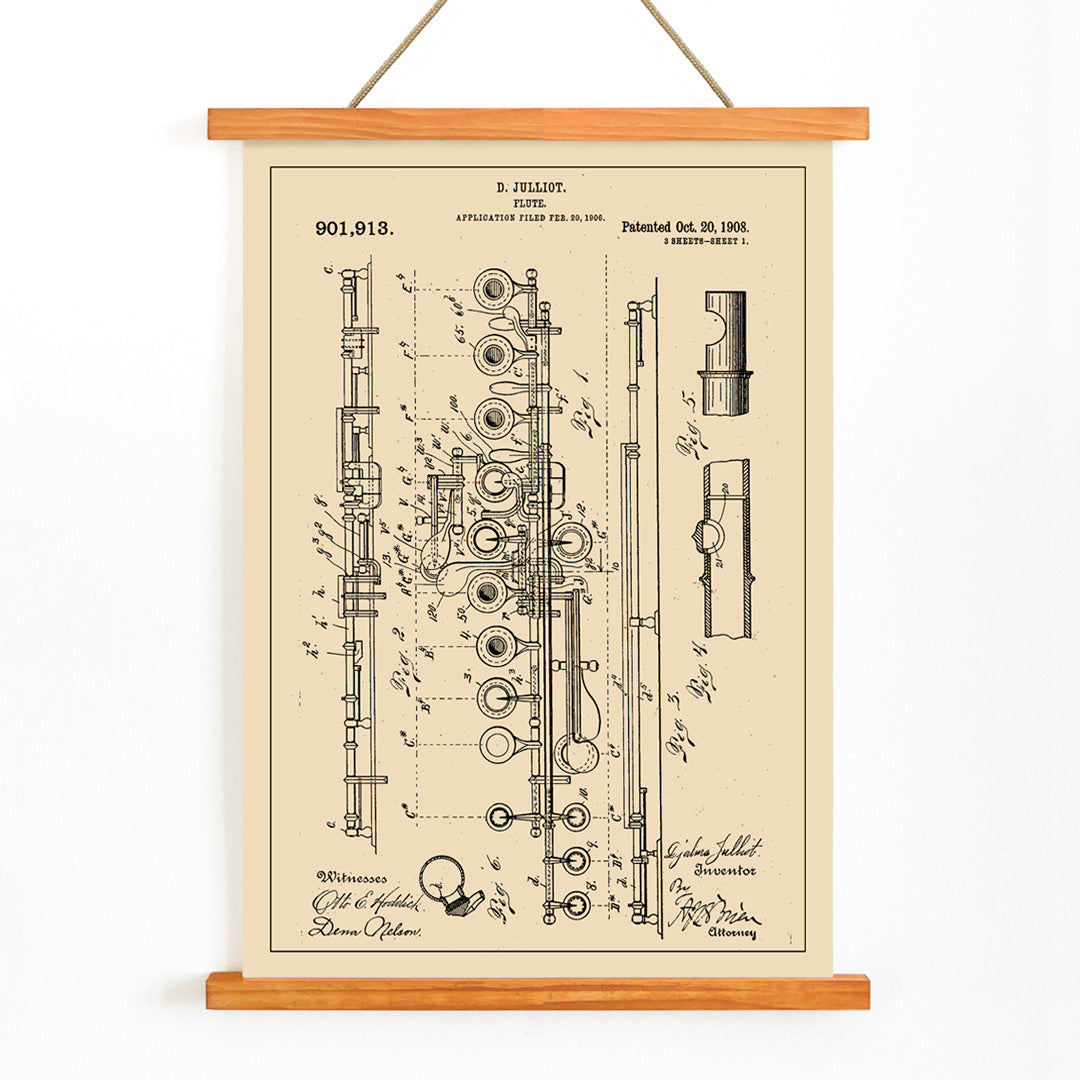
This flute patent print documents a specific moment in the evolution of musical instrument design. Patent drawings like this one were essential for illustrating how new mechanisms improved performance, playability, or manufacturing. For flutes, such innovations often involved refinements to keywork, joints, or internal structure, all meticulously depicted to demonstrate their significance.
Today, this archival sheet stands as a testament to the collaborative relationship between music and technology. It bridges the worlds of workshop and concert hall, making it a natural companion to music wall art and a thoughtful addition to collections celebrating craftsmanship and scientific progress, such as science-inspired wall decor.
Style & Characteristics
The print features crisp black linework on softly aged beige paper, presenting multiple schematic views of the flute in a balanced, orderly arrangement. Numbered labels, precise contours, and technical lettering create a sense of disciplined rhythm, transforming functional information into visual harmony.
The overall mood is contemplative and quietly nostalgic, reminiscent of a page from an inventor’s archive. This black-and-beige technical illustration appeals to those who appreciate the graphic clarity of black and white prints and the understated elegance of vintage industrial design.
In Interior Design
This vintage print lends a refined, intellectual touch to music rooms, studios, or home offices, where its diagrams inspire curiosity without overwhelming the space. Its neutral palette pairs effortlessly with wood, brass, or leather accents, fitting seamlessly into both minimalist and industrial interiors.
Displayed in a matte black or light oak frame, it offers subtle detail up close while reading as clean geometry from afar, making it ideal for a curated gallery wall focused on music, invention, and design heritage.