


You may also like
-
Red floral pattern Poster
Owen Jones · 1912 · Ornamental floral poster with white blossoms and scrolling vines on deep red
Poster from £9 · Framed from £16
Regular price From £6.00Regular price -
Green Botanical pattern Poster
Owen Jones · 1867 · Victorian botanical print with rhythmic green foliage and bright floral accents
Poster from £9 · Framed from £16
Regular price From £6.00Regular price -
Colorful flower pattern Poster
Owen Jones · 1867 · Vibrant floral poster with rhythmic Victorian ornament and crisp, repeating symmetry
Poster from £9 · Framed from £16
Regular price From £6.00Regular price -
Chinese botanical illustration Poster
Owen Jones · 1897 · Decorative Chinese botanical print with stylized blossoms and balanced ornamental symmetry
Poster from £9 · Framed from £16
Regular price From £6.00Regular price


-

"Very nice Posters. The quality is amazing and we received it very quickly !"
-

"A shop to visit absolutely. Huge selection of posters. We spent more than an hour there !"
-

"Perfect to find gift. Price are very good. An they can frame and pack it on site"


About the Artist
Owen Jones was a pioneering British architect, designer, and theorist whose research into global ornament transformed nineteenth-century decorative arts. His influential work, The Grammar of Ornament, codified principles of structure, geometry, and color that shaped generations of designers. Jones’s legacy continued well into the twentieth century, as his motifs and theories were adapted in later publications and design education.
This 1912 plate demonstrates the ongoing relevance of Jones’s decorative vocabulary, reflecting a period when ornament was regarded as a vital language connecting craft, industry, and interiors. It stands as a testament to how historical pattern studies informed both teaching and practice in the decorative arts.
The Artwork
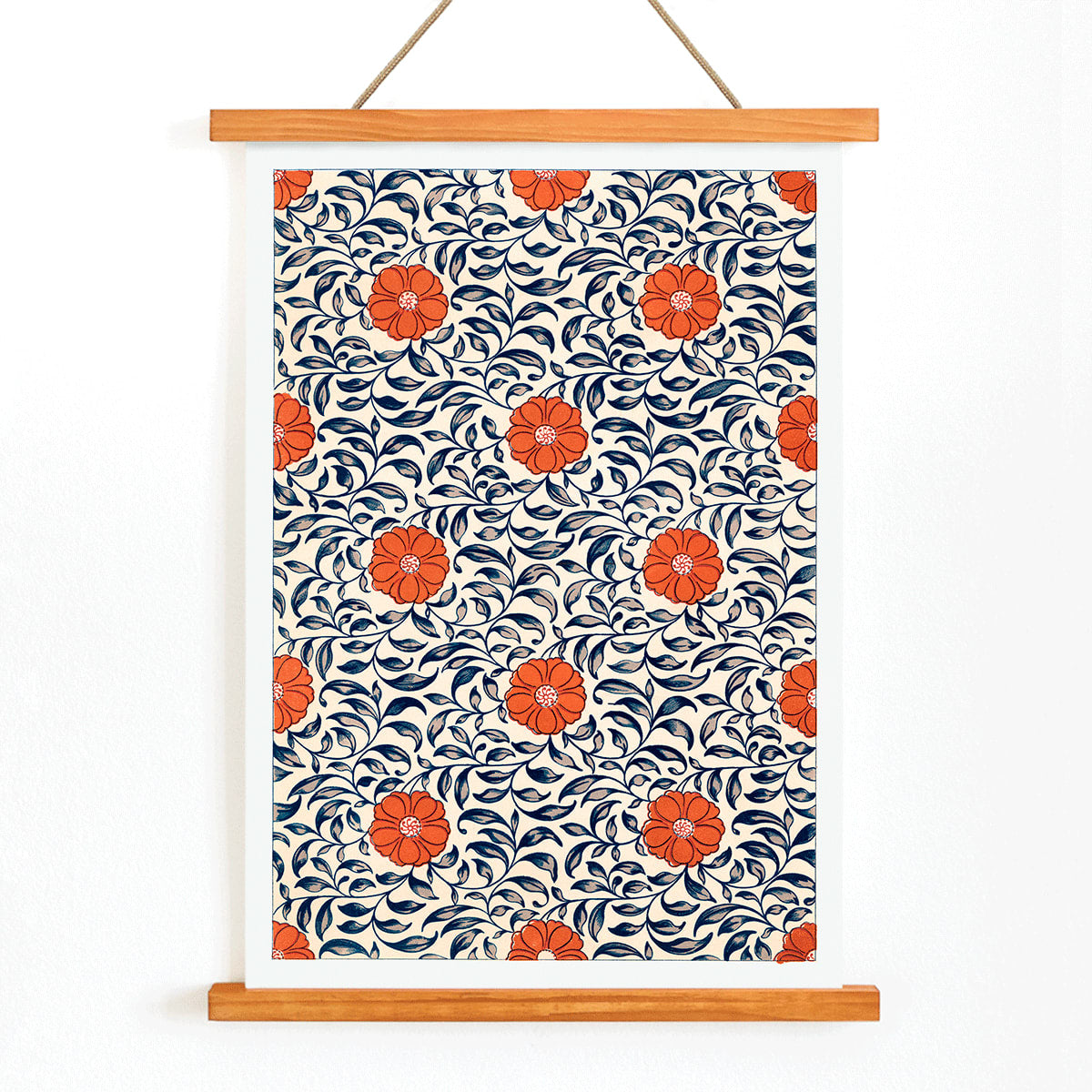
This floral pattern is part of the tradition of ornamental plates created for practical application in design. Pattern books like this circulated widely in studios and workshops, providing adaptable motifs for wallpapers, textiles, tiles, and architectural details. Such resources enabled designers to reinterpret historical and cross-cultural influences for contemporary use.
The design’s reference to Chinese ornament highlights the Western fascination with East Asian aesthetics, particularly the interplay of stylized and natural forms. As a vintage decorative plate, it illustrates how global visual research enriched the decorative arts and influenced interior design from the late Victorian era into the early twentieth century.
Style & Characteristics
The pattern features a repeating floral motif arranged with precise symmetry and ample white space, lending the composition an airy, balanced quality. Stylized red and blue blossoms and foliage interlock in a rhythmic, orderly fashion, emphasizing clarity and restraint over painterly expression.
The limited palette of white, red, and blue creates strong contrast and visual clarity, making the design both striking and versatile. The overall effect is refined and decorative, offering a timeless botanical print that bridges historic design with modern sensibilities.
In Interior Design
This artwork brings subtle energy to kitchens, dining rooms, entryways, or offices, where pattern enlivens the space without overwhelming it. It pairs beautifully with porcelain whites, indigo textiles, and red accents, and also complements warm woods and brass for a classic touch.
For a cohesive look, display it alongside other East Asian inspired wall decor or curate a gallery with botanical art prints. Its crisp palette also fits seamlessly into blue tone posters, making it a versatile choice for a range of interior styles.