


You may also like
-
Adiantum tenerum Poster
Anna Atkins · 1850 · Delicate cyanotype fern print with crisp white fronds on deep blue ground
Poster from £9 · Framed from £16
Regular price From £6.00Regular price -
Adiantum cuneatum Poster
Anna Atkins · 1850 · Prussian-blue cyanotype print featuring a delicate white fern with lace-like fronds
Poster from £9 · Framed from £16
Regular price From £6.00Regular price -
Ceylon Poster
Anna Atkins · 1850 · Luminous fern print in classic cyanotype blue with delicate white botanical silhouettes
Poster from £9 · Framed from £16
Regular price From £6.00Regular price -
Pteris rotundifolia Poster
Anna Atkins · 1850 · Luminous cyanotype botanical print of a fern frond with airy, lace-like detail
Poster from £9 · Framed from £16
Regular price From £6.00Regular price


-

"Very nice Posters. The quality is amazing and we received it very quickly !"
-

"A shop to visit absolutely. Huge selection of posters. We spent more than an hour there !"
-

"Perfect to find gift. Price are very good. An they can frame and pack it on site"


About the Artist
Anna Atkins was a pioneering British botanist and photographer who played a crucial role in the early history of photography. In the 1840s, she began using the cyanotype process, recently developed by John Herschel, to document botanical specimens with scientific precision. Atkins is widely recognized as the first person to publish a book illustrated with photographic images, merging her passion for botany with groundbreaking photographic techniques.
Her work bridged the worlds of science and art, providing an innovative way to record and share plant specimens. Collectors of early photography and vintage photo prints value Atkins for her clarity, subtlety, and the quiet innovation she brought to both fields.
The Artwork
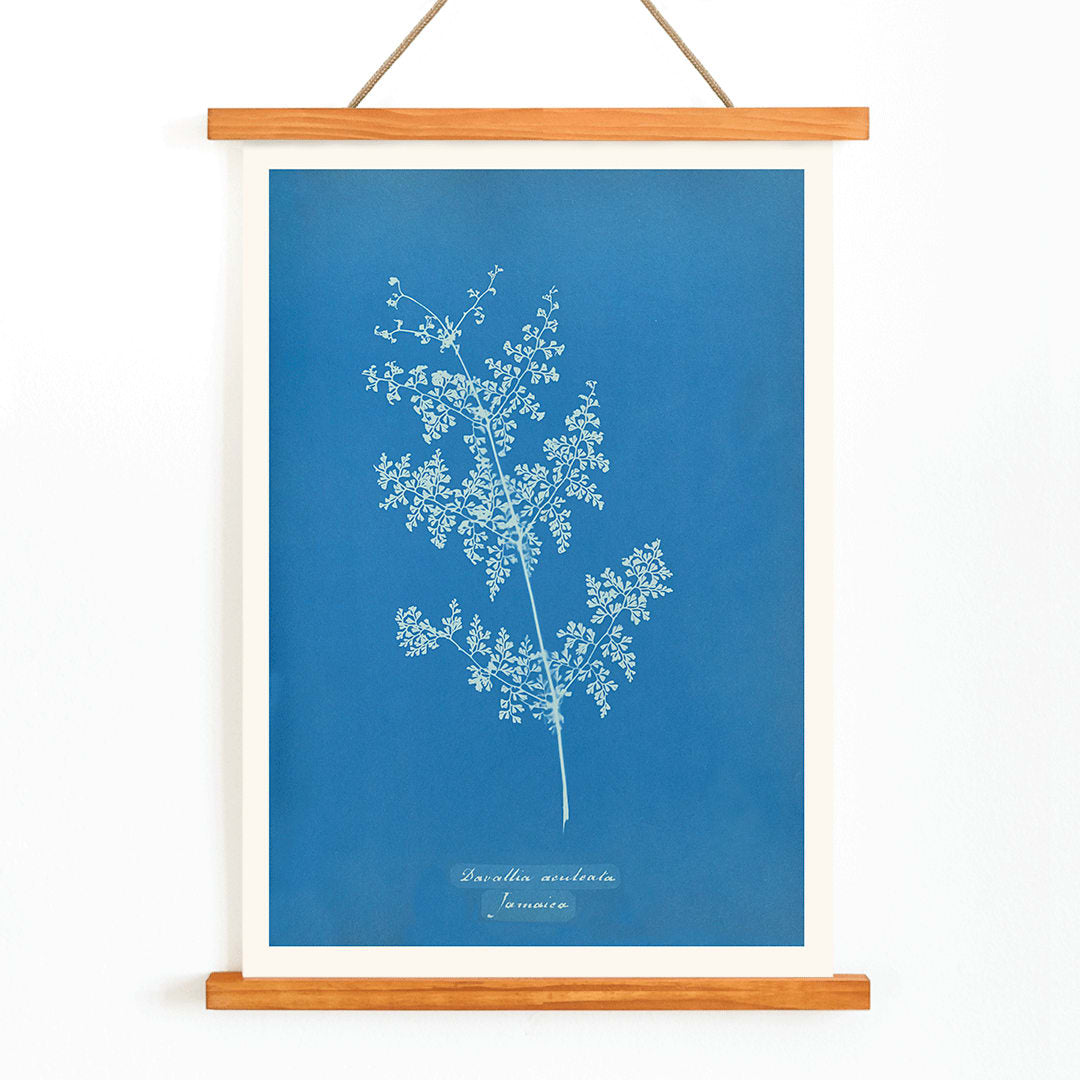
This cyanotype of Davallia aeuleata was created during the Victorian era, a time when the study and collection of ferns became a popular pursuit among scientists and amateurs alike. Atkins produced these images as part of her efforts to create a visual herbarium, enabling accurate identification and appreciation of plant forms without relying on hand-drawn illustrations.
The artwork reflects the Victorian fascination with cataloging the natural world and the desire to bring scientific discovery into the domestic sphere. As a vintage botanical print, it embodies the era’s blend of curiosity, scholarship, and aesthetic appreciation, connecting the viewer to a moment when science was both a personal and collective endeavor. For those interested in natural history, it resonates with the spirit found in scientific wall art.
Style & Characteristics
The image features a delicate fern frond rendered in luminous white against a rich, deep blue background, a hallmark of the cyanotype process. Each leaflet and branching stem is captured with crisp precision, revealing the intricate structure of the plant through negative space. The composition is centered with generous margins, creating a sense of calm and archival order.
The restrained palette of blue and white lends the print a serene, timeless quality. The overall effect is both modern and historic, making it a versatile choice for minimalist or nature-inspired interiors. The fine detail and clarity of the cyanotype technique give the artwork a quiet elegance that stands out in any collection.
In Interior Design
This cyanotype art print brings a tranquil, contemplative mood to spaces such as studies, bedrooms, or serene bathrooms. Its cool blue and white tones complement Scandinavian, coastal, and classic interiors, and it integrates beautifully into a gallery wall of nature-inspired art.
Pair it with white or light-toned walls, natural woods, and indigo accents for a cohesive look. For those seeking to expand their botanical collection, explore our botanical wall art and consider frames that highlight the print’s archival character.