


You may also like
-

Color Patchwork Poster
Paul Klee · 1914 · Playful abstract art print of patchwork squares balancing warm reds and cool blues
Poster from £9 · Framed from £16
-

Hammamet Poster
Paul Klee · 1914 · Radiant abstract art print evoking Hammamet with mosaic blocks of red, blue, yellow
Poster from £9 · Framed from £16
-

Park Near Lu Poster
Paul Klee · 1938 · Dreamlike abstract landscape art print with rhythmic blocks suggesting a quiet park
Poster from £9 · Framed from £16
-

Colorful Architecture Poster
Paul Klee · 1917 · Playful geometric architecture poster with bright blocks of blue, pink, and yellow
Poster from £9 · Framed from £16


-

"Very nice Posters. The quality is amazing and we received it very quickly !"
-

"A shop to visit absolutely. Huge selection of posters. We spent more than an hour there !"
-

"Perfect to find gift. Price are very good. An they can frame and pack it on site"


About the Artist
Paul Klee (1879–1940) was a Swiss German painter whose innovative approach bridged Expressionism, Cubism, and abstraction. Deeply influenced by his musical upbringing and time as a violinist, Klee often brought a sense of rhythm and harmony to his visual art. His teaching at the Bauhaus and his exploration of color theory made him a central figure in early twentieth-century modernism.
By 1919, Klee had developed a distinctive visual language, using geometric forms and symbolic motifs to express complex ideas. His work from this period reflects a search for new artistic order in the aftermath of World War I, resonating with collectors who appreciate both intellect and emotion in art.
The Artwork
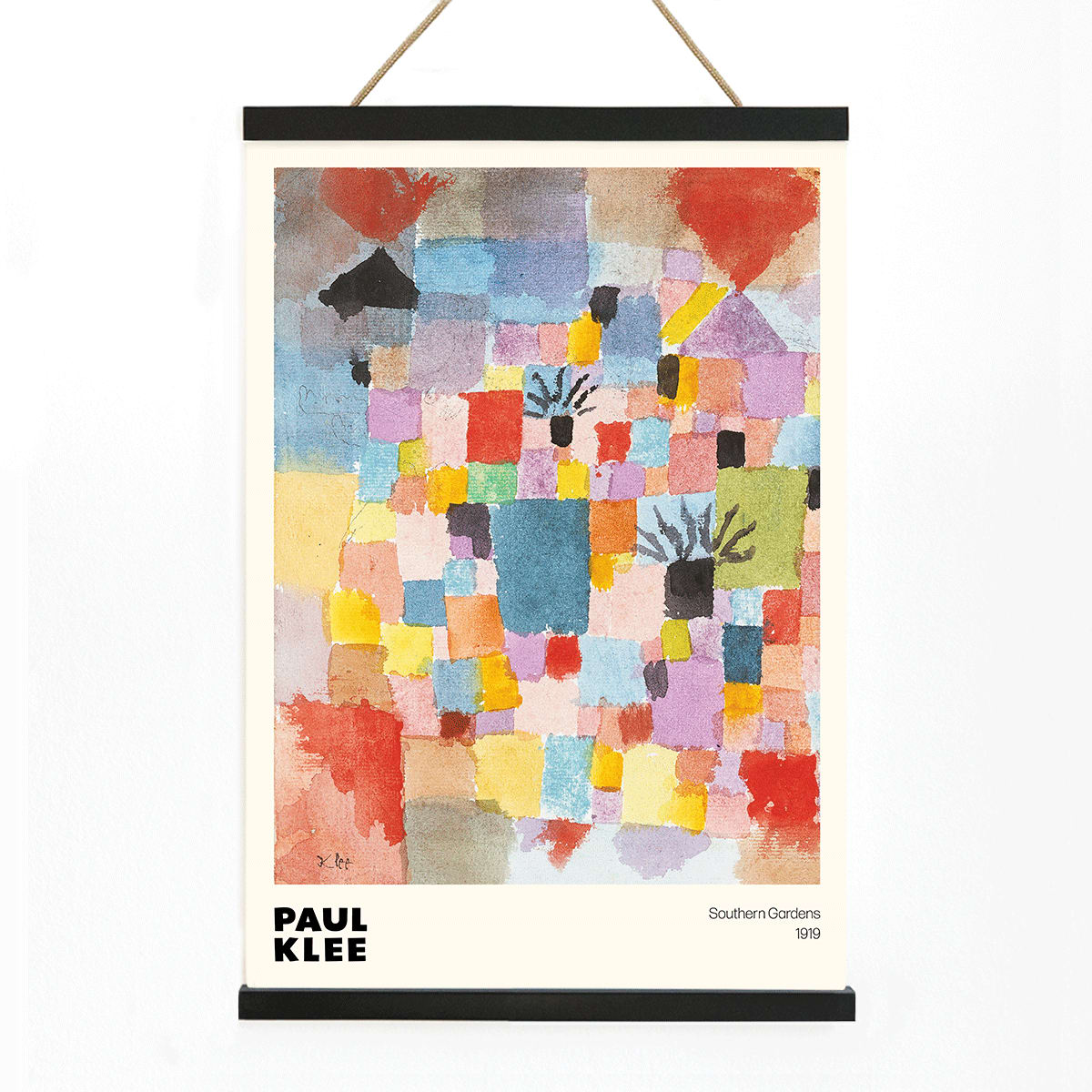
Southern Gardens, created in 1919, emerged during a time when artists across Europe were reimagining the possibilities of abstraction. The garden motif became a metaphor for regeneration and structure, offering a vision of hope and renewal after the turmoil of war. Rather than depicting a literal place, Klee’s work invites viewers into an imaginative landscape shaped by memory and musicality.
This piece exemplifies Klee’s fascination with the interplay between nature and constructed order, turning the idea of a garden into a poetic meditation on growth, pattern, and the inner world. It stands as a testament to the spirit of experimentation that defined the early Bauhaus years.
Style & Characteristics
The composition features a harmonious arrangement of geometric shapes—rectangles, squares, and lines—creating a rhythmic visual field. Vivid reds, blues, yellows, greens, and pinks are balanced by black accents, lending the work both vibrancy and structure. The interplay of bold color blocks and subtle transitions encourages the eye to move across the surface, much like following a musical score.
The overall mood is playful yet composed, embodying the clarity and inventiveness of Bauhaus-era abstraction. This abstract art print is well-suited for modern interiors and those drawn to design history and expressive color.
In Interior Design
This poster brings a lively yet refined presence to living rooms, studios, or offices, adding color without overwhelming the space. It pairs beautifully with light wood, matte black frames, and neutral textiles, and can enliven a palette of white, beige, or grey.
For a curated gallery wall, combine it with works from our abstract wall art or discover more in our Paul Klee posters. For those interested in design history, it also complements pieces from the Bauhaus collection.