


You may also like
-

Coffee Mill Patent Poster
C. Morgan · 1891 · Detailed coffee mill patent poster with crisp technical linework on warm beige
Poster from £9 · Framed from £16
-

Coffee-Pot Patent Poster
J.S. Stidham · 1889 · Detailed coffee pot patent vintage print with numbered diagrams and crisp technical linework
Poster from £9 · Framed from £16
-

Coffee Maker Patent Poster
F.E. Wolcott · 1934 · Technical coffee maker patent vintage print with crisp blueprint linework on warm beige
Poster from £9 · Framed from £16
-

Coffee Making Machine Patent Poster
G.R. Bunn · 1962 · Precise vintage print of a coffee making machine patent with schematic multi-view diagrams
Poster from £9 · Framed from £16


-

"Very nice Posters. The quality is amazing and we received it very quickly !"
-

"A shop to visit absolutely. Huge selection of posters. We spent more than an hour there !"
-

"Perfect to find gift. Price are very good. An they can frame and pack it on site"


About the Artist
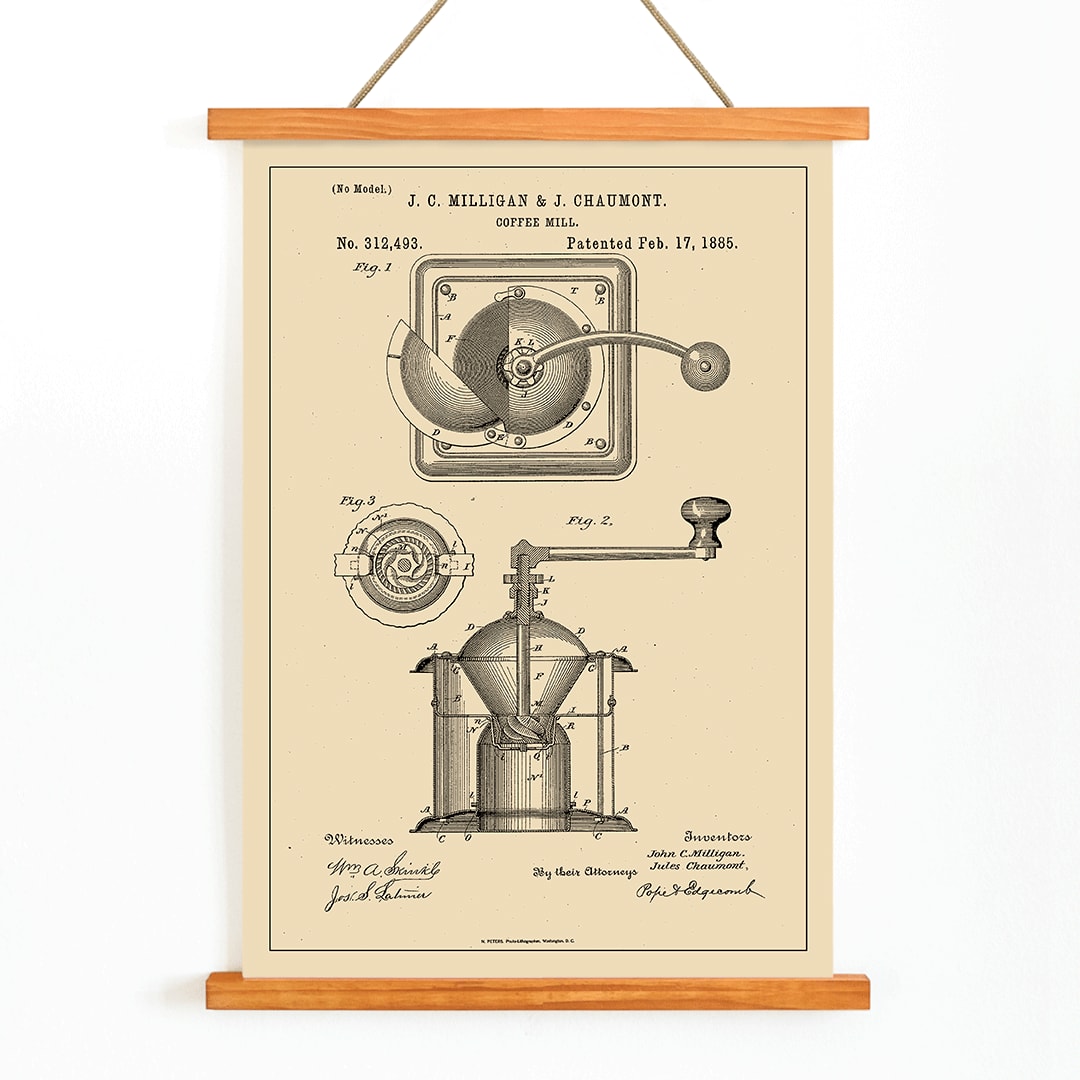
J.C. Milligan is credited on this 1885 patent sheet, representing the skilled technical draftsmen who transformed inventive ideas into precise visual documentation. During a period of rapid industrial growth, such draftsmen played a crucial role in making complex mechanisms understandable to both patent examiners and the public.
Milligan’s contribution lies in his technical accuracy rather than personal artistic flair, ensuring that the design could be faithfully reproduced and legally protected. Today, this patent sheet stands as a testament to the intersection of engineering, design history, and the rituals of daily life, especially the enduring culture of coffee.
The Artwork
This Coffee Mill Patent captures a pivotal moment in domestic innovation, when household tools were being refined for efficiency and reliability. Patent drawings like this one served as official records, safeguarding inventors’ rights while reflecting broader trends in kitchen technology during the late nineteenth century.
Beyond its legal function, the sheet narrates the evolution of coffee as a modern habit, shaped by tools that standardized grinding and enhanced flavor control. Positioned at the crossroads of culinary tradition and the world of scientific and technical prints, it documents how everyday rituals were transformed by mechanical ingenuity.
Style & Characteristics
The artwork features crisp black linework on a warm beige background, arranged in clear, diagrammatic views for easy comparison. Fine outlines, measured curves, and precise labels create a disciplined, instructional rhythm that is both functional and visually appealing.
Generous negative space allows the mechanism to stand out, guiding the viewer’s eye across each component. The overall mood is methodical and quietly nostalgic, making it an ideal example of black-and-beige wall art for admirers of industrial-era craftsmanship and black and white decor.
In Interior Design
This vintage print is well suited for coffee corners, kitchens, or dining spaces, where it brings historical depth without overwhelming the room. It pairs beautifully with matte black frames, light oak, or stainless steel, offering a subtle anchor for a gallery wall in a contemporary kitchen.
For a cohesive look, combine it with other kitchen wall art or integrate it into a display of typography and photography for a curated, café-inspired atmosphere. Its restrained palette also complements minimalist and industrial interiors, making it a versatile choice for design-conscious homes.