


You may also like
-

Nude Woman Poster
Carl Newman · 1930 · Expressive black and white nude figure art print with bold charcoal contours
Poster from £9 · Framed from £16
-

Caresse moi donc Poster
Auguste Rodin · 1882 · Intimate nude figure art print capturing a quiet caress in flowing lines
Poster from £9 · Framed from £16
-

Seated nude back view Poster
Egon Schiele · 1917 · A vintage poster art print of a seated nude in expressive contour lines
Poster from £9 · Framed from £16
-

Two figures Poster
Auguste Rodin · 1905 · Intimate figure study poster with fluid linework on warm beige paper
Poster from £9 · Framed from £16


-

"Very nice Posters. The quality is amazing and we received it very quickly !"
-

"A shop to visit absolutely. Huge selection of posters. We spent more than an hour there !"
-

"Perfect to find gift. Price are very good. An they can frame and pack it on site"


About the Artist
Carl Newman is credited with this 1917 figure study, created during a period when artists were redefining the nude as a subject of personal and psychological exploration. While little is known about Newman’s biography, his work aligns with early 20th-century trends that favored expressive line and emotional immediacy over academic tradition.
Emerging at a time of social and artistic transformation, Newman’s approach reflects the modernist search for authenticity and directness in art. His figure studies resonate with those interested in the evolution of figurative representation during a pivotal era in European art.
The Artwork
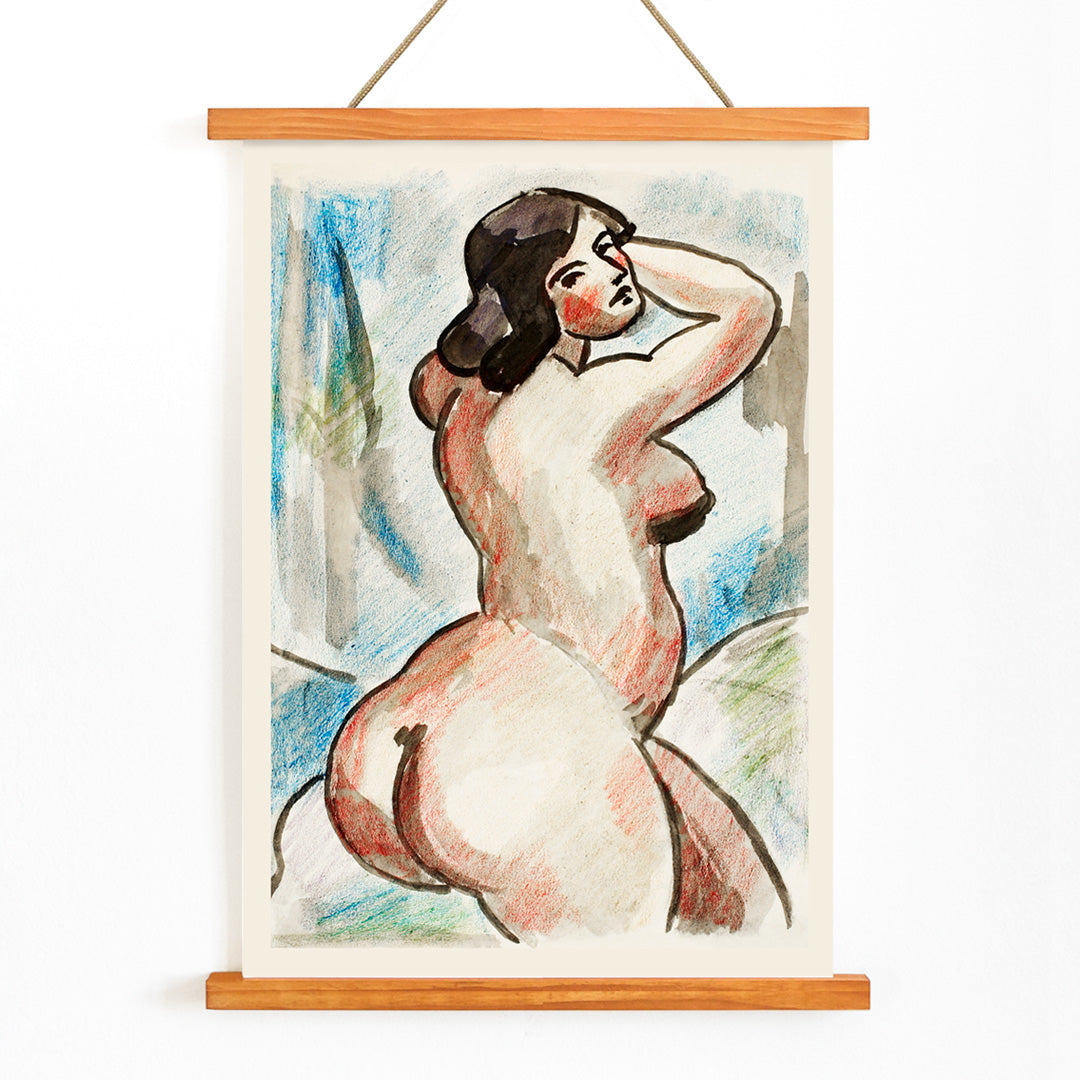
Female Nude is rooted in the tradition of life drawing, serving as both a study of human form and an intimate reflection on presence and vulnerability. Created in 1917, amid the upheaval of World War I, the work embodies a turn toward introspection, as artists sought meaning in the enduring qualities of the human body.
This piece avoids mythological or allegorical themes, instead presenting a straightforward encounter with the model. Its contemplative mood makes it a natural fit for the erotic collection and complements the refined sensibility of classic art prints.
Style & Characteristics
The composition features a single nude figure set against a spacious, unadorned background. Strong, assured contour lines define the pose, while selective areas of color—primarily warm reds and subtle blues—add volume and emphasis without resorting to full realism.
The visible brushwork and simplified anatomy evoke an Expressionist influence, blending observation with emotional resonance. The result is an art print that feels both intimate and graphic, appealing to those who appreciate early modernist figure studies.
In Interior Design
This female nude art print is well suited to bedrooms, studios, or gallery walls where a contemplative atmosphere is desired. Its open composition and clear outlines allow it to harmonize with minimalist or modern interiors, as well as more eclectic spaces.
Consider framing it in black or natural wood, and echoing its accent colors with a red textile, blue ceramic, or green plant. For those who enjoy expressive linework, it pairs beautifully with selections from the Egon Schiele drawings collection.