


You may also like
-

Physical map of the World Poster
James Reynolds · 1850 · Detailed world physical map vintage print with shaded relief and crisp place names
Poster from £9 · Framed from £16
-

Mountains Poster
James Reynolds · 1851 · Educational mountain-height vintage print combining labeled silhouettes into a dramatic panorama
Poster from £9 · Framed from £16
-

Rivers and Lakes Poster
James Reynolds · 1851 · Panoramic rivers and lakes comparison poster blending cartography with early infographic clarity
Poster from £9 · Framed from £16
-

Volcanoes and Earthquakes Poster
James Reynolds · 1849 · Detailed world map vintage print charting volcanic belts and earthquake zones
Poster from £9 · Framed from £16


-

"Very nice Posters. The quality is amazing and we received it very quickly !"
-

"A shop to visit absolutely. Huge selection of posters. We spent more than an hour there !"
-

"Perfect to find gift. Price are very good. An they can frame and pack it on site"


About the Artist
James Reynolds was a prominent mid-nineteenth century illustrator known for his detailed educational wall charts and reference prints. Working during a time when visual aids were essential for learning, Reynolds specialized in translating complex subjects—such as architecture—into accessible formats for a broad audience. His works often bridged the gap between scientific accuracy and public curiosity, making global knowledge available in the home.
Reynolds’s prints are part of a wider tradition of nineteenth-century classic art that valued clarity and precision. His approach reflects the era’s fascination with cataloguing and comparing the achievements of different cultures, a theme that resonates with collectors of vintage educational imagery.
The Artwork
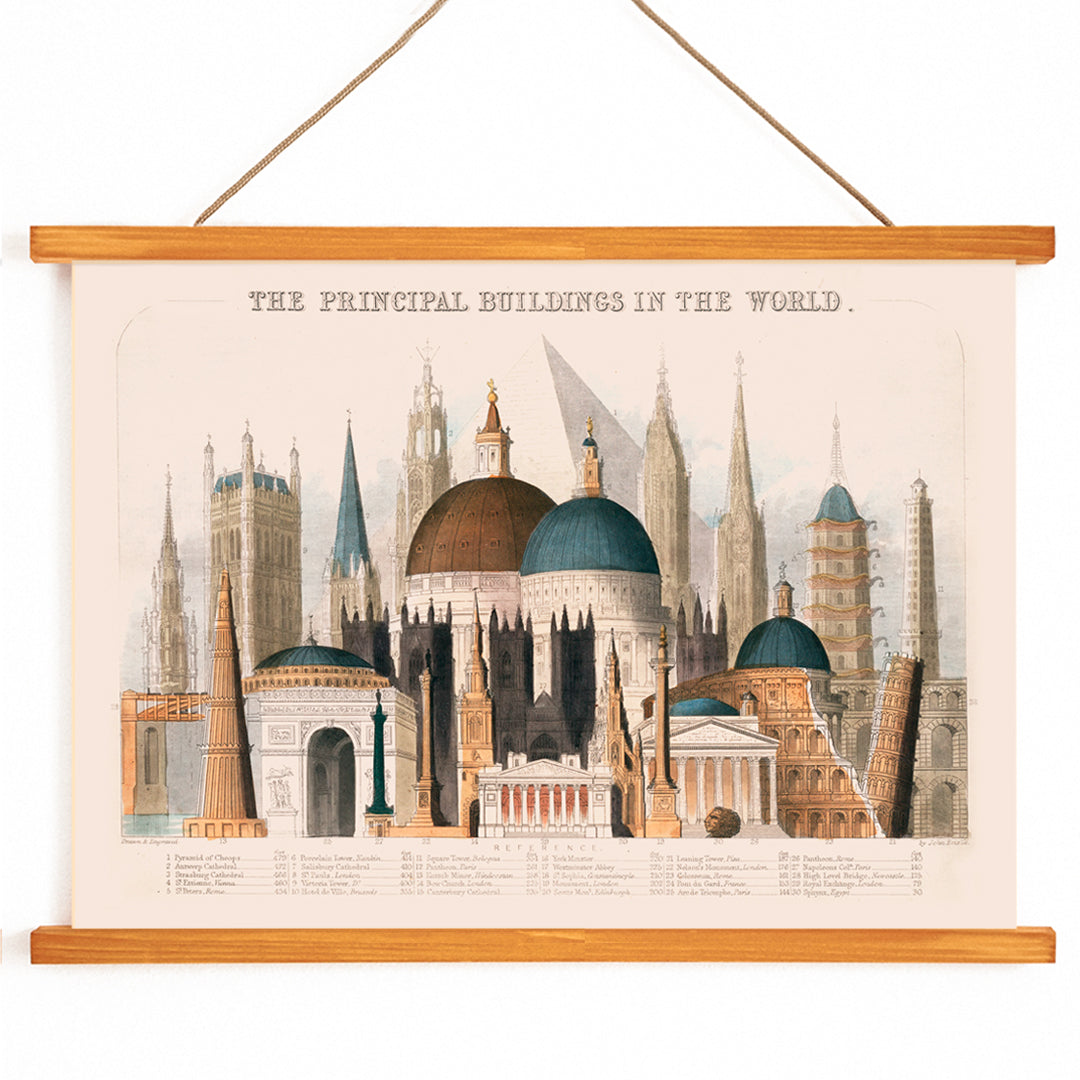
Principal buildings in the world was created at a time when Victorian society was eager to explore and compare the achievements of civilizations through their architecture. This print served as an educational tool, enabling viewers to visually compare iconic structures from around the globe without leaving their homes. The work reflects the mid-1800s enthusiasm for encyclopedic knowledge and the democratization of information brought about by advances in printing and travel.
Produced in 1850, this piece exemplifies the era’s desire to understand the world through systematic observation and comparison. It pairs naturally with cartographic works from the maps collection, offering a window into the global curiosity of the period.
Style & Characteristics
The print features a carefully organized arrangement of architectural landmarks, each rendered in precise linework and measured outlines. The composition is reminiscent of an engraved reference plate, emphasizing clarity and order over artistic flourish. The restrained palette includes warm beige paper, brown sepia ink, and subtle blue accents, lending the sheet a calm, archival quality.
This scholarly aesthetic, combined with the fine detail and balanced layout, gives the print a contemplative and informative presence. The overall effect is decorative yet purposeful, suitable for both study and display alongside other classic art or maps prints.
In Interior Design
This vintage architectural print is ideal for spaces that celebrate learning and exploration, such as home offices, libraries, or reading nooks. Its neutral tones and structured composition complement both modern and traditional interiors, especially when paired with wood furnishings and muted textiles.
Framing the print with a simple mat and one of our frames enhances its refined, scholarly appeal, making it a distinguished focal point in any room.