


You may also like
-
King Kong Poster
Boye · 1933 · Dramatic King Kong poster with piercing red eyes and a heroine in vivid red
Poster from £9 · Framed from £16
Regular price From £6.00Regular price -
We Can Do It! Poster
J. Howard Miller · 1942 · Bold poster with Rosie the Riveter and a strong wartime slogan
Poster from £9 · Framed from £16
Regular price From £6.00Regular price -
The Revenge of Tarzan Poster
Unknown artist · 1920 · Classic jungle adventure poster of Tarzan wrestling a lion beneath bold title lettering
Poster from £9 · Framed from £16
Regular price From £6.00Regular price -
Drink Brazilian coffee Poster
Jean d'Ylen · 1931 · Bold Art Deco coffee poster with a vibrant red figure and crisp typography
Poster from £9 · Framed from £16
Regular price From £6.00Regular price


-

"Very nice Posters. The quality is amazing and we received it very quickly !"
-

"A shop to visit absolutely. Huge selection of posters. We spent more than an hour there !"
-

"Perfect to find gift. Price are very good. An they can frame and pack it on site"


About the Artist
Harry Ryle Hopps was an American artist and theatrical set designer whose work helped define the visual language of early twentieth-century propaganda. During World War I, Hopps applied his background in stagecraft to poster design, creating images that harnessed drama and immediacy to influence public opinion. His posters, with their striking symbolism and bold compositions, became powerful tools for mobilizing support and communicating national messages.
Hopps remains a significant figure for those interested in the evolution of American graphic design and vintage advertising posters, where art and mass communication intersected during times of crisis.
The Artwork
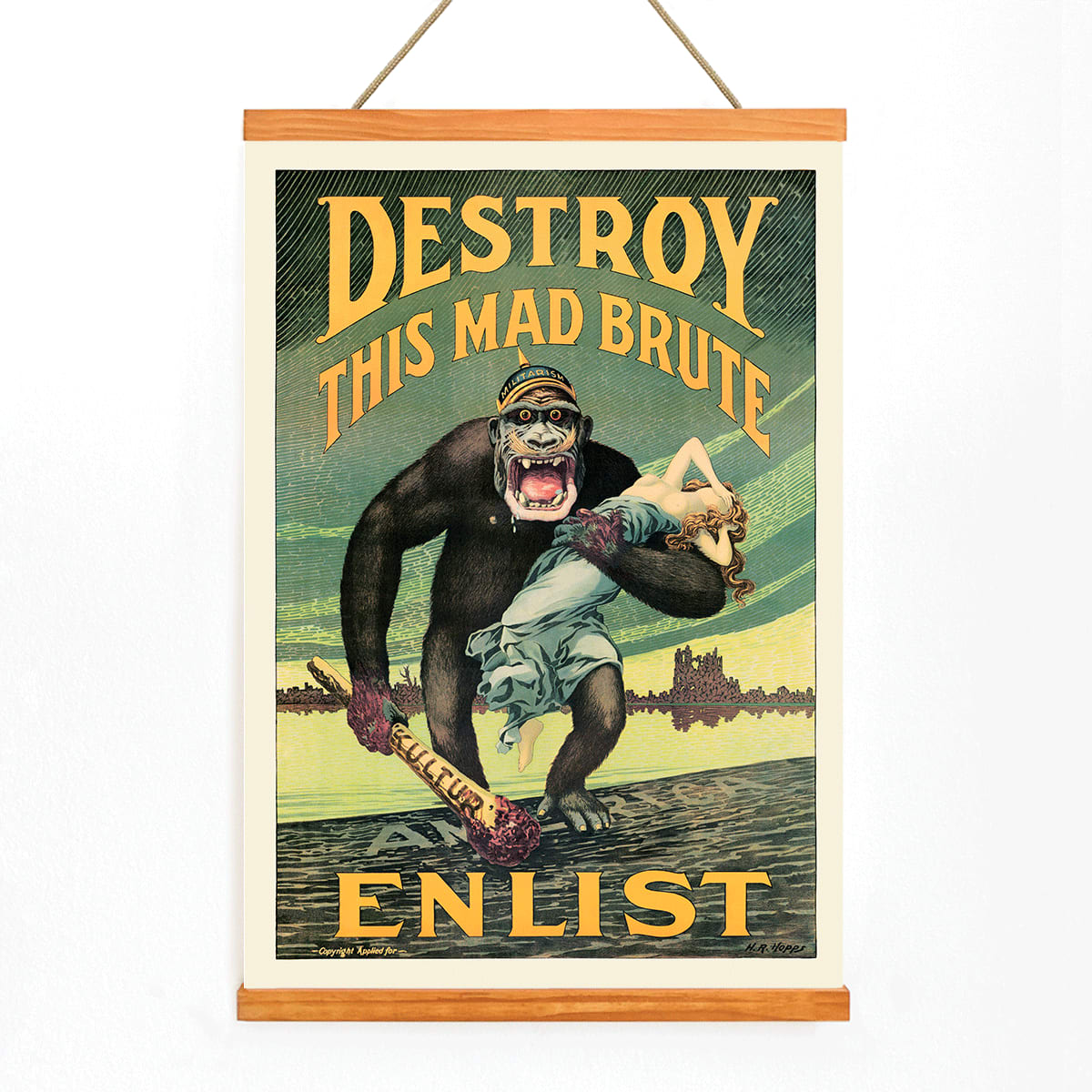
Destroy this mad brute was produced in 1917 as the United States entered World War I, aiming to galvanize enlistment and unify public sentiment. The poster uses allegory to embody the perceived threat facing America, transforming anxieties about the war into a monstrous figure that personifies the enemy. By presenting danger as immediate and personal, the image sought to provoke a sense of urgency and responsibility among viewers.
This work exemplifies how wartime propaganda distilled complex international conflicts into instantly recognizable symbols, leveraging the power of visual storytelling to shape public perception and action.
Style & Characteristics
The poster centers on a menacing gorilla clad in a German military helmet, striding aggressively toward the viewer while wielding a bloodied club and carrying a distressed woman. The composition is dominated by exaggerated anatomy and forceful lines, heightening the sense of threat and chaos. Large, bold typography at the top and bottom delivers a direct message, reinforcing the poster’s call to action.
The color palette features vivid yellows and greens contrasted with deep blacks and cooler blue tones, creating a high-impact, theatrical effect. The overall mood is confrontational and urgent, characteristic of early twentieth-century propaganda art.
In Interior Design
This historic poster serves as a commanding focal point in spaces such as offices, libraries, or media rooms. Its dramatic imagery pairs well with dark woods, black metal, and archival decor, lending a curated, scholarly atmosphere. In contemporary interiors, the bold graphics and colors can anchor minimalist furnishings, providing a striking visual counterpoint.
Accents in yellow, green, or black can be echoed in textiles or frames for cohesion. This piece also complements a vertical poster wall or can be displayed alongside other bold works from the animals collection.