


You may also like
-
Economical use of plants Poster
Marcius Willson · 1865 · Detailed botanical chart poster mapping practical plant uses in crisp labeled vignettes
Poster from £9 · Framed from £16
Regular price From £6.00Regular price -
Familiar colors Poster
Marcius Willson · 1890 · Educational color chart poster featuring geometric squares and triangles in vivid primary colors
Poster from £9 · Framed from £16
Regular price From £6.00Regular price -
The Chromatic scale of colors Poster
Marcius Willson · 1890 · Meticulously labeled chromatic color wheel poster with crisp geometry and vivid spectrum
Poster from £9 · Framed from £16
Regular price From £6.00Regular price -
Economical uses of plants Poster
Norman A. Calkins · 1890 · Vintage educational botanical print mapping useful plants and everyday products in labeled vignettes
Poster from £9 · Framed from £16
Regular price From £6.00Regular price


-

"Very nice Posters. The quality is amazing and we received it very quickly !"
-

"A shop to visit absolutely. Huge selection of posters. We spent more than an hour there !"
-

"Perfect to find gift. Price are very good. An they can frame and pack it on site"


About the Artist
Marcius Willson was an American educator and prolific textbook writer whose work reflected the late 19th century conviction that careful observation fostered critical thinking. During a period when illustrated teaching materials became increasingly accessible thanks to advances in printing, Willson played a key role in shaping the visual language of classroom learning, blending clarity with curiosity.
This 1890 botanical wall chart belongs to the tradition of educational natural history art, where visual aids and clear labeling transformed ordinary plant forms into lasting knowledge. Today, it carries the calm authority of a classic classroom reference while offering a quietly decorative presence in modern interiors.
The Artwork
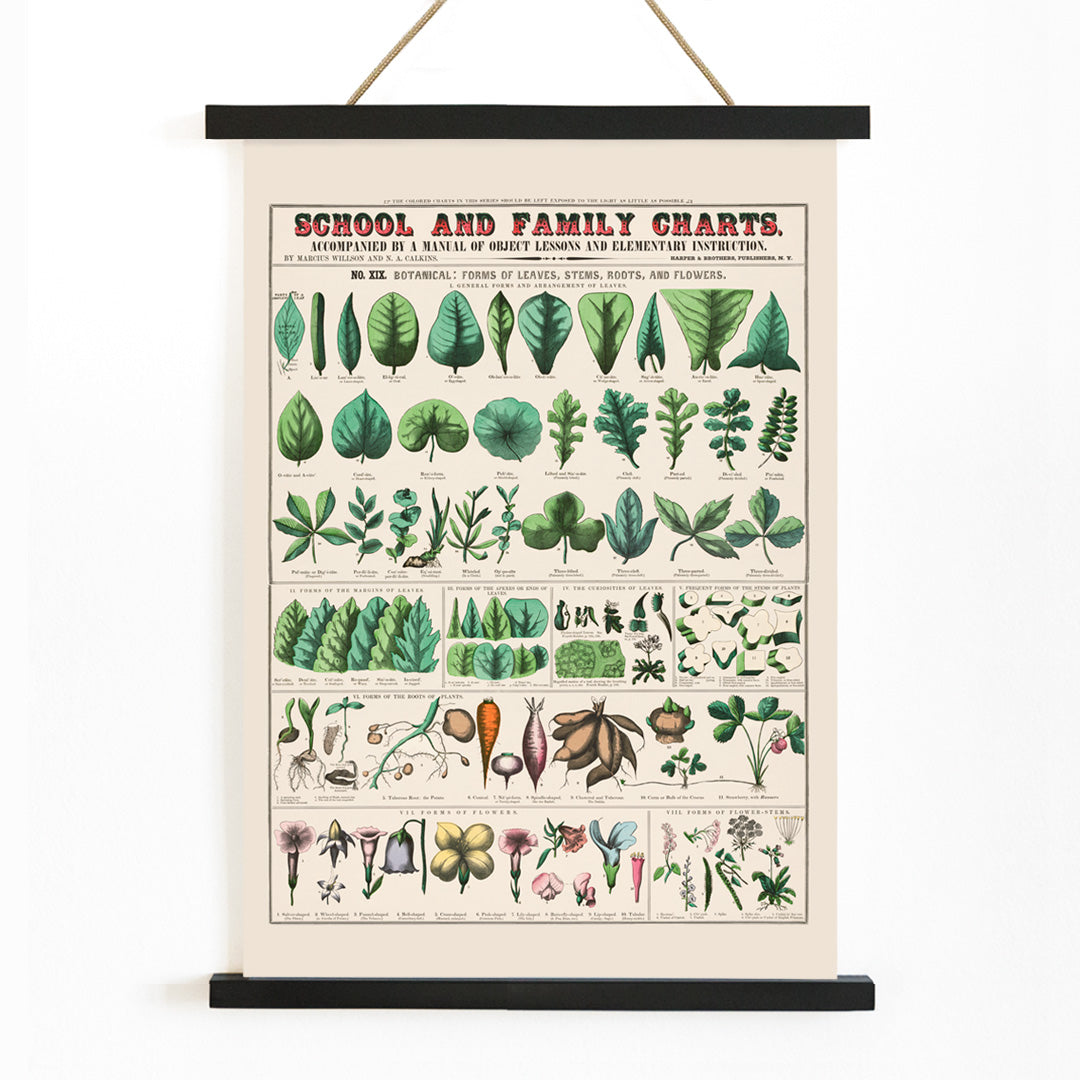
Forms of leaves was designed as a pedagogical tool, introducing students to the foundational vocabulary of plant structure and classification. By systematically comparing a variety of leaf shapes and parts, it encouraged viewers to observe how nature creates diversity from a single theme, fostering both scientific understanding and appreciation.
Such charts were central to the broader nature study movement of the era, when botany was valued as both a practical science and a means of moral education. As a vintage botanical print, it connects contemporary spaces to a time when learning began with attentive looking. Discover related works in our science wall art collection.
Style & Characteristics
The composition is reminiscent of a precise 19th century textbook plate: multiple leaf forms are arranged for direct comparison, each clearly labeled to guide careful study. Fine linework delineates contours and veins, giving the image an exact, explanatory quality typical of academic illustration.
A warm beige background evokes the feel of aged paper, while natural greens dominate the leaf subjects, accented by occasional touches of red. The overall mood is studious and serene, making it ideal for gallery walls that blend decorative art with educational value. Explore more botanical prints in a similar spirit.
In Interior Design
This fine art print is especially suited as botanical wall art for kitchens, hallways, or home offices, where its orderly design complements daily routines. It pairs well with light woods, linen fabrics, and ceramics, lending a gentle museum-like quality without formality.
To harmonize with its palette, consider adding green plants or sage textiles, and echo the background with warm whites and sandy tones. It also fits beautifully in a calm children’s room or study nook, inviting curiosity and quiet focus. For more coordinated palettes, browse our green tone posters selection.