


You may also like
-

Métamorphose du violon Poster
Le Corbusier · 1920 · Modernist violin poster turning instrument curves into crisp geometric rhythms in primary tones
Poster from £9 · Framed from £16
-

Le Modulor Poster
Le Corbusier · 1950 · Iconic proportional-man diagram poster balancing black linework with red and blue accents
Poster from £9 · Framed from £16
-

Secret Poster
Le Corbusier · 1987 · Enigmatic abstract poster with bold black lines and pink, orange, and blue blocks
Poster from £9 · Framed from £16
-

Maison de la Pensée française poster Poster
Henri Matisse · 1950 · Exhibition poster with a masklike face and blue lettering
Poster from £9 · Framed from £16


-

"Very nice Posters. The quality is amazing and we received it very quickly !"
-

"A shop to visit absolutely. Huge selection of posters. We spent more than an hour there !"
-

"Perfect to find gift. Price are very good. An they can frame and pack it on site"


About the Artist
Le Corbusier (1887–1965) is renowned as a pioneer of modernist architecture, but his creative pursuits extended deeply into painting and printmaking. Throughout his career, he explored how visual art could embody his theories of proportion, structure, and the emotional resonance of simplified forms. His artworks reflect the same intellectual rigor and inventive spirit that shaped his buildings, offering a unique intersection of art and architectural thought. Le Corbusier's prints are valued for their ability to merge visual clarity with conceptual depth, making them significant within the history of twentieth-century design.
His influence connects to movements such as Bauhaus modernism and postwar European abstraction, where artists sought new ways to express the dynamism of contemporary life through pared-down forms and bold compositions.
The Artwork
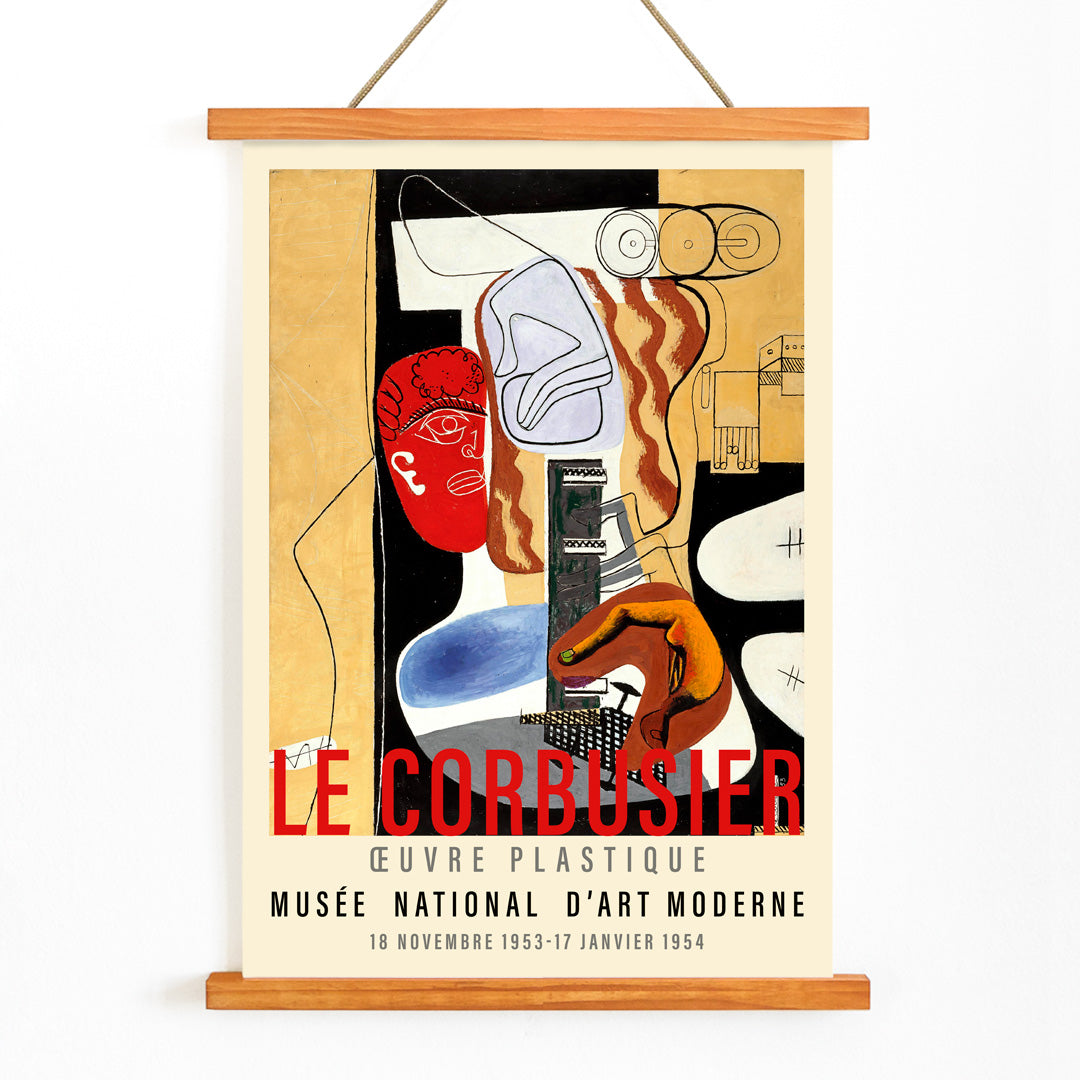
Arbalète I, created in 1953, emerged during a period when Le Corbusier and his contemporaries were redefining visual language in response to a rapidly modernizing world. The title references a crossbow, symbolizing tension, precision, and the interplay of mechanical forces—concepts that resonate with Le Corbusier's fascination with engineered structures. Rather than depicting the object directly, he transforms its essence into an abstract motif, inviting viewers to contemplate the balance and energy inherent in modern design.
This work stands as a testament to the postwar search for new artistic vocabularies, embodying the spirit of innovation that defined mid-century abstraction. It holds particular appeal for those interested in the evolution of abstract art and the dialogue between art and architecture.
Style & Characteristics
The composition features bold geometric shapes and assertive lines, arranged with the precision of an architect. Areas of flat color—primarily red, blue, brown, black, and white—are set against crisp edges, creating a striking sense of rhythm and contrast. The interplay of forms suggests both tension and harmony, echoing the mechanical inspiration behind the piece.
The overall mood is energetic yet controlled, with a sculptural quality that emphasizes weight and counterbalance. For admirers of abstract posters and those drawn to modernist aesthetics, this art print delivers a compelling visual statement suitable for contemporary interiors.
In Interior Design
This Le Corbusier poster makes a sophisticated focal point in living rooms, offices, hallways, or creative studios. Its geometric clarity complements mid-century furnishings, minimalist shelving, and interiors that prioritize clean lines and intentional design, such as those found in minimalist wall art collections.
To harmonize with its palette, consider echoing the red and blue tones in textiles or decorative objects, while black and white elements can be reflected in frames or lighting. This piece is well-suited for design enthusiasts and anyone curating a refined modern space.