


You may also like
-

Bicycle patent Poster
Charles D. Rice · 1896 · Detailed bicycle patent print featuring technical diagrams in crisp black on beige
Poster from £9 · Framed from £16
-

Bicycle-support Patent Poster
B. Peisen · 1899 · Detailed bicycle support vintage print with crisp patent diagrams and neat annotation
Poster from £9 · Framed from £16
-

Film Reel Patent Poster
Michael G. Delaney · 1897 · Crisp film reel patent vintage print with precise diagrams and numbered components
Poster from £9 · Framed from £16
-

Flute Patent Poster
D. Julliot · 1874 · Detailed flute patent vintage print with crisp schematics and archival beige paper
Poster from £9 · Framed from £16


-

"Very nice Posters. The quality is amazing and we received it very quickly !"
-

"A shop to visit absolutely. Huge selection of posters. We spent more than an hour there !"
-

"Perfect to find gift. Price are very good. An they can frame and pack it on site"


About the Artist
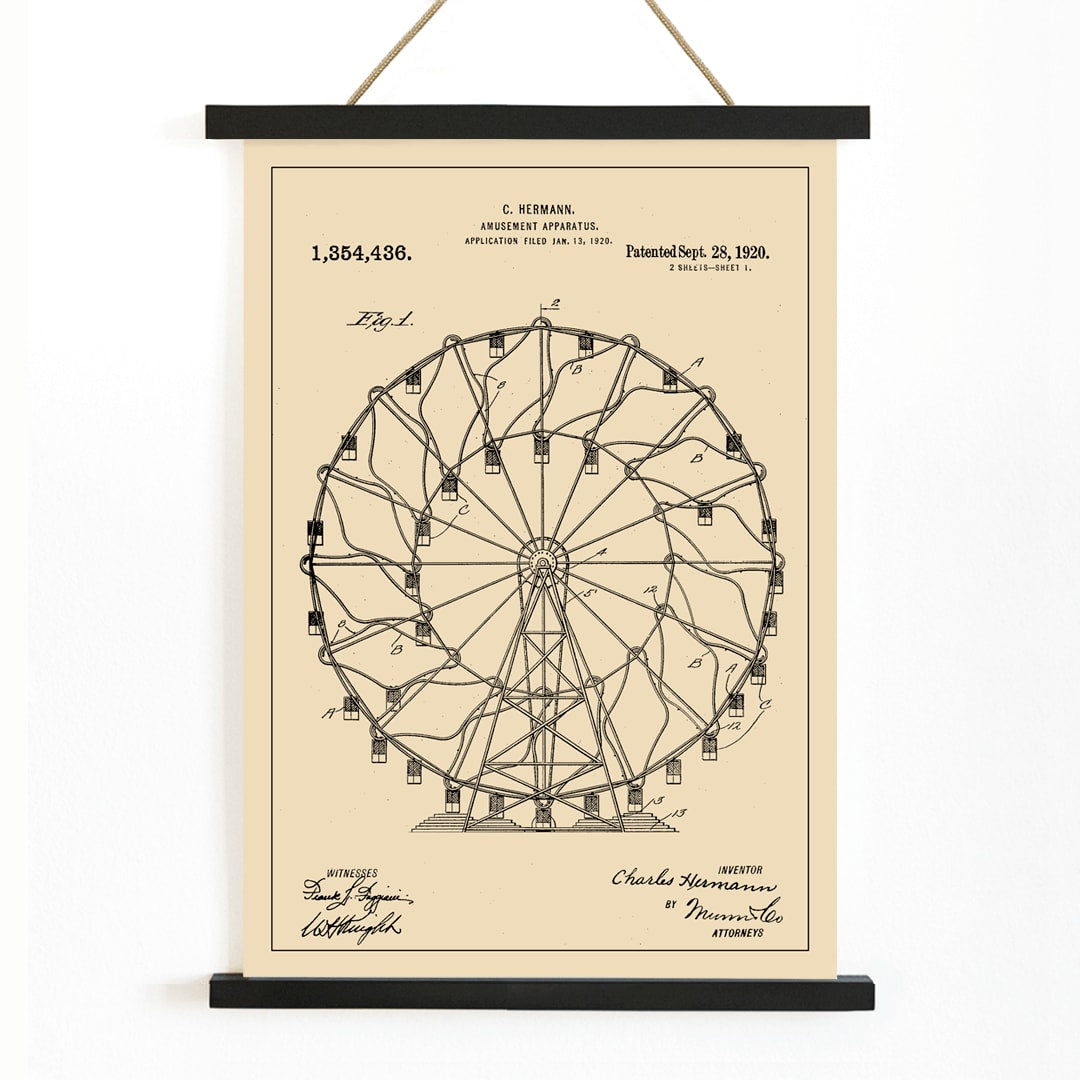
C. Hermann is credited as the inventor behind this 1920 amusement apparatus patent drawing, reflecting a period when inventors and technical draftsmen played a crucial role in shaping the visual language of innovation. Patent illustrations from the early twentieth century were not just legal documents but also artifacts of industrial progress, capturing the optimism and ingenuity of their era.
These drawings were crafted to communicate complex mechanical concepts with clarity and precision, serving both as practical guides for builders and as persuasive evidence for patent examiners. Today, they offer a glimpse into the inventive spirit that drove the rapid evolution of entertainment technology during this dynamic period.
The Artwork
This patent drawing documents a unique amusement apparatus that merges the grandeur of a Ferris wheel with the excitement of a gravity railway. Created at a time when public amusement was becoming increasingly sophisticated, it illustrates the competitive drive among amusement parks to offer new experiences defined by innovation, safety, and spectacle.
As a historical document, the image was intended to establish the novelty and functionality of the design for legal protection. Now viewed as vintage industrial art, it embodies the era's belief in progress and the transformative power of engineering in everyday life.
Style & Characteristics
The artwork features crisp black linework meticulously rendered on a warm, aged beige background. Numbered annotations and detailed schematic views organize the composition, emphasizing clarity and technical accuracy. The visual rhythm is orderly and analytical, with the diagrammatic style lending a sense of quiet drama to the piece.
Its restrained palette and precise execution make it an ideal fit for black and white prints enthusiasts or those seeking science-inspired posters that highlight the intersection of art and technology.
In Interior Design
This Ferris wheel patent poster brings a touch of intellectual curiosity to home offices, studios, hallways, or media rooms. Its neutral tones complement minimalist, industrial, or modern interiors, especially when paired with materials like steel, wood, or concrete.
For a cohesive look, combine it with beige wall art or technical drawings, and use simple frames to enhance its archival character. It works well in gallery walls that celebrate invention, design, and the enduring appeal of vintage engineering.