


You may also like
-

Airplane patent Poster
Igor Ivanovich Sikorsky · 1910 · Precise airplane patent print featuring multi-view schematics in crisp black linework
Poster from £9 · Framed from £16
-

Flute Patent Poster
D. Julliot · 1874 · Detailed flute patent vintage print with crisp schematics and archival beige paper
Poster from £9 · Framed from £16
-

Sail Boat Patent Poster
Lewis Francis Herreshoff · 1933 · Crisp sailboat patent poster with multiple elevations and numbered rigging details
Poster from £9 · Framed from £16
-

Resilient Golf Club Head Patent Poster
L.A. Young · 1931 · Crisp vintage print of a resilient golf club head patent with annotated diagrams
Poster from £9 · Framed from £16


-

"Very nice Posters. The quality is amazing and we received it very quickly !"
-

"A shop to visit absolutely. Huge selection of posters. We spent more than an hour there !"
-

"Perfect to find gift. Price are very good. An they can frame and pack it on site"


About the Artist
W.D Clark worked within the early twentieth century world where inventors, engineers, and draftsmen translated new ideas into standardized patent drawings. While little biographical information is widely circulated, the name is preserved through this precise technical document and its careful visual logic.
Like many patent illustrators of the era, Clark balances clarity and persuasion, turning an experimental machine into something legible to examiners and compelling to future readers. It is a natural fit for collectors drawn to scientific and technical wall art and early aviation history.
The Artwork
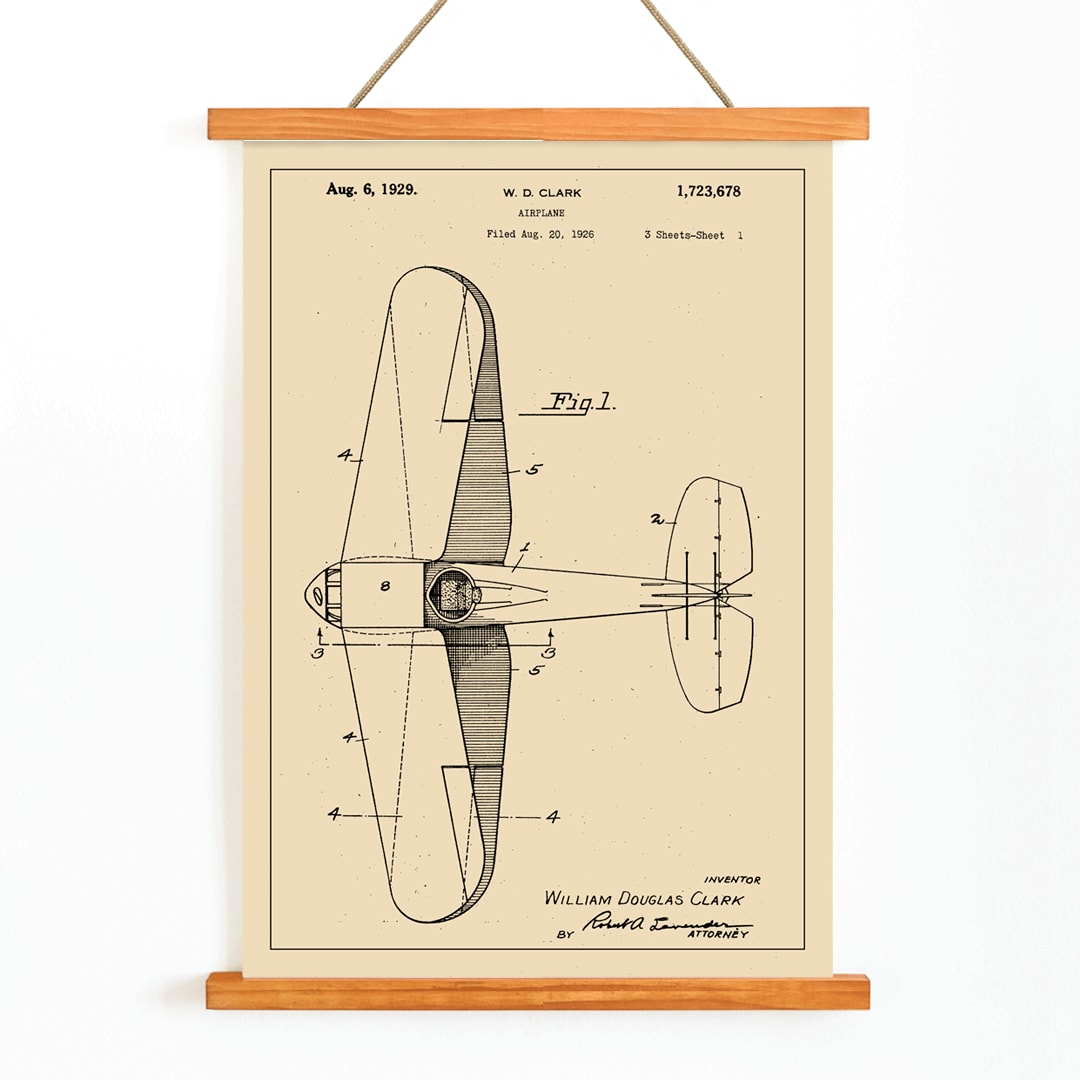
This 1926 airplane patent print captures a pivotal moment in aviation history, when flight was evolving from daring experiment to engineered system. Patent illustrations like this were created to document innovation, serving as both legal record and technical communication. Rather than offering a romantic vision of flight, the artwork presents a structured argument—defining new mechanisms, relationships, and functions that advanced the field.
The image reflects the spirit of the interwar years, when inventors and engineers refined aircraft design for safety and practicality. As a vintage print, it brings the culture of invention into the present, highlighting the incremental progress that shaped modern aviation.
Style & Characteristics
Visually, this piece is a blueprint-style technical plate rendered in crisp black linework on warm beige paper. Multiple orthographic views display the airplane from different angles, accompanied by precise annotations and measured callouts that keep the composition disciplined and readable.
The overall mood is calm and methodical, emphasizing the quiet drama of precision engineering. As black and white poster art, it suits interiors that appreciate graphic structure, technical typography, and the aesthetic of invention.
In Interior Design
This airplane patent print works especially well in an office, studio, library, or hallway where viewers can appreciate its detailed design. Its restrained palette complements wood, leather, steel, and concrete, bridging vintage and contemporary styles.
Pair it with cream, sand, charcoal, or matte black accents, or echo its paper tone with beige wall art for a cohesive display. It also fits seamlessly into minimalist and industrial spaces, serving as a conversation piece for aviation enthusiasts and design aficionados.