


You may also like
-
Anatomy of a Murder Poster
Saul Bass · 1959 · Iconic minimalist movie poster featuring a fragmented black silhouette and bold orange background
Poster from £9 · Framed from £16
Regular price From £6.00Regular price -
Vertigo Poster
Saul Bass · 1958 · Hypnotic spiral movie poster with stark figures that channel pure psychological suspense
Poster from £9 · Framed from £16
Regular price From £6.00Regular price -
Saint Joan Poster
Saul Bass · 1957 · Iconic Saint Joan movie poster with bold red blocks and a solitary figure
Poster from £9 · Framed from £16
Regular price From £6.00Regular price -
The Cardinal Poster
Saul Bass · 1963 · Minimalist movie poster with bold red and black forms and striking modernist composition
Poster from £9 · Framed from £16
Regular price From £6.00Regular price


-

"Very nice Posters. The quality is amazing and we received it very quickly !"
-

"A shop to visit absolutely. Huge selection of posters. We spent more than an hour there !"
-

"Perfect to find gift. Price are very good. An they can frame and pack it on site"


About the Artist
Saul Bass was a pivotal American graphic designer whose mid-century modern approach revolutionized film marketing, transforming movie posters into powerful vehicles for visual storytelling. Collaborating with leading studios and directors, Bass distilled complex narratives into instantly recognizable symbols, setting a new standard for cinematic graphics.
By the mid-1950s, Bass’s work marked a turning point where film advertising began to merge with high art. His posters, now highly sought after by collectors, exemplify the clarity, tension, and restraint that define the modernist movement in graphic design.
The Artwork
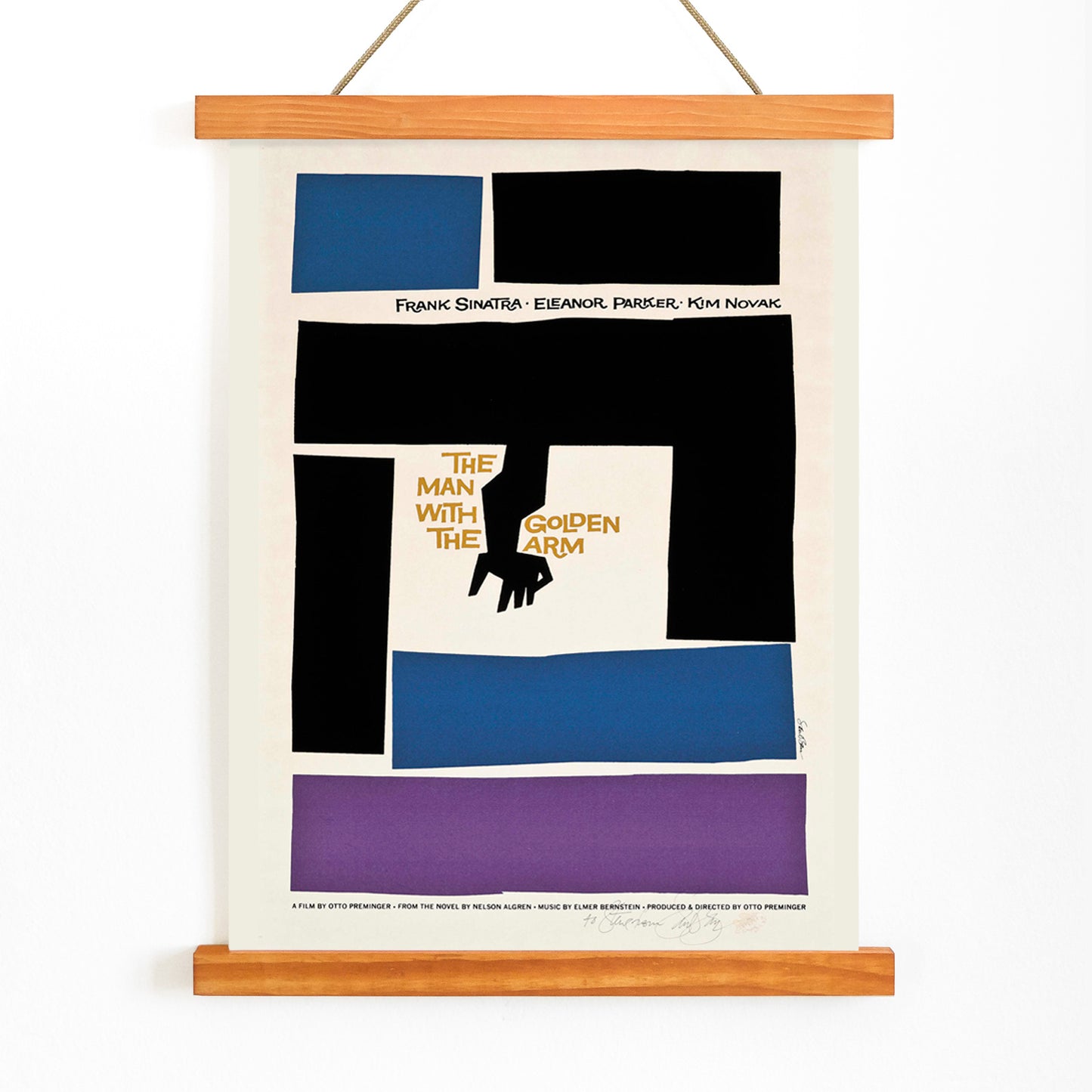
This poster was created in 1955 for Otto Preminger’s film The Man with the Golden Arm, a groundbreaking drama exploring addiction and redemption. Rather than depicting a literal scene, Bass captured the film’s psychological intensity through a single, striking emblem, making the poster itself a cultural icon of postwar American cinema.
At a time when Hollywood often relied on glamorous star portraits, Bass introduced a conceptual approach that challenged audiences to engage with the film’s deeper themes. This work helped shape the identity of movie posters as collectible art and remains a touchstone for film and design enthusiasts.
Style & Characteristics
The composition centers on a jagged, white abstract arm set against a stark black background, with bold, angular shapes and compact blocks of modernist typography. Accents of blue and purple punctuate the layout, guiding the viewer’s eye across the design and reinforcing its sense of movement and tension.
Defined by hard edges, asymmetry, and simplified forms, the poster exemplifies modernist graphic design, where drama emerges from geometry and negative space. Fans of minimalist posters and abstract wall art will appreciate its crisp, cinematic impact and enduring visual power.
In Interior Design
This poster makes a bold statement in living rooms, offices, or media spaces, where its graphic strength sets an unmistakable tone. Its deep black ground and vivid accents pair seamlessly with black frames, chrome, walnut, or mid-century furnishings for a curated, confident look.
It also complements interiors that balance monochrome palettes with a single burst of color, especially alongside cobalt blue or violet decor. For film lovers, it harmonizes with black and white prints while introducing a controlled flash of modernist energy.