


You may also like
-

Delicate Soul Poster
Wassily Kandinsky · 1925 · Geometric abstract art print with crisp black lines, yellow highlights, and soft purple forms
Poster from £9 · Framed from £16
-

Gewebe Poster
Wassily Kandinsky · 1923 · Geometric abstract art print featuring rhythmic blocks and lines on warm beige
Poster from £9 · Framed from £16
-

Kleines Warm Poster
Wassily Kandinsky · 1928 · Warm abstract poster with floating circles and sharp black lines in red and yellow
Poster from £9 · Framed from £16
-

Deutliche Verbindung Poster
Wassily Kandinsky · 1925 · Geometric abstract art print balancing circles and angles in energetic primary and violet accents
Poster from £9 · Framed from £16


-

"Very nice Posters. The quality is amazing and we received it very quickly !"
-

"A shop to visit absolutely. Huge selection of posters. We spent more than an hour there !"
-

"Perfect to find gift. Price are very good. An they can frame and pack it on site"


About the Artist
Wassily Kandinsky was a pioneering figure in abstract art, whose theories and works transformed modern painting in the early twentieth century. After his involvement with the Blue Rider group and his influential teaching at the Bauhaus, Kandinsky continued to explore the expressive power of color and form. His late Paris period, to which this 1941 composition belongs, is marked by a more lyrical and organic approach to abstraction. Discover more in our Wassily Kandinsky collection and explore related abstract wall art.
The Artwork
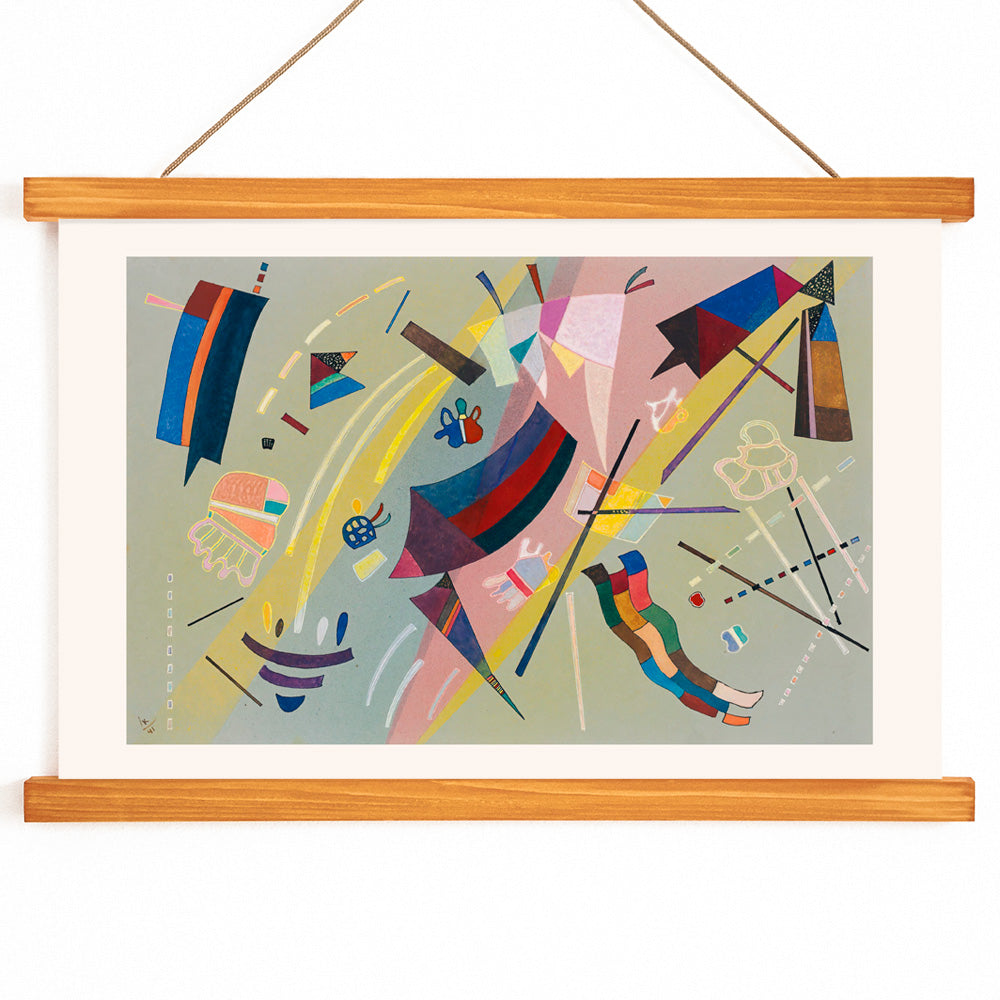
Painted in 1941, this work emerged during a time of upheaval in Europe, as Kandinsky sought to create a sense of harmony and inner order through abstraction. Rather than depicting recognizable scenes, he aimed to evoke emotion and rhythm, much like a musical composition. This approach allowed viewers to experience the artwork on a personal level, free from narrative constraints, and reflected his belief in the universal language of art.
Style & Characteristics
The composition features a pale background enlivened by floating geometric and biomorphic forms, accented with crisp lines. Distinct hues of blue, yellow, pink, and red punctuate the scene, while darker outlines lend definition and movement to the shapes. The absence of a central focal point encourages the eye to wander, creating a dynamic, musical rhythm across the surface. The overall mood is playful yet balanced, characteristic of Kandinsky's late style, and the print embodies the refined sensibility of vintage modernist design.
In Interior Design
This Kandinsky poster brings a vibrant, abstract energy to contemporary interiors, whether displayed in a living room, office, or creative space. Its harmonious palette complements neutral backgrounds such as warm white or beige, while its lively forms pair well with Bauhaus-inspired decor and curated gallery walls. For a cohesive look, consider incorporating accents in primary colors or displaying it alongside other Bauhaus prints and music inspired wall art to echo its rhythmic qualities.