


You may also like
-

Gewebe Poster
Wassily Kandinsky · 1923 · Geometric abstract art print featuring rhythmic blocks and lines on warm beige
Poster from £9 · Framed from £16
-

Deutliche Verbindung Poster
Wassily Kandinsky · 1925 · Geometric abstract art print balancing circles and angles in energetic primary and violet accents
Poster from £9 · Framed from £16
-

Kleines Warm Poster
Wassily Kandinsky · 1928 · Warm abstract poster with floating circles and sharp black lines in red and yellow
Poster from £9 · Framed from £16
-

Berührung Poster
Wassily Kandinsky · 1924 · Dynamic abstract poster featuring intersecting circles, angular lines, and bold red and orange accents
Poster from £9 · Framed from £16


-

"Very nice Posters. The quality is amazing and we received it very quickly !"
-

"A shop to visit absolutely. Huge selection of posters. We spent more than an hour there !"
-

"Perfect to find gift. Price are very good. An they can frame and pack it on site"


About the Artist
Wassily Kandinsky was a pivotal figure in modern art, renowned for pioneering abstract painting as a means to express emotion and intellectual ideas. After his early involvement with Der Blaue Reiter, Kandinsky became an influential teacher at the Bauhaus, where he developed a distinctive approach to geometric abstraction and visual harmony.
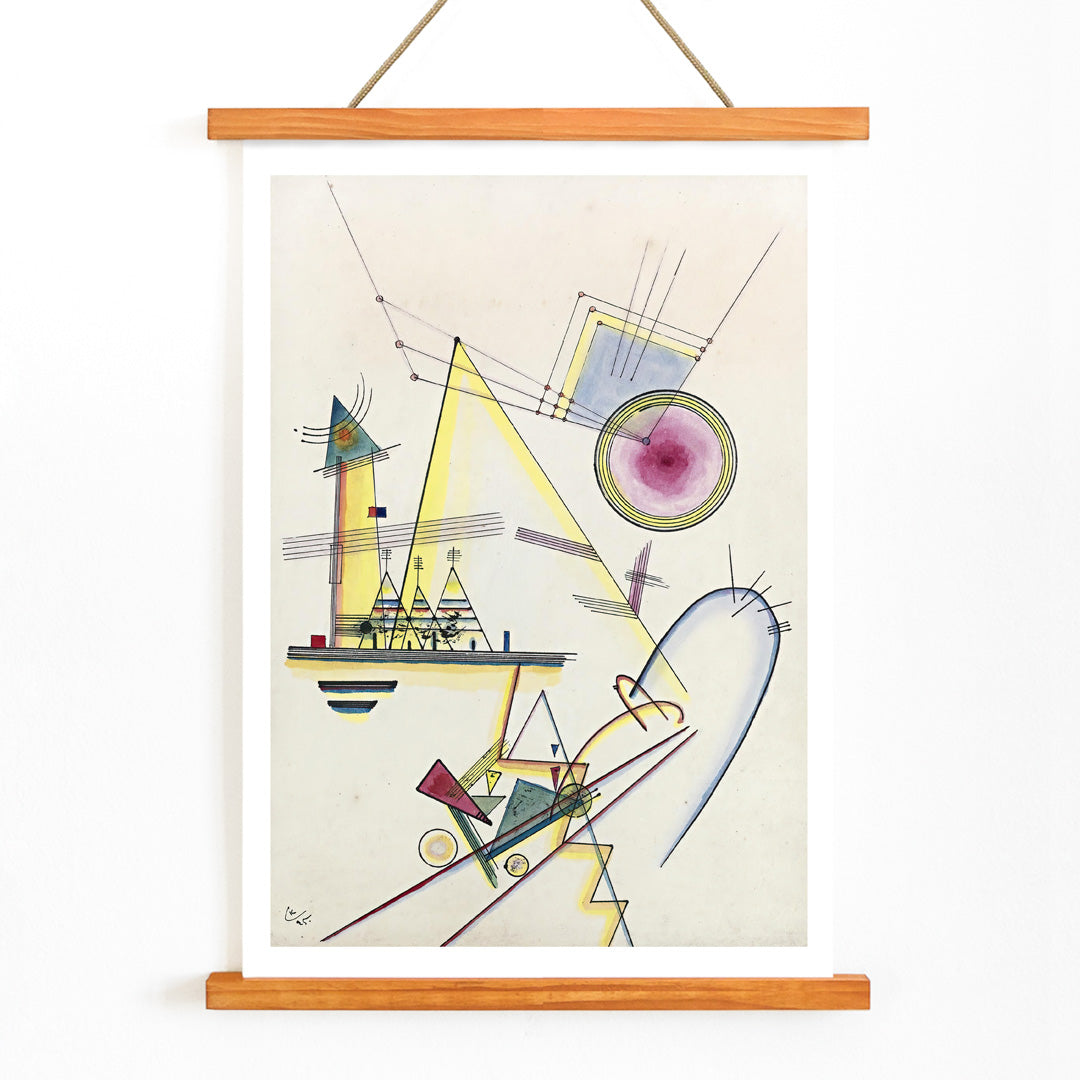
This 1925 piece reflects his mature Bauhaus period, when he used precise forms and spatial relationships to evoke musicality and inner experience. Discover more in our Wassily Kandinsky collection and explore additional works in our famous artists wall art.
The Artwork
Created during the height of the Bauhaus movement, this composition embodies the era’s search for a new visual language aligned with modern architecture and design. Rather than depicting recognizable subjects, Kandinsky invites viewers to interpret the interplay of shapes and lines as a reflection of psychological states and abstract thought.
He believed that abstraction could communicate like music, with visual elements acting as notes and rhythms. This artwork stands as a testament to that philosophy, offering a contemplative experience that resonates with the intellectual spirit of the 1920s avant-garde.
Style & Characteristics
The artwork features a luminous yellow accent set against a spacious white background, intersected by bold black lines and softened with touches of purple. The composition is carefully balanced yet asymmetrical, guiding the eye through arcs, diagonals, and small geometric details.
The mood is poised and introspective, with a crisp clarity that typifies Kandinsky’s Bauhaus-era style. Its refined abstract quality makes it a versatile addition to any gallery wall. For similar aesthetics, browse our abstract art prints and Bauhaus posters.
In Interior Design
This Kandinsky art print enhances living rooms, studios, or home offices where a sense of focus and calm is desired. The open composition keeps spaces feeling light, while the geometric motifs introduce a thoughtful, modern energy.
It pairs beautifully with neutral palettes, pale woods, or matte black accents. The yellow brings warmth to beige and white interiors, and the purple details can be echoed in textiles or ceramics. Perfect for admirers of classic modernism and those seeking a minimalist yet expressive vintage print.