


You may also like
-

Delicate Soul Poster
Wassily Kandinsky · 1925 · Geometric abstract art print with crisp black lines, yellow highlights, and soft purple forms
Poster from £9 · Framed from £16
-

Gewebe Poster
Wassily Kandinsky · 1923 · Geometric abstract art print featuring rhythmic blocks and lines on warm beige
Poster from £9 · Framed from £16
-

Deutliche Verbindung Poster
Wassily Kandinsky · 1925 · Geometric abstract art print balancing circles and angles in energetic primary and violet accents
Poster from £9 · Framed from £16
-

Kandinsky 1941 Poster
Wassily Kandinsky · 1941 · Lyrical abstract poster with floating geometric accents in blue, yellow, pink, and red
Poster from £9 · Framed from £16


-

"Very nice Posters. The quality is amazing and we received it very quickly !"
-

"A shop to visit absolutely. Huge selection of posters. We spent more than an hour there !"
-

"Perfect to find gift. Price are very good. An they can frame and pack it on site"


About the Artist
Wassily Kandinsky was a pioneering figure of early abstract art, renowned for transforming musical ideas into visual compositions. By 1930, during his influential Bauhaus period, Kandinsky’s approach became more geometric and structured, reflecting his deep exploration of color theory and compositional balance. His legacy continues to inspire generations of artists and collectors, and his works are frequently paired with other Wassily Kandinsky prints and selections from famous artists for a cohesive modern art display.
Kandinsky believed that painting could evoke the same emotional resonance as music, using abstract forms to express inner experiences rather than depict the external world. His work from this era, including Standing, exemplifies his vision of art as a universal language capable of stirring the senses and imagination.
The Artwork
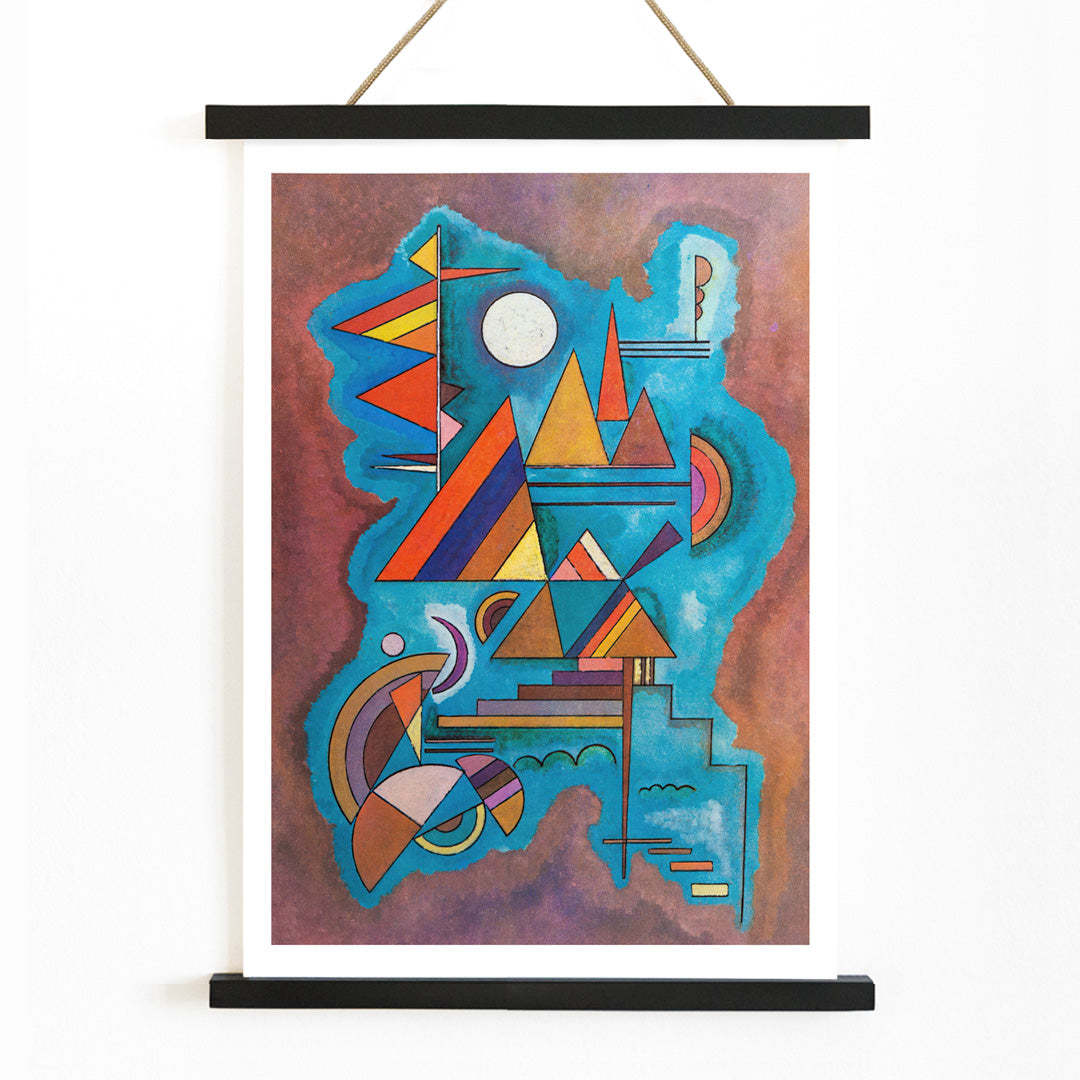
Standing, created in 1930, emerged during a period when European avant-garde artists were redefining abstraction as a means of conveying balance and harmony. The title suggests a sense of presence or figure, yet the composition remains non-representational, inviting viewers to interpret meaning through the arrangement of forms. Kandinsky’s intention was to create an immersive visual experience, akin to listening to a symphony, where the viewer becomes attuned to the interplay of shapes and rhythms.
This work reflects the Bauhaus ethos of integrating art, design, and theory, and stands as a testament to Kandinsky’s commitment to innovation. For those interested in the intersection of art and music, the music collection offers further exploration of this theme.
Style & Characteristics
The composition features a light background with crisp black lines, floating circles, and geometric blocks in vivid blue, red, and yellow, accented by touches of orange and brown. The arrangement of elements suggests both movement and stability, with sharp angles balanced by rounded forms. The palette is bright yet harmonious, creating a sense of controlled energy across the surface.
The overall mood is both analytical and playful, combining architectural order with improvisational flair. This abstract poster exemplifies geometric modernism and pairs well with other abstract works or Bauhaus-inspired art for a visually dynamic interior.
In Interior Design
This Kandinsky poster introduces bold color and structure to contemporary interiors, making it a striking focal point in living rooms, offices, or creative spaces. Its vertical format and rhythmic design can anchor a gallery wall or stand alone above furniture, lending sophistication and energy to the room.
To enhance its effect, coordinate with textiles or decor in blue, red, or warm wood tones. Framed simply, it becomes a refined vintage print that bridges classic modernism and present-day style.