


You may also like
-
Kleine Welten I Poster
Wassily Kandinsky · 1922 · Geometric abstract poster balancing circles, lines, and bright primary accents on white
Poster from £9 · Framed from £16
Regular price From £6.00Regular price -
Kleine Welten IV Poster
Wassily Kandinsky · 1922 · Abstract art print of circles and angular lines with bright blue yellow green accents
Poster from £9 · Framed from £16
Regular price From £6.00Regular price -
Kleine Welten V Poster
Wassily Kandinsky · 1922 · Rhythmic geometric poster of circles and sharp lines against a deep black field
Poster from £9 · Framed from £16
Regular price From £6.00Regular price -
Violet Poster
Wassily Kandinsky · 1923 · Geometric abstract art print with violet, blue, and yellow shapes on pale ground
Poster from £9 · Framed from £16
Regular price From £6.00Regular price


-

"Very nice Posters. The quality is amazing and we received it very quickly !"
-

"A shop to visit absolutely. Huge selection of posters. We spent more than an hour there !"
-

"Perfect to find gift. Price are very good. An they can frame and pack it on site"


About the Artist
Wassily Kandinsky was a pioneering force in early abstract art, profoundly influencing the evolution of modern painting and printmaking. After his involvement with the influential Der Blaue Reiter group, Kandinsky became a central figure at the Bauhaus, where he explored the connections between visual form, music, and spiritual experience. His teaching and theoretical writings helped shape a new visual language for the twentieth century.
Collectors interested in his innovative graphic works often explore our Wassily Kandinsky posters, where geometry and emotion are interwoven in enduring modern compositions.
The Artwork
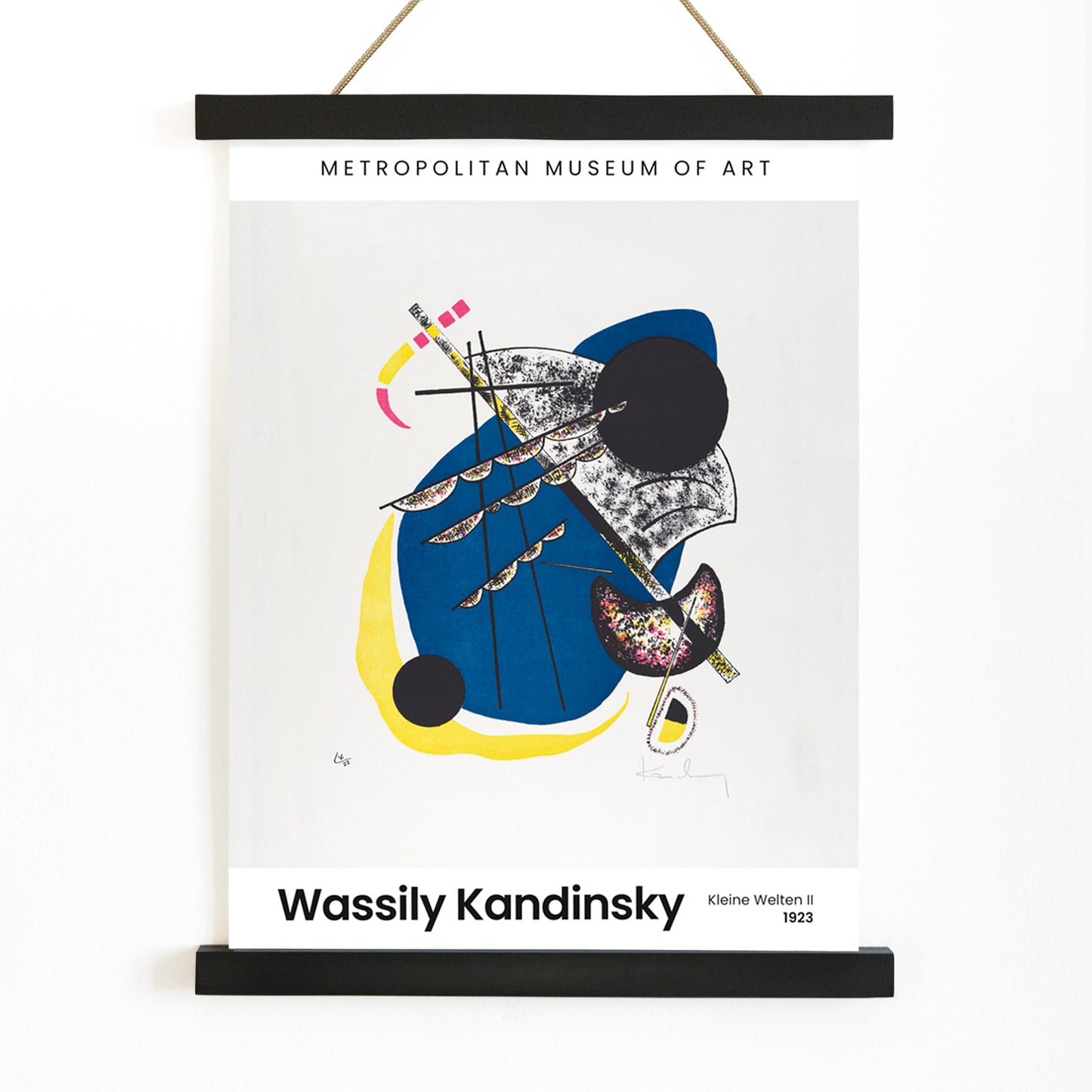
Kleine Welten II is part of Kandinsky’s renowned Kleine Welten series, created in 1922 during his tenure at the Bauhaus. This series reflects his desire to express inner emotional states and musical rhythms through abstract means. Rather than depicting a physical place, the work proposes a conceptual universe—an exploration of harmony, movement, and balance within a confined space.
Emerging in the context of postwar Europe and the Bauhaus search for new artistic principles, this vintage print stands as a testament to Kandinsky’s belief in the transformative power of abstraction and its capacity to evoke a personal, introspective response.
Style & Characteristics
The composition features crisp geometric forms—circles, arcs, and angular lines—set against a deep black background. Vivid accents of blue, yellow, and white create striking contrast and a sense of dynamic rhythm. The floating circles and sharp lines suggest orbital movement, while the interplay of shapes and colors evokes a musical, almost improvisational quality.
This precise yet expressive style is emblematic of Kandinsky’s Bauhaus period and appeals to those seeking abstract wall art with intellectual depth and a modernist sensibility.
In Interior Design
As a modernist art print, Kleine Welten II brings both structure and creative energy to interiors such as living rooms, offices, or hallways. Its bold contrasts and geometric clarity make it a striking focal point, whether displayed alone or as part of a gallery wall.
Pair it with minimalist furnishings, natural woods, or industrial materials for a Bauhaus-inspired look, and echo its blue or yellow accents with curated decor pieces. This work is especially suited for design enthusiasts and those building a thoughtful, historically informed modern space.