


You may also like
-

Rhythms Poster
Robert Delaunay · 1932 · Vibrant concentric-circle art print pulsing with blue, green, yellow, and orange rhythms
Poster from £9 · Framed from £16
-

Rythme n°3 Poster
Robert Delaunay · 1938 · Energetic abstract poster of concentric circles pulsing in blue, red, yellow, and green
Poster from £9 · Framed from £16
-

Rythme n°2 Poster
Robert Delaunay · 1938 · Abstract rhythm art print of interlocking circles and arcs in vibrant primaries
Poster from £9 · Framed from £16
-

Composition Abstraite Poster
Otto Freundlich · 1937 · Vibrant geometric art print of interlocking color blocks outlined in black
Poster from £9 · Framed from £16


-

"Very nice Posters. The quality is amazing and we received it very quickly !"
-

"A shop to visit absolutely. Huge selection of posters. We spent more than an hour there !"
-

"Perfect to find gift. Price are very good. An they can frame and pack it on site"


About the Artist
Robert Delaunay was a pioneering figure in early European abstraction, renowned for his exploration of color as an independent force in painting. Working in the vibrant avant-garde scene of Paris, Delaunay helped establish Orphism—a movement that sought to evoke sensation and rhythm through pure color relationships, moving beyond representational art.
By the 1930s, Delaunay had refined his theories into bold, architectural compositions that reflected the energy of modern life. His work from this period is often sought after by those interested in the roots of modernist abstraction, as seen in collections like famous artist posters and abstract wall art.
The Artwork
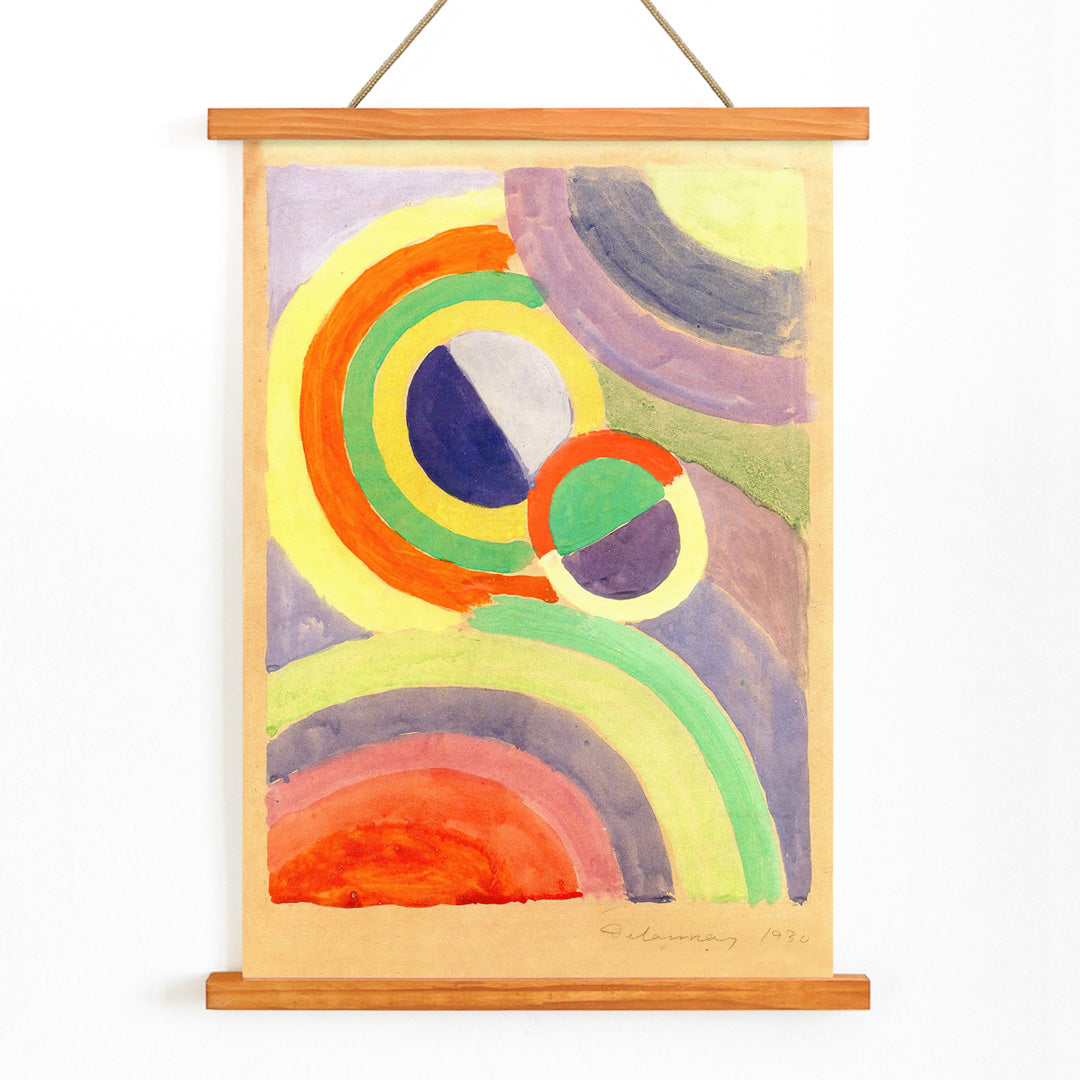
This composition is part of Delaunay's ongoing quest to create harmony and movement through abstraction, rather than depicting recognizable subjects. Conceived during a time of rapid urban and technological change, the artwork embodies the spirit of the machine age—where speed, light, and dynamic relationships define experience.
In the interwar years, artists like Delaunay saw abstraction as a universal language, capable of expressing optimism and progress. This piece stands as a testament to that vision, offering a self-contained world built on balance and rhythm, emblematic of early twentieth-century innovation.
Style & Characteristics
The artwork features a striking arrangement of interlocking circles, arcs, and angular segments, creating a sense of rotation and visual energy. Flat, crisp areas of color—yellow, orange, red, green, and purple—alternate across the surface, enhancing the impression of movement and depth without traditional shading.
The palette is both saturated and harmonious, with warm and cool tones playing off one another. The overall effect is lively yet precise, reflecting Delaunay's commitment to clarity and structure, and resonating with the aesthetics of Bauhaus inspired design posters.
In Interior Design
This modernist art print serves as a dynamic focal point in spaces such as living rooms, studios, or offices where intentional color and form are valued. It pairs seamlessly with minimalist interiors, mid-century furnishings, and clean architectural lines, adding both vibrancy and order.
To integrate the piece, consider echoing one of its hues in accent textiles or ceramics, while keeping surrounding walls neutral for balance. The circular geometry also complements linear shelving and contemporary lighting, making this print a compelling choice for curated gallery walls of twentieth-century abstract design.